Aggregator Module in Java
An aggregator module is a concept within the Java Module System that plays a crucial role in managing dependencies in Java applications. It is a special type of module that does not contain any code itself but serves as a convenient way to group related modules into a single unit. This allows other modules to depend on the aggregator module and automatically gain readability of all the modules it aggregates.
Definition and Purpose
An aggregator module is defined by its lack of code and its use of the requires transitive directive on all its dependencies. This design allows it to create a coherent set of modules that other modules can easily depend on by simply requiring the aggregator module. This is particularly useful for representing module families, where a set of related modules work together to implement a feature. By including an aggregator module, a developer can automatically bring in a collection of related modules without having to specify each one individually.
Examples
A classic example of an aggregator module is the java.se module, which references the modules that make up the core Java SE API. By depending on java.se, a module gains readability of all the core Java SE modules without having to explicitly require each one.
Another example is the ServiceMonitor application, which can have an aggregator module called monitor.core. This module requires transitive monitor.observer and monitor.statistics. As a result, other modules can depend on monitor.core and automatically gain readability of monitor.observer and monitor.statistics.
Visual Representation
[Figure 11.5](https://livebook.manning.com/the-java-9-module-system/chapter-11/figure--11-5)](https://livebook.manning.com/book/the-java-9-module-system/chapter-11/81)
 The aggregator module core (left) contains no code and uses requires transitive directives to refer to the aggregated modules observer and statistics (right), which contain the functionality. Thanks to implied readability, clients of the aggregator module can use the APIs of the aggregated modules.
[Figure 11.6](https://livebook.manning.com/the-java-9-module-system/chapter-11/figure--11-6)](https://livebook.manning.com/book/the-java-9-module-system/chapter-11/81)
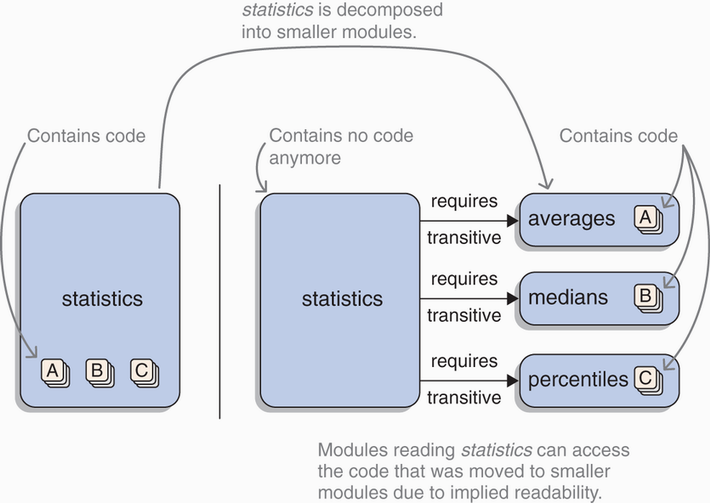 Before refactoring, the statistics module contains a lot of functionality (left). It’s then decomposed into three smaller modules that contain all the code (right). To not mandate changes in modules depending on statistics, it isn’t removed, but is instead turned into an aggregator module that implies readability of the modules it was split into.
[Figure 1.11](https://livebook.manning.com/the-java-9-module-system/chapter-1/figure--1-11)](https://livebook.manning.com/book/the-java-9-module-system/chapter-1/145)
 A selection of platform modules. The arrows show their dependencies, but some aren’t depicted to keep the graph simpler: The aggregator module java.se directly depends on each module, and each module directly depends on java.base.
Use Cases
Aggregator modules are not limited to core functionality. Any family of modules that cooperate to implement a feature can be represented by an aggregator module. This approach simplifies module management and dependency handling, as it reduces the need for modules to explicitly require each individual module they depend on.
In some cases, when a module is refactored into smaller modules, the original module can be turned into an aggregator module. This ensures that existing modules depending on the original module do not need to change their dependencies, as the aggregator module will provide readability to the new, smaller modules.
In summary, aggregator modules are a powerful tool in the Java Module System, providing a streamlined way to manage module dependencies and enhance modularity in Java applications. They simplify the process of managing dependencies, especially in large projects, by ensuring that all necessary components are included with minimal effort, thus streamlining the development process and reducing the potential for errors related to missing dependencies.
| Book Title | Usage of Aggregator Module | Technical Depth | Connections to Other Concepts | Examples Used | Practical Application |
|------------|----------------------------|-----------------|-------------------------------|---------------|-----------------------|
| [The Java Module System](https://www.manning.com/books/the-java-9-module-system) | Describes aggregator modules as a way to group related modules into a single unit, using `requires transitive` to imply readability of dependencies. [more](https://livebook.manning.com/book/the-java-9-module-system/chapter-11/72) | Provides a detailed explanation of the aggregator module's role in the Java Module System, including its design and purpose. [more](https://livebook.manning.com/book/the-java-9-module-system/chapter-11/72) | Connects aggregator modules to the concept of module families and dependency management. [more](https://livebook.manning.com/book/the-java-9-module-system/chapter-11/76) | Uses examples like `java.se` and *ServiceMonitor* application to illustrate the concept. [more](https://livebook.manning.com/book/the-java-9-module-system/chapter-1/145) | Discusses practical use cases such as simplifying module management and handling dependencies in large projects. [more](https://livebook.manning.com/book/the-java-9-module-system/chapter-11/76) |
| [The Well-Grounded Java Developer, Second Edition](https://www.manning.com/books/the-well-grounded-java-developer-second-edition) | Highlights the role of aggregator modules in managing dependencies by acting as a shortcut mechanism. [more](https://livebook.manning.com/book/the-well-grounded-java-developer-second-edition/chapter-2/149) | Offers a concise overview of the aggregator module's function in simplifying dependency management. [more](https://livebook.manning.com/book/the-well-grounded-java-developer-second-edition/chapter-2/149) | Emphasizes the utility of aggregator modules in large projects to streamline development and reduce errors. [more](https://livebook.manning.com/book/the-well-grounded-java-developer-second-edition/chapter-2/149) | Provides the `java.se` module as a common example to demonstrate its use. [more](https://livebook.manning.com/book/the-well-grounded-java-developer-second-edition/chapter-2/149) | Focuses on the practical benefits of using aggregator modules to ensure all necessary components are included efficiently. [more](https://livebook.manning.com/book/the-well-grounded-java-developer-second-edition/chapter-2/149) |
FAQ (Frequently asked questions)
What is an aggregator module?
What is an example of an aggregator module in Java?
How do aggregator modules function in Java applications?
What is an aggregator module in Java?
Can you give an example of an aggregator module?
Does an aggregator module contain any code?
What is the purpose of 'requires transitive' in an aggregator module?
How does an aggregator module benefit other modules?
How does an aggregator module use 'requires transitive'?
What is the benefit of implied readability in aggregator modules?
What is an example of an aggregator module in the ServiceMonitor application?
How does the monitor.core module benefit other modules?
What is the function of aggregator modules?
How do aggregator modules affect module dependencies?