Balanced Tree
Overview
A balanced tree is a type of binary tree where the two branches of all subtrees contain the same number of elements. This structure ensures that the tree remains efficient for various operations. Perfectly balanced binary trees are sometimes referred to as perfect trees.
Definition
In more technical terms, a balanced tree is a tree data structure where the height difference between the left and right subtrees of any node is minimal. This balance is crucial as it ensures optimal performance for operations such as insertion, deletion, and lookup. By maintaining a minimal height difference, balanced trees prevent the tree from degenerating into a linear structure, which would degrade performance.
Example
To illustrate the concept of balanced trees, consider Figure 10.2, which presents three examples of trees containing the same elements. The first tree in the figure is perfectly balanced, meaning that each subtree has an equal number of elements on both branches. This balance is what characterizes a perfect tree.
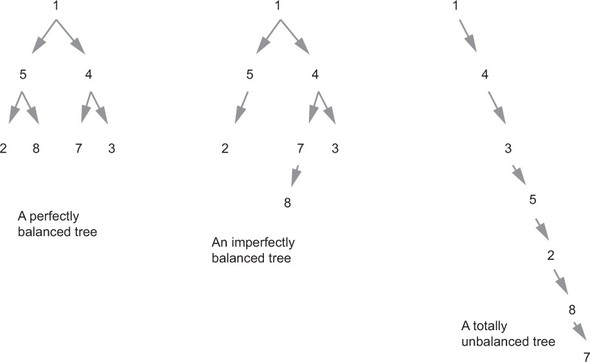 Figure 10.2. Trees can be more or less balanced.
In contrast, the tree on the right in Figure 10.2 is a totally unbalanced tree, which is essentially a singly linked list. A singly linked list can be viewed as a special case of a totally unbalanced tree, where all elements are aligned along a single branch, leading to inefficient operations compared to a balanced structure.
FAQ (Frequently asked questions)
What is a balanced tree?
What is a perfectly balanced binary tree called?
What does Figure 10.2 illustrate in the context of balanced trees?
What is the significance of a balanced tree in terms of performance?