Branch in Binary Trees
Definition of a Branch
In the context of binary trees, a branch is a fundamental concept that refers to the link between nodes. Specifically, a branch is a connection from one node to another, which can be either a left or right branch. Each node in a binary tree has two branches, allowing it to connect to two other nodes. This structure is what gives binary trees their characteristic form, where each node can lead to two subtrees.
Example of Branches in a Binary Tree
To better understand branches, consider the example illustrated in Figure 10.1. In this figure, the branches are depicted as the links from the root node to the left and right subtrees. This visual representation helps clarify how branches function as the connecting elements between nodes in a binary tree.
 Figure 10.1. A binary tree is a recursive structure composed of a root and two branches. The left branch is a link to the left subtree, and the right branch is a link to the right subtree. Terminal elements have empty branches (not represented in the figure) and are called leaves.
Merging Trees and Branches
The concept of branches is also crucial when discussing operations such as merging trees. Figures 10.8 through 10.13 illustrate various scenarios of merging binary trees, highlighting the role of branches in these operations.
-
Figure 10.8 shows two trees that are to be merged, with the left tree being the current tree and the right tree being the parameter tree.
 Figure 10.8. The two trees to be merged. On the left is this tree, and on the right is the parameter tree.
-
Figure 10.9 demonstrates a scenario where the root of the parameter tree is higher than the root of the current tree. In this case, the right branch of the current tree is merged with the parameter tree after removing its left branch.
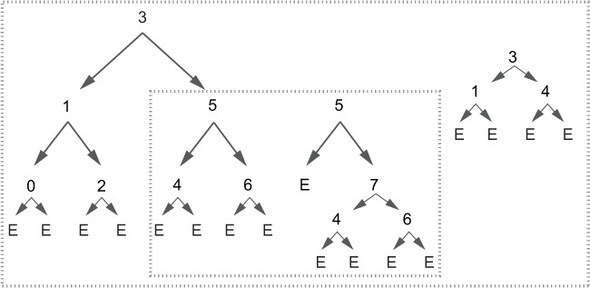 Figure 10.9. The root of the parameter tree is higher than the root of this tree. Merge the right branch of this tree with the parameter tree with its left branch removed. (The merging operation is represented by the dotted box.)
-
Figure 10.10 illustrates a case where the roots of both trees to be merged are equal. The result of the merge uses this root value, and the left and right branches are the results of merging the corresponding branches from both trees.
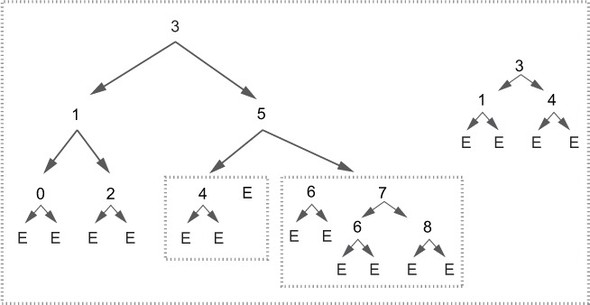 Figure 10.10. The roots of each tree to be merged being equal, you use this value for the result of the merge. The left branch will be the result of merging the two left branches, and the right branch will be the result of merging the two right branches.
-
Figure 10.11 and Figure 10.12 further explore merging scenarios, including merging with empty trees and handling trees with equal roots.
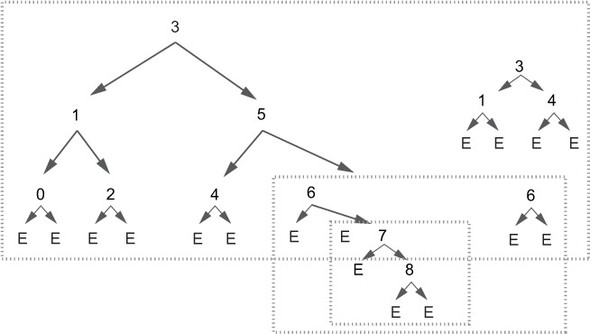 Figure 10.11. For the left branch, merging with an empty tree is trivial and just returns the original tree (root 4 and two empty branches). For the right branch, the first tree has empty branches and 6 as its root, and the second tree has 7 as its root, so you remove the left branch of the 7 rooted tree and use the result to merge with the empty right branch of the 6 rooted tree. The removed left branch will be merged with the result of the previous merge. Note that the 6 rooted tree on the right comes from the 7 rooted tree, where it has been replaced by an empty tree.
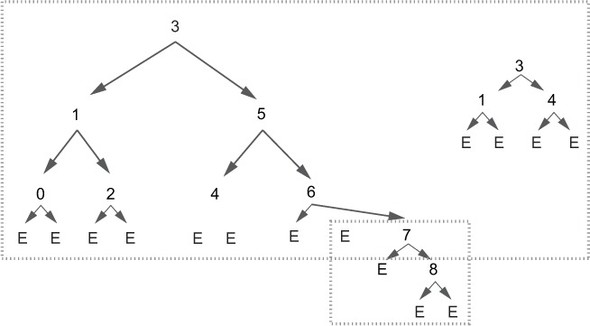 Figure 10.12. The two trees to be merged have equal roots (6) so you merge the branches (left with left and right with right). Because the tree to be merged has both branches empty, there is in fact nothing to do.
-
Figure 10.13 concludes with the scenario where merging an empty tree results in the tree to be merged, leaving two trees with the same root to merge.
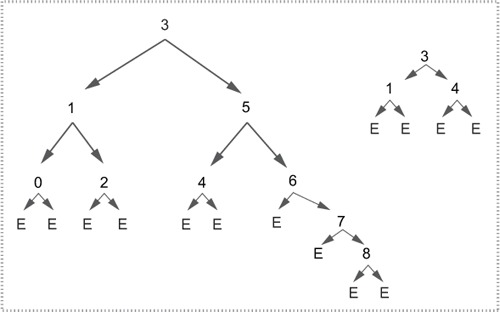 Figure 10.13. Merging an empty tree simply results in the tree to be merged. You’re left with two trees with the same root to merge.
These figures collectively demonstrate the importance of branches in the structure and manipulation of binary trees, particularly in operations like merging.
FAQ (Frequently asked questions)
What is a branch in a binary tree?
How many branches does each node in a binary tree have?
What do the branches in Figure 10.1 represent?