CommentNotificationProxy
The CommentNotificationProxy is a key component in the design of a comment publishing system, which is part of a larger application architecture. This component is responsible for handling the notification aspect of the comment publishing process. The design leverages interfaces to decouple the implementation details from the core logic, allowing for flexibility and easier future modifications.
Overview
The CommentNotificationProxy interface defines the contract for sending notifications related to comments. This interface is implemented by classes that handle the actual notification logic, such as sending an email. By using an interface, the system can easily switch out the notification mechanism without altering the core logic of the application.
Interface Definition
The CommentNotificationProxy interface is defined as follows:
Listing 4.4 Define a CommentNotificationProxy interface
public interface CommentNotificationProxy {

  void sendComment(Comment comment);
}
This interface declares a single method, sendComment, which takes a Comment object as a parameter. Implementations of this interface will define how the comment notification is sent.
Implementation
One of the implementations of the CommentNotificationProxy interface is the EmailCommentNotificationProxy class. This class is responsible for sending comment notifications via email.
Listing 4.5 Implementation of the CommentNotificationProxy interface
public class EmailCommentNotificationProxy
  implements CommentNotificationProxy {

  @Override
  public void sendComment(Comment comment) {
    System.out.println("Sending notification for comment: "
                         + comment.getText());
  }
}
In this implementation, the sendComment method simply prints a message to the console, simulating the sending of an email notification.
Integration with Spring
To integrate the EmailCommentNotificationProxy with a Spring application, the class is annotated with @Component, allowing Spring to manage it as a bean.
Listing 4.9 Adding @Component to the EmailCommentNotificationProxy class
@Component
public class EmailCommentNotificationProxy
  implements CommentNotificationProxy {

  @Override
  public void sendComment(Comment comment) {
    System.out.println(
      "Sending notification for comment: " +
         comment.getText());
  }
}
Usage in CommentService
The CommentNotificationProxy is used as a dependency in the CommentService class, which handles the "publish comment" use case. The CommentService class is designed to be flexible and decoupled from the specific implementations of its dependencies.
Listing 4.6 Implementing the CommentService object
public class CommentService {

  private final CommentRepository commentRepository;
  private final CommentNotificationProxy commentNotificationProxy;

  public CommentService(
           CommentRepository commentRepository,
           CommentNotificationProxy commentNotificationProxy) {

    this.commentRepository = commentRepository;
    this.commentNotificationProxy = commentNotificationProxy;
  }

  public void publishComment(Comment comment) {
    commentRepository.storeComment(comment);
    commentNotificationProxy.sendComment(comment);
  }
}
In this design, the CommentService class delegates the responsibilities of storing comments and sending notifications to its dependencies, CommentRepository and CommentNotificationProxy, respectively.
Demonstration
The following Main class demonstrates how to use the CommentService with its dependencies:
Listing 4.7 Calling the use case in the Main class
public class Main {

  public static void main(String[] args) {
    var commentRepository =
      new DBCommentRepository();
    var commentNotificationProxy =
      new EmailCommentNotificationProxy();

    var commentService =
      new CommentService(
          commentRepository, commentNotificationProxy);

    var comment = new Comment();
    comment.setAuthor("Laurentiu");
    comment.setText("Demo comment");

    commentService.publishComment(comment);
  }
}
Design Considerations
The design of the CommentNotificationProxy and its integration into the CommentService is illustrated in the following figures:
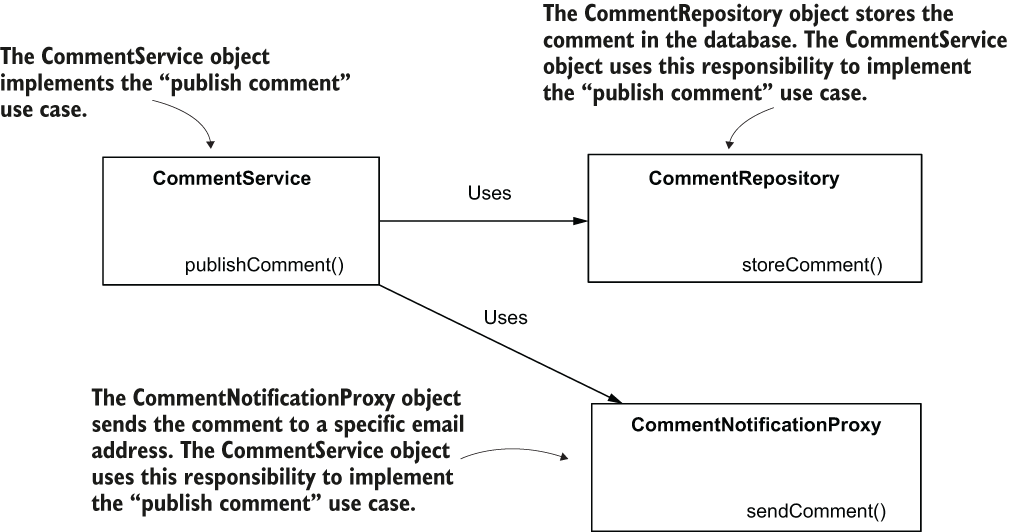 Figure 4.5 The CommentService object implements the “publish comment” use case. To do this, it needs to delegate to the responsibilities implemented by the CommentRepository and the CommentNotificationProxy objects.
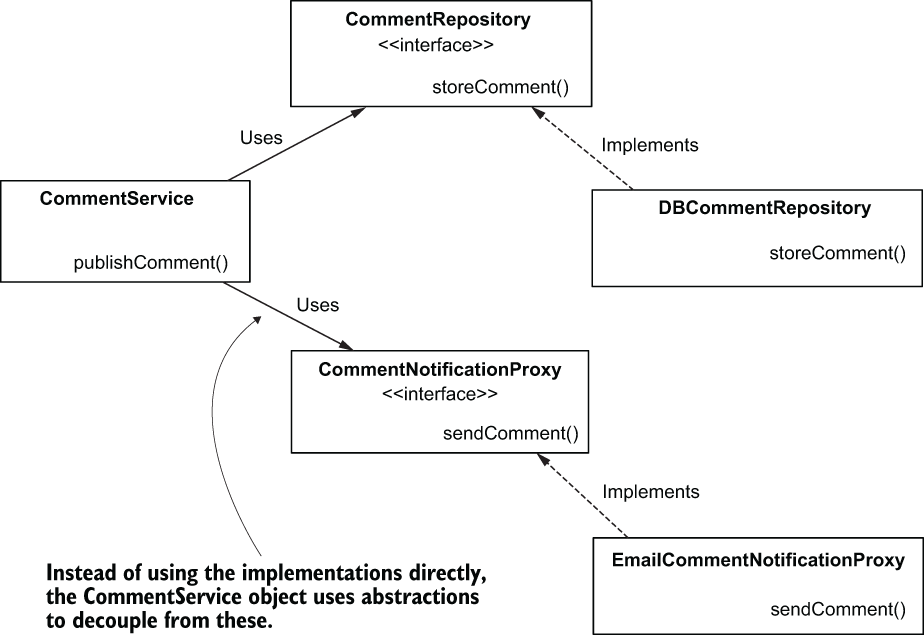 Figure 4.6 The CommentService object depends on the abstractions provided by CommentRepository and CommentNotificationProxy interfaces. The classes DBCommentRepository and EmailCommentNotificationProxy further implement these interfaces. This design decouples the implementation of the “publish comment” use case from its dependencies and makes the application easier to change for future developments.
These figures highlight the importance of using interfaces to decouple the CommentService from the specific implementations of its dependencies, allowing for greater flexibility and easier maintenance.
FAQ (Frequently asked questions)
What is the role of the CommentService object in the application?
How does the design of CommentService improve the application?
Which classes implement the CommentRepository and CommentNotificationProxy interfaces?
How is the CommentNotificationProxy interface implemented?
What does the sendComment method do in the EmailCommentNotificationProxy class?
How is the EmailCommentNotificationProxy class added to the Spring context?
What is the purpose of the @Component annotation in the EmailCommentNotificationProxy class?