CrudRepository in Java
The CrudRepository is a core interface in the Spring Data framework, designed to provide generic CRUD (Create, Read, Update, Delete) operations for a repository of a specific type. It is a fundamental part of Spring Data, which aims to simplify database access and reduce the amount of boilerplate code required for database operations. By extending the Repository interface, CrudRepository offers a set of methods that facilitate interaction with the data layer, making it a powerful tool for managing entities in a database.
Overview
The CrudRepository interface is a generic interface, meaning it is parameterized by the entity type and its ID type. This allows for type-safe CRUD operations on entities. It provides a standardized way to perform CRUD operations on a repository, making it flexible and reusable for different entity types. The interface is part of the Spring Data project, which significantly reduces the complexity of data access in Java applications.
Core Methods
The CrudRepository interface includes several key methods that are crucial for data manipulation:
<S extends T> S save(S entity);: Saves a given entity. This method is used to either insert a new entity or update an existing one.Optional<T> findById(ID id);: Finds an entity by its given ID. It returns anOptionalthat contains the entity if found, or is empty if not.Iterable<T> findAll();: Retrieves all entities managed by the repository.long count();: Returns the total number of entities available in the repository.void deleteById(ID id);: Deletes the entity with the specified ID from the repository.
These methods provide a straightforward API for interacting with the data layer, abstracting the complexities of data access and manipulation.
Usage and Examples
When creating a repository interface in Spring Data, you can extend CrudRepository to inherit its methods for basic CRUD operations. This simplifies the process of interacting with the database, as you do not need to manually implement these operations.
Example: UserRepository
public interface UserRepository extends CrudRepository<User, Long> {
}
In this example, UserRepository is an interface that extends CrudRepository, designed to manage User entities with Long IDs. By extending CrudRepository, UserRepository inherits all the CRUD methods provided by the interface.
Example: ItemRepository
public interface ItemRepository extends CrudRepository<Item, Long> {
   Iterable<Item> findByMetricWeight(double weight);
}
Similarly, the ItemRepository interface extends CrudRepository to manage Item entities with Long IDs. In addition to the inherited CRUD methods, ItemRepository declares a custom method findByMetricWeight, which follows Spring Data JPA naming conventions to provide additional query capabilities.
Custom Query Methods
Spring Data JPA allows you to define custom query methods in your repository interfaces. These methods can be automatically implemented by Spring Data JPA based on their names. For example, in the ItemRepository, the method findByMetricWeight is automatically implemented to find items by their metric weight.
Integration with Spring Context
When you define a repository interface that extends CrudRepository, Spring automatically provides an implementation of this interface and registers it as a bean in the Spring context. This allows other components in the application to inject and use the repository bean directly from the context.
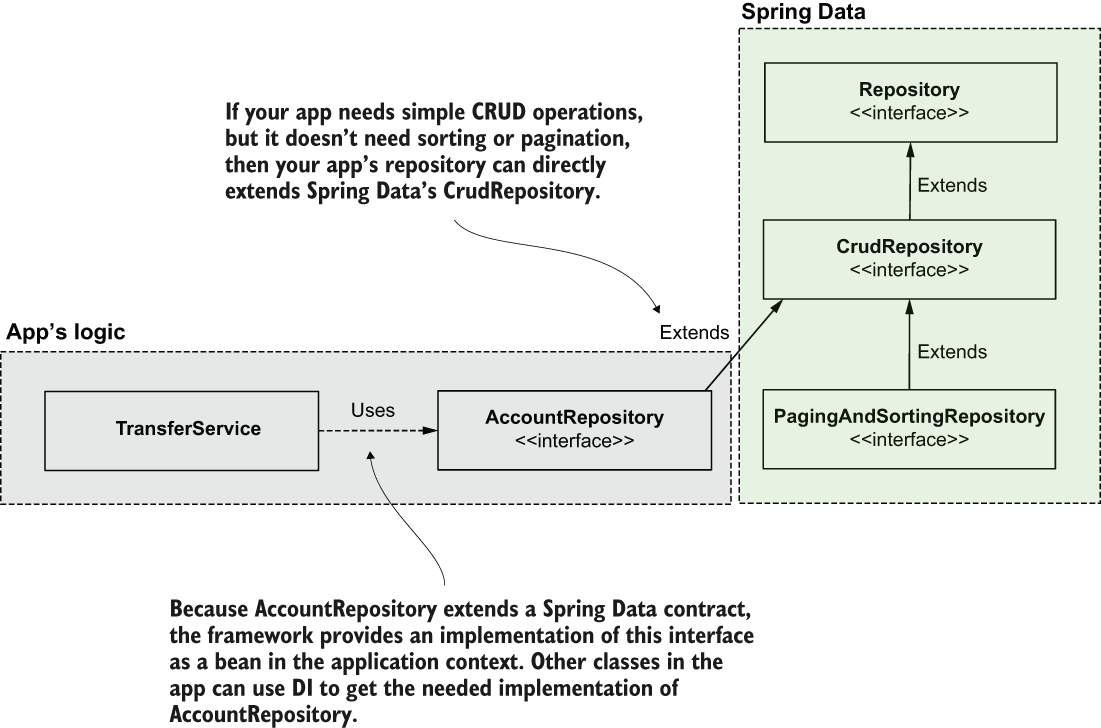 Figure 14.7 To create a Spring Data repository, you define an interface that extends one of the Spring Data contracts. For example, if your app only needs CRUD operations, the interface you define as a repository should extend the CrudRepository interface. The app adds a bean that implements the contract you define to the Spring context, so any other app components that need to use it can simply inject it from the context.
Extensibility and Relationship with Other Interfaces
In addition to the CrudRepository, Spring Data provides other interfaces like the PagingAndSortingRepository, which extends the CrudRepository. This extension adds support for pagination and sorting of entities, allowing for more advanced data retrieval operations. The CrudRepository serves as a foundational interface in the Spring Data ecosystem, providing essential CRUD functionality that can be extended and customized to fit various data access needs.
Figure 3.5 The relationship between core interfaces in the Spring Data Commons module.
By leveraging the CrudRepository interface, developers can quickly set up a repository with minimal configuration, taking advantage of Spring's powerful dependency injection and data access capabilities.
| Book Title | Usage of crudrepository | Technical Depth | Connections to Other Concepts | Examples Used | Practical Application |
|------------|-------------------------|-----------------|-------------------------------|---------------|-----------------------|
| [Spring Boot in Practice](https://www.manning.com/books/spring-boot-in-practice) | Discusses `CrudRepository` as a fundamental part of Spring Data, providing generic CRUD operations. [more](https://livebook.manning.com/book/spring-boot-in-practice/chapter-3/472) | Explains core methods like `save()`, `findById()`, `findAll()`, `count()`, and `deleteById()`. [more](https://livebook.manning.com/book/spring-boot-in-practice/chapter-3/135) | Describes its relationship with other interfaces like `PagingAndSortingRepository`. [more](https://livebook.manning.com/book/spring-boot-in-practice/chapter-3/130) | Provides a listing of `CrudRepository` methods. [more](https://livebook.manning.com/spring-boot-in-practice/chapter-3/listing--3-14) | Focuses on managing entities in a database. [more](https://livebook.manning.com/book/spring-boot-in-practice/chapter-3/130) |
| [Java Persistence with Spring Data and Hibernate epub](https://www.manning.com/books/java-persistence-with-spring-data-and-hibernate) | Highlights `CrudRepository` as a core interface in Spring Data JPA for CRUD operations. [more](https://livebook.manning.com/book/java-persistence-with-spring-data-and-hibernate/chapter-6/111) | Discusses type-safe CRUD operations and custom query methods. [more](https://livebook.manning.com/book/java-persistence-with-spring-data-and-hibernate/chapter-6/111) | Shows how to extend `CrudRepository` for additional query capabilities. [more](https://livebook.manning.com/book/java-persistence-with-spring-data-and-hibernate/chapter-6/117) | Examples include `UserRepository` and `ItemRepository`. [more](https://livebook.manning.com/java-persistence-with-spring-data-and-hibernate/chapter-6/listing--6-10) | Emphasizes testing with Spring Data JPA. [more](https://livebook.manning.com/book/java-persistence-with-spring-data-and-hibernate/chapter-6/117) |
| [Spring Start Here](https://www.manning.com/books/spring-start-here) | Describes `CrudRepository` as providing basic persistence capabilities. [more](https://livebook.manning.com/book/spring-start-here/chapter-14/112) | Covers basic CRUD operations and generic types. [more](https://livebook.manning.com/book/spring-start-here/chapter-14/43) | Explains integration with Spring context for dependency injection. [more](https://livebook.manning.com/book/spring-start-here/chapter-14/31) | Example of `AccountRepository` interface. [more](https://livebook.manning.com/spring-start-here/chapter-14/listing--14-2) | Focuses on reducing boilerplate code for database operations. [more](https://livebook.manning.com/book/spring-start-here/chapter-14/31) |
| [Spring Microservices in Action](https://www.manning.com/books/spring-microservices-in-action) | Discusses `CrudRepository` as a foundation for creating repository interfaces. [more](https://livebook.manning.com/book/spring-microservices-in-action/chapter-3/99) | Highlights automatic query generation and extensibility. [more](https://livebook.manning.com/book/spring-microservices-in-action/chapter-3/99) | Shows how to define custom query methods in repository interfaces. [more](https://livebook.manning.com/book/spring-microservices-in-action/chapter-3/99) | Example of `LicenseRepository` interface. [more](https://livebook.manning.com/spring-microservices-in-action/chapter-3/listing--3-7) | Emphasizes reducing boilerplate code and focusing on business logic. [more](https://livebook.manning.com/book/spring-microservices-in-action/chapter-3/99) |
FAQ (Frequently asked questions)
What is CrudRepository in Spring Data JPA?
How is CrudRepository generified?
What is an example of a repository interface extending CrudRepository?
What is the purpose of the UserRepository interface in the given code snippet?
What is the CrudRepository interface in Spring Data?
What methods does the CrudRepository interface include?
What is the purpose of the CrudRepository interface in Spring Data?
What does the generic type T represent in the CrudRepository interface?
What does the ID type represent in the CrudRepository interface?
What does the save() method do in the CrudRepository interface?
How does the findById() method function in the CrudRepository interface?
What is the purpose of the findAll() method in the CrudRepository interface?
What does the count() method return in the CrudRepository interface?
What is the function of the deleteById() method in the CrudRepository interface?
What operations does the CrudRepository interface provide?
What is CrudRepository in Spring Data?
What operations does CrudRepository offer?
How do you create a Spring Data repository for CRUD operations?
How is a Spring Data repository added to the Spring context?
What is the purpose of the CrudRepository interface in Spring Data?
What generic types does CrudRepository require?
How do you define a Spring Data repository using CrudRepository?
What do the generic types in CrudRepository represent?
What does the CrudRepository interface provide?
What is CrudRepository in Spring?
How does CrudRepository support additional query methods?