Endpoint in Java
In the Java ecosystem, the term "endpoint" is used in various contexts, particularly in web services and application monitoring. An endpoint generally refers to a specific URL or path that clients can access to interact with a service. This entry synthesizes information from multiple Java books to provide a comprehensive understanding of endpoints in different contexts.
Endpoint in Spring Boot
In Spring Boot, an endpoint is a crucial component of the Actuator module, which provides a way to monitor and manage applications. Endpoints expose various pieces of information and operations about the application, which can be accessed over HTTP or JMX. Spring Boot comes with several built-in endpoints, such as health and info, which provide essential insights into the application's status and configuration.
Configuring Endpoint Exposure
Spring Boot allows you to configure which endpoints are exposed via HTTP. This is done through properties in the application.properties or application.yml file. For example, you can specify which endpoints to include using the management.endpoints.web.exposure.include property:
management.endpoints.web.exposure.include=beans,threaddump
management.endpoints.web.exposure.include=*
In this example, the beans and threaddump endpoints are explicitly included, and the wildcard * is used to include all available endpoints.
Custom Endpoints
Spring Boot Actuator also allows the creation of custom endpoints. This is particularly useful for exposing application-specific data and functionality that are not covered by the built-in endpoints. Custom endpoints are created using the @Endpoint annotation.
Example: ReleaseNotesEndpoint
package com.manning.sbip.ch04.endpoint;

import java.util.Collection;
import org.springframework.beans.factory.annotation.Autowired;
import org.springframework.boot.actuate.endpoint.annotation.Endpoint;
import org.springframework.boot.actuate.endpoint.annotation.ReadOperation;
import org.springframework.stereotype.Component;
import com.manning.sbip.ch04.model.ReleaseNote;

@Component
@Endpoint(id = "releaseNotes")
public class ReleaseNotesEndpoint {

    private final Collection<ReleaseNote> releaseNotes;

    @Autowired
    public ReleaseNotesEndpoint(Collection<ReleaseNote> releaseNotes) {
        this.releaseNotes = releaseNotes;
    }

    @ReadOperation
    public Iterable<ReleaseNote> releaseNotes() {
        return releaseNotes;
    }
}
In this class, the @Endpoint annotation is used to define a new endpoint with the ID releaseNotes. The @ReadOperation annotation indicates that the releaseNotes method should be invoked for HTTP GET requests, returning the collection of release notes.
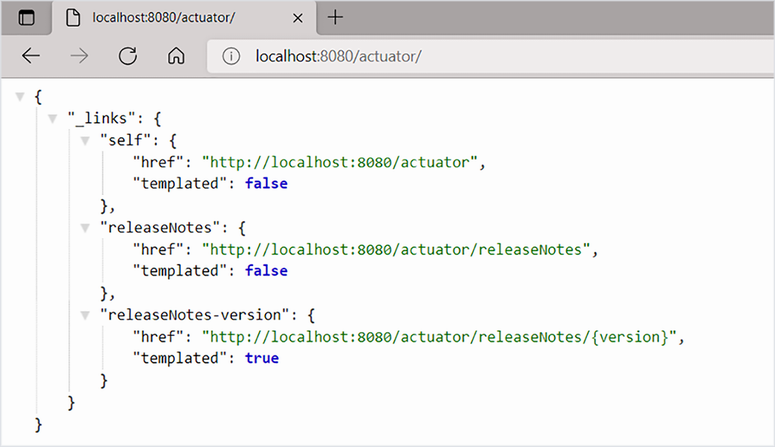 Figure 4.15 Defining custom endpoint /releaseNotes and exposing it through the Actuator discovery page
Endpoint in Spring Microservices
In the context of web services, an endpoint is a specific URL or path that clients can access to interact with a service. Endpoints are crucial in defining how different parts of a system communicate with each other. In Spring Boot applications, endpoints are typically defined in controller classes and are used to expose various functionalities of the application. They can be used for a variety of purposes, such as retrieving data, performing operations, or managing authentication processes.
Defining Endpoints in Spring Boot
In a Spring Boot application, endpoints are defined using the @RequestMapping annotation within a controller class. This annotation specifies the URL and the HTTP method (such as GET, POST, PUT, DELETE) that can be used to access the service.
Example of a GET HTTP Endpoint
@RequestMapping(value="/{licenseId}",method = RequestMethod.GET)
public License getLicenses(
@PathVariable("organizationId") String organizationId,
@PathVariable("licenseId")   String licenseId) {
    return new License()
      .withId(licenseId)
      .withProductName("Teleco")
      .withLicenseType("Seat")
      .withOrganizationId("TestOrg");
 }
In this example, the endpoint is defined to handle GET requests at the path /{licenseId}. It uses path variables to capture the organizationId and licenseId from the URL, and returns a License object populated with sample data.
Spring Boot Actuator Endpoints
Spring Boot Actuator provides several built-in endpoints that help in monitoring and managing applications. One such example is the /env endpoint. This endpoint returns the current environment configuration of the application, including active profiles and property values. Actuator endpoints are particularly useful for gaining insights into the application's runtime behavior and configuration.
For more detailed information, you can refer to the Spring Boot in Practice and Spring Microservices in Action books.
| Book Title | Usage of Endpoint | Technical Depth | Connections to Other Concepts | Examples Used | Practical Application |
|------------|-------------------|-----------------|-------------------------------|---------------|-----------------------|
| [Spring Boot in Practice](https://www.manning.com/books/spring-boot-in-practice) | Discusses endpoints as part of the Actuator module for monitoring and managing applications. | Covers configuration of endpoint exposure and creation of custom endpoints. | Connects endpoints to application monitoring and management. | Provides examples of configuring and creating custom endpoints like `ReleaseNotesEndpoint`. | Focuses on enhancing application manageability and observability. [more](https://www.manning.com/books/spring-boot-in-practice) |
| [Spring Microservices in Action](https://www.manning.com/books/spring-microservices-in-action) | Describes endpoints as URLs for client-service interaction, crucial for system communication. | Explains endpoint definition using `@RequestMapping` and their role in OAuth2 processes. | Links endpoints to web services, OAuth2, and Spring Boot Actuator. | Includes examples of GET HTTP endpoints and Actuator endpoints like `/env`. | Emphasizes endpoints' role in authentication, authorization, and application monitoring. [more](https://www.manning.com/books/spring-microservices-in-action) |
FAQ (Frequently asked questions)
How is an endpoint defined in a Spring Boot application?
What does the @RequestMapping annotation do in Spring Boot?
Can you provide an example of a GET HTTP endpoint in Spring Boot?
What is an example of an endpoint provided by Spring Boot Actuator?
What information does the /env endpoint in Spring Boot Actuator provide?
What is an endpoint in the context of a web service?
How are endpoints used in the context of OAuth2?