Future in Java
In Java, the term "future" encompasses several concepts, primarily focusing on asynchronous programming and potential language enhancements. The Future interface in java.util.concurrent is a key component for handling asynchronous tasks, allowing developers to manage and retrieve results from tasks that may not have completed yet. Additionally, the term "future" also refers to anticipated enhancements in Java, such as the introduction of value types, which aim to improve the language's performance and type safety.
Future Interface in Java
The Future interface is a powerful tool for managing asynchronous tasks in Java. It represents a task that may not have completed yet, providing methods to check the task's status, retrieve its result, or cancel it if necessary. Key methods include:
get(): Retrieves the result of the computation, blocking if necessary until the task is complete.isDone(): Checks if the task has completed.cancel(): Attempts to cancel the execution of the task.
The Future interface supports nonblocking concurrency and can be used with timeouts to prevent indefinite blocking. This is particularly useful in scenarios where tasks may take an unpredictable amount of time to complete. An advanced implementation of Future is CompletableFuture, which allows for more complex asynchronous workflows.
Example: Finding Prime Numbers Using Future
The following Java code snippet demonstrates the use of a Future to find a large prime number. The get() method is used with a timeout to ensure that the task does not block indefinitely.
Future<Long> fut = getNthPrime(1_000_000_000);
try {
    long result = fut.get(1, TimeUnit.MINUTES);
    System.out.println("Found it: " + result);
} catch (TimeoutException tox) {
    // Timed out - better cancel the task
    System.err.println("Task timed out, cancelling");
    fut.cancel(true);
} catch (InterruptedException e) {
    fut.cancel(true);
    throw e;
} catch (ExecutionException e) {
    fut.cancel(true);
    e.getCause().printStackTrace();
}
In this example, getNthPrime() is assumed to return a Future that is executing on a background thread. The task is canceled if it does not complete within the specified timeout.
Nonblocking I/O with Future
The Future interface can also be used for nonblocking I/O operations. The following code snippet illustrates how a Future can be used to perform an asynchronous file read operation, allowing the main thread to perform other tasks while waiting for the I/O operation to complete.
try {
    Path file = Paths.get("/Users/karianna/foobar.txt");
    var channel = AsynchronousFileChannel.open(file);
    var buffer = ByteBuffer.allocate(1_000_000);
    Future<Integer> result = channel.read(buffer, 0);
    BusinessProcess.doSomethingElse();
    var bytesRead = result.get();
    System.out.println("Bytes read [" + bytesRead + "]");
} catch (IOException | ExecutionException | InterruptedException e) {
    e.printStackTrace();
}
This approach allows the main thread to continue executing other tasks while the I/O operation is handled by a background thread.
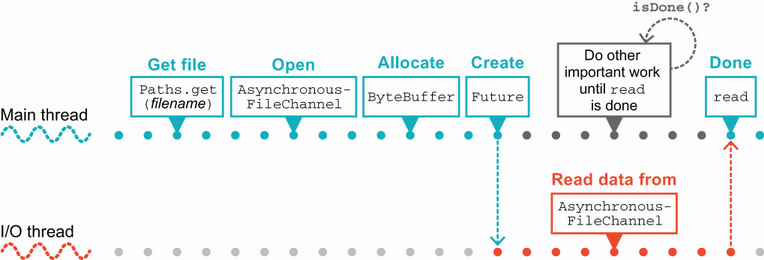 Figure 6.9 Using Future in Java
Future in Clojure
In Clojure, a future is an abstraction for asynchronous computation. It starts executing immediately on a background thread and can be checked for completion or dereferenced, which blocks until the computation is complete. This allows for efficient handling of tasks that can be performed concurrently.
Example: Futures in Clojure
The following Clojure code snippet demonstrates the use of a future to perform a series of tasks asynchronously.
user=> (def simple-future
  (future (do
        (println "Line 0")
        (Thread/sleep 10000)
        (println "Line 1")
        (Thread/sleep 10000)
        (println "Line 2"))))

#'user/simple-future
Line 0
user=> (future-done? simple-future)
user=> false
Line 1
user=> @simple-future
Line 2
nil
In this example, the future starts executing immediately, and the future-done? function can be used to check if the task is complete. Dereferencing the future with @simple-future blocks until the computation is finished.
Future of the Java Module System
The Java Module System is currently version agnostic, meaning version information does not influence its behavior. While there is interest in incorporating version features in the future, the outlook for such development is not promising. Mark Reinhold, the chief architect of the Java Platform Group at Oracle, has expressed skepticism about the inclusion of version support due to the significant investment required and the uncertain benefits.
Future Enhancements in Java
In the realm of Java programming, the concept of "future" also refers to upcoming enhancements and proposals that aim to improve the language's capabilities. One such anticipated feature is the introduction of real value types.
Value Types
Value types are a proposed addition to Java that aim to combine the benefits of both objects and primitives. They are designed to be manipulated like objects but perform with the efficiency of primitives. This dual nature allows for enhanced type safety in business applications without sacrificing performance.
Current State and Future Prospects
As of now, Java does not have built-in support for real value types. The value types discussed in various chapters and resources are not true value types as envisioned in the proposal. Instead, they are a conceptual framework that developers can use to simulate some of the benefits of value types.
The proposal to include real value types in a future version of Java is detailed in a document available at OpenJDK's website. This proposal outlines the potential implementation and benefits of value types, marking a significant step forward in Java's evolution. By incorporating real value types, Java aims to enhance its performance and type safety, making it more robust for complex business applications. This future development is eagerly anticipated by the Java community, as it promises to bring substantial improvements to the language.
| Book Title | Usage of Future | Technical Depth | Connections to Other Concepts | Examples Used | Practical Application |
|------------|-----------------|-----------------|-------------------------------|---------------|-----------------------|
| [The Well-Grounded Java Developer, Second Edition](https://www.manning.com/books/the-well-grounded-java-developer-second-edition) | Discusses `Future` in Java for handling asynchronous tasks, including methods like `get()`, `isDone()`, and `cancel()`. Also covers `CompletableFuture` for complex workflows. [more](https://livebook.manning.com/book/the-well-grounded-java-developer-second-edition/chapter-6/251) | Provides a detailed explanation of `Future` and its advanced implementations like `CompletableFuture`. [more](https://livebook.manning.com/book/the-well-grounded-java-developer-second-edition/chapter-6/251) | Connects `Future` to nonblocking I/O operations and concurrency management. [more](https://livebook.manning.com/book/the-well-grounded-java-developer-second-edition/chapter-6/261) | Includes examples like finding prime numbers and asynchronous file read operations. [more](https://livebook.manning.com/book/the-well-grounded-java-developer-second-edition/chapter-6/257) | Demonstrates practical use cases in Java applications, such as nonblocking I/O and task management. [more](https://livebook.manning.com/book/the-well-grounded-java-developer-second-edition/chapter-6/261) |
| [The Java Module System](https://www.manning.com/books/the-java-9-module-system) | Discusses the future of the Java Module System, focusing on its version agnostic nature and the skepticism around incorporating version features. [more](https://livebook.manning.com/book/the-java-9-module-system/chapter-13/54) | Explores the technical challenges and investment required for potential future developments in the module system. [more](https://livebook.manning.com/book/the-java-9-module-system/chapter-13/54) | Highlights the ongoing debate about version support in Java's module system. [more](https://livebook.manning.com/book/the-java-9-module-system/chapter-13/54) | No specific examples provided. [more](https://livebook.manning.com/book/the-java-9-module-system/chapter-13/54) | Discusses the implications of future developments on Java's module system. [more](https://livebook.manning.com/book/the-java-9-module-system/chapter-13/54) |
| [Functional Programming in Java: How functional techniques improve your Java programs](https://www.manning.com/books/functional-programming-in-java) | Covers the concept of "future" in terms of upcoming Java enhancements like real value types. [more](https://livebook.manning.com/book/functional-programming-in-java/chapter-3/409) | Discusses the proposal for real value types and their potential impact on Java's performance and type safety. [more](https://livebook.manning.com/book/functional-programming-in-java/chapter-3/409) | Connects future developments to Java's evolution and the benefits of combining objects and primitives. [more](https://livebook.manning.com/book/functional-programming-in-java/chapter-3/409) | No specific examples provided. [more](https://livebook.manning.com/book/functional-programming-in-java/chapter-3/409) | Anticipates the practical benefits of future Java enhancements for complex business applications. [more](https://livebook.manning.com/book/functional-programming-in-java/chapter-3/409) |
FAQ (Frequently asked questions)
What is the Future interface in Java?
What methods does the Future interface provide?
How does the Future interface support nonblocking concurrency?
What is CompletableFuture in Java?
What does Figure 6.9 illustrate in the context of Java Futures?
How can you find prime numbers using a Future in Java?
What should you do if a Future task times out in Java?
How do you handle exceptions when using Future in Java?
What is a future in Clojure?
How does a future work in Clojure?
How do you create a future in Clojure?
What happens when you dereference a future in Clojure?
How can you check if a future is done in Clojure?
What is the purpose of a future in Clojure?
How does a future execute in Clojure?
Is the Java module system currently version agnostic?
Do developers hope for version support in Java's future?
What is Mark Reinhold's stance on version support in Java's future?
Does Java currently have built-in value types?
What are value types in Java?
Is there a proposal to include value types in Java?
Where can I find more information about the proposal for value types in Java?