Generator in Java
In Java, the term "generator" can refer to different concepts depending on the context. Generally, a generator is a construct that allows for the creation of sequences of values on demand, which can be particularly useful for handling large datasets or modeling infinite sequences. In the realm of Java Persistence API (JPA) and Hibernate, a generator is a mechanism used to automatically generate primary key values for entity instances, ensuring each entity has a unique identifier for database operations.
Generators in JPA and Hibernate
In the context of JPA and Hibernate, generators are crucial for managing primary key values for entities. They ensure that each entity instance has a unique identifier, which is essential for database operations.
Overview of Generators
Generators in JPA can be of various types, such as sequence, table, or identity. These types define how primary key values are created and assigned to entities. The @GeneratedValue annotation is used to specify the strategy for generating these values.
Types of Generators
-
Sequence Generator: Utilizes a database sequence to generate unique identifiers. This is often the preferred method when the database supports sequences, as it can efficiently generate unique values.
-
Table Generator: Uses a special table to simulate a sequence. This is useful when the database does not support sequences natively.
-
Identity Generator: Relies on the database's identity column feature, which automatically generates a unique value upon insertion.
Hibernate-Specific Generators
While JPA provides basic generator strategies, Hibernate extends these capabilities with additional features. The @org.hibernate.annotations.GenericGenerator annotation allows for more advanced configurations, supporting all Hibernate identifier generator strategies.
Enhanced-Sequence Strategy
The enhanced-sequence strategy is a popular choice in Hibernate, as it provides real portability across different database management systems (DBMS). If the DBMS supports sequences, Hibernate will use an actual database sequence. Otherwise, it will manage a "sequence table" to simulate this behavior. This strategy ensures that the generator can be called before performing an SQL INSERT, unlike auto-increment identity columns.
Configuration Example:
@org.hibernate.annotations.GenericGenerator(
  name = "ID_GENERATOR",
  strategy = "enhanced-sequence",
  parameters = {
     @org.hibernate.annotations.Parameter(
        name = "sequence_name",
        value = "JPWHSD_SEQUENCE"
     ),
     @org.hibernate.annotations.Parameter(
        name = "initial_value",
        value = "1000"
     )
})
- Sequence Name: Specifies the name of the sequence or sequence table.
- Initial Value: Sets the starting point for generated values, useful for separating test data from production data.
Foreign Key Generator
In certain cases, such as shared primary key one-to-one associations, a special-purpose generator like the foreign strategy is used. This strategy allows an entity to use the primary key of another associated entity.
Example with Foreign Key Generator:
@Entity
public class Address {
    @Id
    @GeneratedValue(generator = "addressKeyGenerator")
    @org.hibernate.annotations.GenericGenerator(
        name = "addressKeyGenerator",
        strategy = "foreign",
        parameters =
            @org.hibernate.annotations.Parameter(
                name = "property", value = "user"
            )
    )
    private Long id;

    @OneToOne(optional = false)
    @PrimaryKeyJoinColumn
    private User user;

    // Constructors and other fields...
}
In this example, the Address entity uses the foreign strategy to derive its primary key from the associated User entity.
Persisting Entities with Generated Keys
When persisting entities, the generator automatically assigns a primary key value. This is demonstrated in the following listings:
Using Hibernate JPA:
em.getTransaction().begin();

Item item = new Item();
item.setName("Some Item");
item.setAuctionEnd(Helper.tomorrow());
em.persist(item);

em.getTransaction().commit();
Using Spring Data JPA:
Item item = new Item();
item.setName("Some Item");
item.setAuctionEnd(Helper.tomorrow());
itemRepository.save(item);
After executing these operations, a new ITEM is inserted into the database with the primary key value generated by the configured generator.
Figures
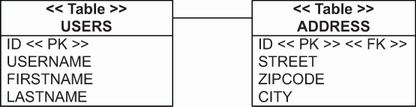 Figure 9.3 The ADDRESS table has a foreign key constraint on its primary key.
This figure illustrates the foreign key constraint on the primary key of the ADDRESS table, which is part of the shared primary key one-to-one association.
Generators in Java Programming
In a broader programming context, a generator in Java is a construct that allows for the creation of sequences of values on demand, rather than storing them in memory. This is particularly useful for modeling infinite sequences or when working with large datasets where storing all values at once would be inefficient.
Generators in Java
In Java, generators can be implemented using interfaces such as ISeq. The following example demonstrates a simple integer sequence generator using Java's ISeq interface:
public class IntGeneratorSeq implements ISeq {
  private final int current;
  private final Function<Integer, Integer> generator;

  private IntGeneratorSeq(int seed,
                          Function<Integer, Integer> generator) {
      this.current = seed;
      this.generator = generator;
  }

  public static IntGeneratorSeq of(int seed,
                                   Function<Integer, Integer> generator) {
      return new IntGeneratorSeq(seed, generator);
  }

  @Override
  public Object first() {
      return generator.apply(current);
  }

  @Override
  public ISeq rest() {
      return new IntGeneratorSeq(generator.apply(current), generator);
  }
}
Explanation
- State Management: The
IntGeneratorSeqclass maintains the current state of the sequence using thecurrentvariable. - Generator Function: A
Function<Integer, Integer>is used to determine the next value in the sequence. - Lazy Evaluation: The sequence is generated lazily. The
first()method returns the current value, and therest()method generates the next sequence element by applying the generator function to the current value. - Purity: The generator function should ideally be pure, meaning it should not have side effects and should return the same result given the same input. However, Java does not enforce this.
Generators in Clojure
Clojure provides a more abstracted and powerful way to work with generators, particularly through the clojure.test.check.generators package. This package is used for creating randomized data, which is useful for testing purposes.
Usage
To use the generators in Clojure, you can require the package and alias it for convenience:
user=> (require '[clojure.test.check.generators :as gen])
nil
Functions
generate: This function is used to obtain a single random value from a generator.sample: This function retrieves a set of random values from a generator.
Example
An example use case is simulating a coin flip by generating random Boolean values. This showcases the power of Clojure's generators in creating randomized data for testing or simulation purposes.
In summary, generators in both Java and Clojure provide a mechanism for creating sequences of values on demand, with Clojure offering more built-in support for randomized data generation.
| Book Title | Usage of Generator | Technical Depth | Connections to Other Concepts | Examples Used | Practical Application |
|------------|--------------------|-----------------|-------------------------------|---------------|-----------------------|
| [Java Persistence with Spring Data and Hibernate](https://www.manning.com/books/java-persistence-with-spring-data-and-hibernate) | Discusses generators in the context of JPA and Hibernate for generating primary keys. | Detailed explanation of different generator types like sequence, table, and identity. | Connects to database operations and entity management. | Provides configuration examples for enhanced-sequence and foreign key generators. | Practical examples of persisting entities with generated keys. [more](https://livebook.manning.com/book/java-persistence-with-spring-data-and-hibernate/chapter-5/78) |
| [The Well-Grounded Java Developer, Second Edition](https://www.manning.com/books/the-well-grounded-java-developer-second-edition) | Describes generators as constructs for creating sequences of values on demand. | Explains implementation using Java interfaces like `ISeq`. | Links to concepts like lazy evaluation and purity in functional programming. | Includes Java code for an integer sequence generator and Clojure examples for random data generation. | Highlights use in modeling infinite sequences and testing with randomized data. [more](https://livebook.manning.com/book/the-well-grounded-java-developer-second-edition/chapter-15/355) |
FAQ (Frequently asked questions)
What is a generator in JPA and Hibernate?
How do you specify the strategy for generating primary key values in JPA?
What is the purpose of a generator in JPA?
What types of generators are available in JPA?
How do generators define primary key values in JPA?
How do you require the test.check generators in Clojure?
What is an example of a generator in Clojure using Java's ISeq interface?
How does the IntGeneratorSeq class generate a sequence?