HTTP Basic Authentication
Overview
HTTP Basic Authentication is a straightforward method for an HTTP user agent to provide a username and password when making a request. This authentication scheme is built into the HTTP protocol and involves sending the credentials encoded in Base64 with each request. Despite its simplicity, HTTP Basic Authentication is not recommended for production use due to its security limitations. The primary concern is that Base64 encoding can be easily decoded, exposing the plain-text password and making it insecure for sensitive applications.
HTTP Basic Authentication in Spring Security
In the context of Spring Security, HTTP Basic Authentication is used to authenticate users by sending credentials with each HTTP request. It is configured using the HttpSecurity object within the SecurityConfiguration class. This setup allows for the integration of HTTP Basic Authentication with other authentication mechanisms, such as JDBC authentication, to verify user credentials against a database.
Security Configuration Example
Below is an example of a SecurityConfiguration class that demonstrates how to configure HTTP Basic Authentication with JDBC in a Spring Boot application:
package com.manning.sbip.ch05.security;

import org.springframework.beans.factory.annotation.Autowired;
import org.springframework.context.annotation.Bean;
import org.springframework.context.annotation.Configuration;
import org.springframework.security.config.annotation.authentication.builders.AuthenticationManagerBuilder;
import org.springframework.security.config.annotation.web.builders.HttpSecurity;
import org.springframework.security.config.annotation.web.builders.WebSecurity;
import org.springframework.security.config.annotation.web.configuration.WebSecurityConfigurerAdapter;
import org.springframework.security.crypto.password.NoOpPasswordEncoder;
import org.springframework.security.crypto.password.PasswordEncoder;

import javax.sql.DataSource;

@Configuration
public class SecurityConfiguration extends WebSecurityConfigurerAdapter {

    @Autowired
    private DataSource dataSource;

    @Override
    protected void configure(HttpSecurity http) throws Exception {    #1
        http
                .authorizeRequests()
                .anyRequest()
                .authenticated()
                .and()
                .httpBasic();
    }

    @Override
    protected void configure(AuthenticationManagerBuilder auth) throws Exception {
        auth.jdbcAuthentication().dataSource(dataSource);
    }

    @Override
    public void configure(WebSecurity web) throws Exception {
        web
                .ignoring()
                .antMatchers("/webjars/**", "/images/**", "/css/**", "/h2-console/**");
    }

    @Bean
    public PasswordEncoder passwordEncoder() {
        return NoOpPasswordEncoder.getInstance();
    }
}
In this configuration:
- The
configure(HttpSecurity http)method specifies that all requests to the application must be authenticated using HTTP Basic Authentication. - The
configure(AuthenticationManagerBuilder auth)method sets up JDBC authentication, allowing user credentials to be retrieved from a database. - The
configure(WebSecurity web)method is used to ignore certain paths from authentication, such as static resources.
Figure: HTTP Basic Authentication Dialogue
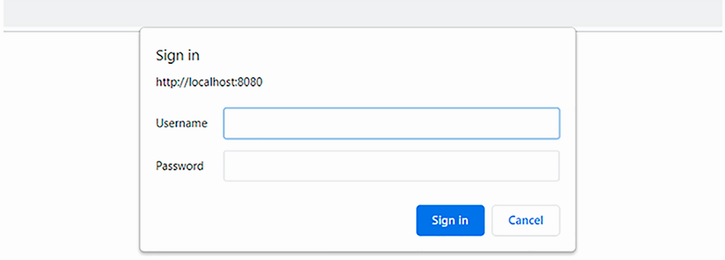 Figure 5.18 HTTP basic authentication dialogue box for user authentication in Google Chrome browser
This figure illustrates the HTTP Basic Authentication dialogue box as seen in the Google Chrome browser, where users are prompted to enter their credentials. This is a common user interface element when HTTP Basic Authentication is employed in web applications.