Image in Java
In the Java ecosystem, the term "image" can refer to various concepts depending on the context. Below, we explore the different interpretations and uses of "image" as discussed in several Java-related books.
Image in the Context of Containers
In the realm of containerization, an image is a lightweight, standalone, executable software package that includes everything needed to run an application. This encompasses the application code, runtime, libraries, and settings. Images are fundamental to containerization as they are used to create containers, which are the running instances of these images.
Creating a Docker Image
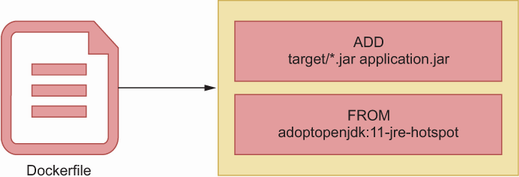
To create a Docker image, a Dockerfile is used. A Dockerfile is a text file containing all the commands required to assemble and create the image. Below is an example of a Dockerfile used for a Java application:
FROM adoptopenjdk:11-jre-hotspot
ADD target/*.jar application.jar
ENTRYPOINT ["java", "-jar","application.jar"]
EXPOSE 8080
This Dockerfile specifies a base image, adds the application JAR, and sets the command to run the application. The EXPOSE directive indicates the port on which the application will run.
Image Layers
Docker images consist of multiple layers. Each instruction in a Dockerfile creates a new layer in the image. The base image forms the initial layer, and subsequent instructions add additional layers. This layered structure is depicted in the following figure:
Optimizing Dockerfiles
For Java applications, a more efficient Dockerfile can be created by leveraging the layering capabilities of the application framework. This involves splitting the application JAR into layers, which are then added to the image. This approach optimizes the build process and reduces image size.
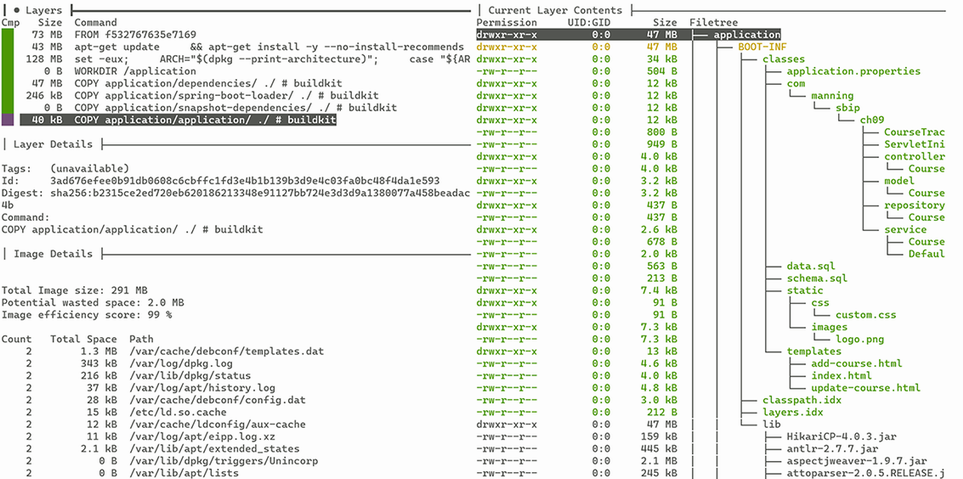
Image in Java Persistence with Spring Data and Hibernate
In the context of Java Persistence with Spring Data and Hibernate, an "Image" is an embeddable component class that encapsulates properties such as filename, width, and height. This component is used as part of a collection within an Item entity, allowing for the management of image data in a structured and efficient manner.
Mapping Images as a Collection
Images can be mapped as a simple set of strings, where each string represents an image path or filename. Alternatively, an embeddable class can encapsulate all properties of an image:
@Embeddable
public class Image {
    @Column(nullable = false)
    private String filename;
    private int width;
    private int height;
}
This approach allows for a more detailed representation of image data within a database entity.
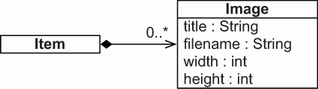
Image in Functional Programming
In functional programming, the term "image" refers to the set of elements in the codomain that have a corresponding element in the domain of a function. This concept is crucial for understanding the behavior and properties of functions, particularly in transformations and mappings.
Understanding the image of a function helps in analyzing which values are achievable outputs, providing insights into the function's range and its potential effects when applied to different inputs.
Conclusion
The term "image" in Java can refer to different concepts depending on the context, from containerization and persistence to functional programming. Each interpretation provides unique insights and functionalities that are essential for developing robust Java applications. By understanding these various contexts, developers can better utilize images in their projects, whether for deploying applications, managing data, or transforming data structures.
Here's a markdown table comparing how different 'Java' books discuss the term 'image':
| Book Title | Usage of Image | Technical Depth | Connections to Other Concepts | Examples Used | Practical Application |
|------------|----------------|-----------------|-------------------------------|---------------|-----------------------|
| Spring Boot in Practice | Discusses images in the context of Docker containers, focusing on creating, building, and running Docker images. | Detailed explanation of Dockerfile structure and image layers. | Connects to containerization and application deployment. | Provides Dockerfile examples and commands for building and running images. | Emphasizes optimizing Dockerfiles for efficient application deployment. more |
| Java Persistence with Spring Data and Hibernate epub | Describes images as embeddable components in Java Persistence, focusing on encapsulating image properties. | Explores mapping images as collections and using embeddable classes. | Links to Java Persistence concepts like @ElementCollection and @Embeddable. | Includes code snippets for mapping images and encapsulating properties. | Highlights managing image data within Java entities. more |
| The Well-Grounded Java Developer, Second Edition | Covers Docker images as standalone packages for running software, including building and sharing images. | Provides insights into Dockerfile instructions and image tagging. | Relates to containerization and software deployment. | Demonstrates building Docker images with Gradle and tagging images. | Focuses on sharing images via container registries for deployment. more |
| Functional Programming in Java: How functional techniques improve your Java programs | Defines image in the context of functional programming as the set of output values of a function. | Basic explanation of the image of a function. | Connects to functional programming concepts like transformations and mappings. | Discusses the theoretical concept without specific code examples. | Aids in understanding function behavior and range in functional programming. more |
This table provides a comparative overview of how each book approaches the term 'image', highlighting the diversity in usage, technical depth, and practical applications.
FAQ (Frequently asked questions)
How are images mapped in a Java entity?
What is the purpose of the @CollectionTable annotation in mapping images?
What column name is used to store image filenames in the database?
How is the images collection initialized in the Java entity?
What is an Image in the context of Java Persistence?
How is an Image used in a Java entity?
What does Figure 8.6 illustrate in the context of Java Persistence?
How are image properties encapsulated in Java?
What annotations are used for the Image class in Java Persistence?
What is a Docker image?
How are Docker images built?
Can Docker images be shared?
What command is used to build a Docker image?
What are the internal steps Docker takes when building an image?
How can you test Docker images for vulnerabilities?
What does a Docker image contain?
What is the purpose of a Docker image?
What factors should be considered when selecting a base image for Docker?
How do you build Docker images with Gradle?
What is the image of a function in mathematics?
How is the image of a function defined?