Input in Functional Programming
In the context of functional programming in Java, handling input is a crucial aspect that can significantly influence the design and testability of your programs. This section explores the concept of input, focusing on reading data from the console and files, and introduces a functional approach to managing input operations.
Deterministic and Testable Input
One of the primary goals when dealing with input in functional programming is to make it deterministic and testable. This involves creating abstractions that allow input operations to be predictable and easily verifiable through tests. By designing interfaces for input, you can decouple the source of the input from the logic that processes it, leading to more modular and maintainable code.
Interface for Inputting Data
To facilitate a functional approach to input, the chapter introduces an interface specifically designed for inputting data. This interface serves as a contract for different implementations that can read data from various sources, such as the console or files. By adhering to this interface, you can ensure that your input operations are consistent and interchangeable.
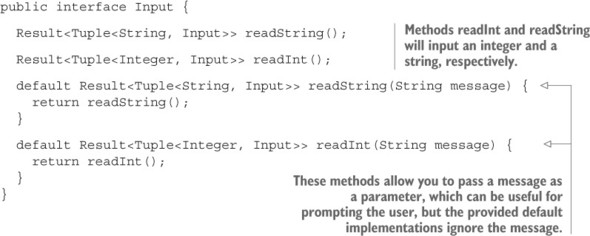 Listing 13.2. An interface for inputting data
Functional Handling of Input
In functional programming, handling input can be enhanced by parameterizing the IO type with the type of the input value. This approach allows the IO type to manage input values effectively and perform computations using functional methods like map and flatMap. By leveraging these methods, you can transform and combine input data in a functional manner, leading to more expressive and concise code.
By adopting these functional techniques, you can improve the way your Java programs handle input, making them more robust, flexible, and easier to test.
FAQ (Frequently asked questions)
How is input discussed in Chapter 13 of 'Functional Programming in Java'?
What does Chapter 13 introduce for inputting data?
What is shown in Listing 13.2 of 'Functional Programming in Java'?
How is input handled in a functional way according to Chapter 13?