JdbcTemplate
JdbcTemplate is a core component of the Spring Framework that simplifies the interaction with relational databases using JDBC (Java Database Connectivity). It is designed to reduce the boilerplate code typically required for database operations, such as obtaining connections and handling exceptions. This makes JdbcTemplate particularly useful for applications that do not require more complex persistence frameworks. It serves as an excellent starting point for developers learning to implement a persistence layer in Spring applications.
Overview
JdbcTemplate provides a template method pattern to handle repetitive tasks such as creating connections, executing SQL queries, and processing result sets. It is often used in Spring Boot applications to streamline database operations, allowing developers to focus on business logic rather than boilerplate code.
For example, in the Course Tracker application, JdbcTemplate is utilized to facilitate database interactions, particularly in the CourseRepositoryImpl class to execute SQL queries and map the results to Course objects. This approach reduces the complexity of database operations and enhances code readability and maintainability.
Definition
JdbcTemplate relies on a data source to connect to the database server and provides a variety of methods for data manipulation and retrieval. Key methods include update() for executing data mutation queries like INSERT, UPDATE, or DELETE, and query() for retrieving data.
Using JdbcTemplate
Injecting JdbcTemplate
In a Spring application, you can inject a JdbcTemplate instance into your repository classes to work with persisted data. This is typically done using constructor injection, as shown in the following example:
@Repository
public class PurchaseRepository {

  private final JdbcTemplate jdbc;

  public PurchaseRepository(JdbcTemplate jdbc) {
    this.jdbc = jdbc;
  }
}
Adding Records
To add a new record to a database table using JdbcTemplate, you can use the update() method. This method simplifies the process by handling the connection, statement creation, and exception management for you. Here is an example of how to use JdbcTemplate to insert a new record into a table:
@Repository
public class PurchaseRepository {

  private final JdbcTemplate jdbc;

  public PurchaseRepository(JdbcTemplate jdbc) {
    this.jdbc = jdbc;
  }

  public void storePurchase(Purchase purchase) {
    String sql = "INSERT INTO purchase VALUES (NULL, ?, ?)";

    jdbc.update(sql,
          purchase.getProduct(),
          purchase.getPrice());
  }
}
Retrieving Records
Retrieving data with JdbcTemplate is straightforward. You write a SELECT query and use a RowMapper to map the result set to your model class. The RowMapper is responsible for transforming each row of the ResultSet into an instance of your model class. Here is an example of how to retrieve all records from a table and map them to Purchase objects:
@Repository
public class PurchaseRepository {

  // Omitted code

  public List<Purchase> findAllPurchases() {
    String sql = "SELECT * FROM purchase";

    RowMapper<Purchase> purchaseRowMapper = (r, i) -> {
      Purchase rowObject = new Purchase();
      rowObject.setId(r.getInt("id"));
      rowObject.setProduct(r.getString("product"));
      rowObject.setPrice(r.getBigDecimal("price"));
      return rowObject;
    };

    return jdbc.query(sql, purchaseRowMapper);
  }
}
RowMapper and Data Transformation
The RowMapper interface is a key component when using JdbcTemplate for data retrieval. It defines how each row of the ResultSet is mapped to an instance of your model class. The following figure illustrates how JdbcTemplate uses the RowMapper to transform the ResultSet into a list of Purchase instances:
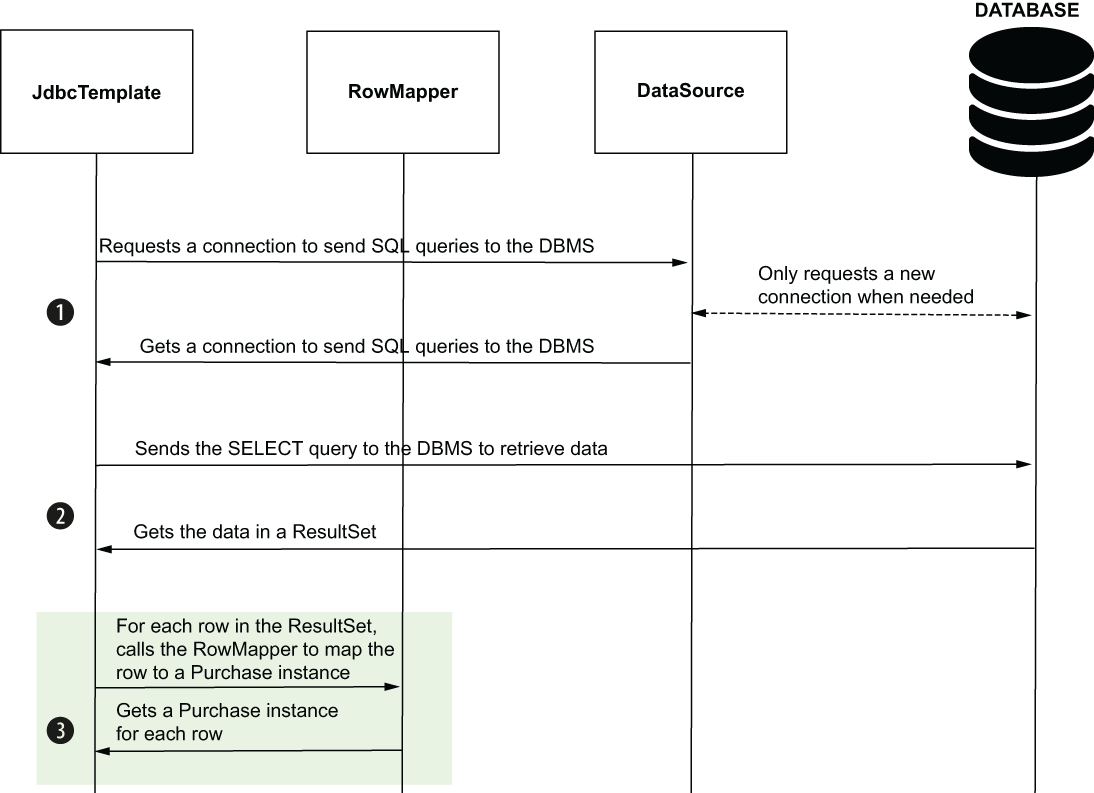 Figure 12.9 JdbcTemplate uses the RowMapper to change the ResultSet to a list of Purchase instances.
Usage in Course Tracker Application
In the Course Tracker application, JdbcTemplate is used in the CourseRepositoryImpl class to perform database operations. Below is the implementation of the CourseRepositoryImpl class:
@Repository
class CourseRepositoryImpl implements CourseRepository {

    @Autowired
    JdbcTemplate jdbcTemplate;

    Iterable<Course> findAll() {
         jdbcTemplate.query("""
            SELECT COURSE_ID, COURSE_NAME,
            COURSE_CATEGORY, COURSE_RATING, COURSE_DESCRIPTION FROM COURSES""", {
            resultSet, newRow -> new Course(
                id : resultSet.getLong(1),
                name : resultSet.getString(2),
                category : resultSet.getString(3),
                rating : resultSet.getInt(4),
                description : resultSet.getString(5))
         } as RowMapper)
    }

    Iterable<Course> findAllByCourseCategory(String category) {
         jdbcTemplate.query("""
            SELECT COURSE_ID, COURSE_NAME,
            COURSE_CATEGORY, COURSE_RATING, COURSE_DESCRIPTION FROM COURSES WHERE
            COURSE_CATEGORY=?""", {
            resultSet, newRow -> new Course(
                id : resultSet.getLong(1),
                name : resultSet.getString(2),
                category : resultSet.getString(3),
                rating : resultSet.getInt(4),
                description : resultSet.getString(5))
         } as RowMapper, category)
    }
}
By leveraging JdbcTemplate, the CourseRepositoryImpl class efficiently handles database operations, providing a clean and concise way to interact with the database in the Course Tracker application.
Here's a markdown table comparing how different 'Java' books discuss the term 'jdbctemplate':
| Book Title | Usage of jdbctemplate | Technical Depth | Connections to Other Concepts | Examples Used | Practical Application |
|------------|-----------------------|-----------------|-------------------------------|---------------|-----------------------|
| Spring Start Here | Discusses JdbcTemplate as a tool to simplify database interactions in Spring, reducing boilerplate code. more | Provides detailed methods like update() and query() for data manipulation and retrieval. more | Connects JdbcTemplate with Spring's dependency injection and data source management. more | Includes examples for injecting JdbcTemplate, adding, and retrieving records. more | Focuses on small applications and learning persistence layers in Spring. more |
| Spring Boot in Practice | Highlights JdbcTemplate in Spring Boot for simplifying database operations, focusing on business logic. more | Describes the use of JdbcTemplate in repository classes with Spring Boot's autowiring. more | Integrates JdbcTemplate with Spring Data repositories and annotations. more | Provides a detailed example with CourseRepositoryImpl class for database operations. more | Used in a Course Tracker application to enhance code readability and maintainability. more |
This table provides a concise comparison of how each book approaches the topic of JdbcTemplate, focusing on its usage, technical depth, connections to other concepts, examples, and practical applications.
FAQ (Frequently asked questions)
How does the CourseRepositoryImpl class use JdbcTemplate?
What SQL query is used in the findAll method of CourseRepositoryImpl?
How does the findAllByCourseCategory method filter courses?
What role does JdbcTemplate play in the Course Tracker application?
How is JdbcTemplate integrated into the CourseRepositoryImpl class?
What is JdbcTemplate in Spring?
Why is JdbcTemplate useful for small applications?
How do you use JdbcTemplate to add a new record to a table?
What does the update() method in JdbcTemplate do?
How does JdbcTemplate connect to a database?
What methods does JdbcTemplate provide for database operations?