JSON (JavaScript Object Notation)
Overview
JSON, or JavaScript Object Notation, is a lightweight data interchange format that is easy to read and write for humans and easy to parse and generate for machines. It is primarily used to exchange data between applications, especially in HTTP requests and responses for REST endpoints. JSON's simplicity and ability to represent complex data structures, including nested objects and collections, make it a popular choice for data interchange.
JSON Structure
JSON represents data as object instances with attributes. These attributes are identified by names and hold values, similar to fields in a Java class. The basic structure of a JSON object involves:
- Curly Braces
{}: Used to define an object. - Attribute-Value Pairs: Each attribute is followed by a colon
:and its corresponding value. - Commas
,: Used to separate multiple attribute-value pairs within an object.
Example
Here is an example of a JSON object representing a product:
{
   "name" : "chocolate",
   "price" : 5,
   "pack" : {
       "color" : "blue"
   }
}
In this example, the JSON object has three attributes: name, price, and pack. The pack attribute itself is an object, demonstrating JSON's ability to represent nested structures.
Figures
Figure D.1
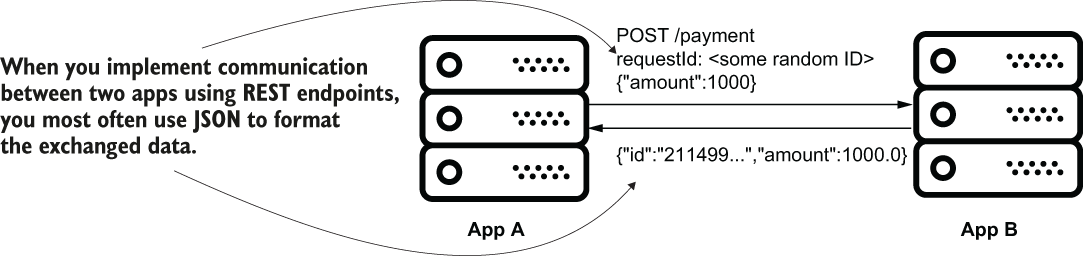 Figure D.1 When you implement business logic, it sometimes implies establishing communication between multiple apps. Most often, you use JSON to format the data the apps exchange. To implement and test your REST endpoints, you need to understand JSON.
This figure illustrates the role of JSON in facilitating communication between applications, particularly in the context of REST endpoints.
Figure D.2
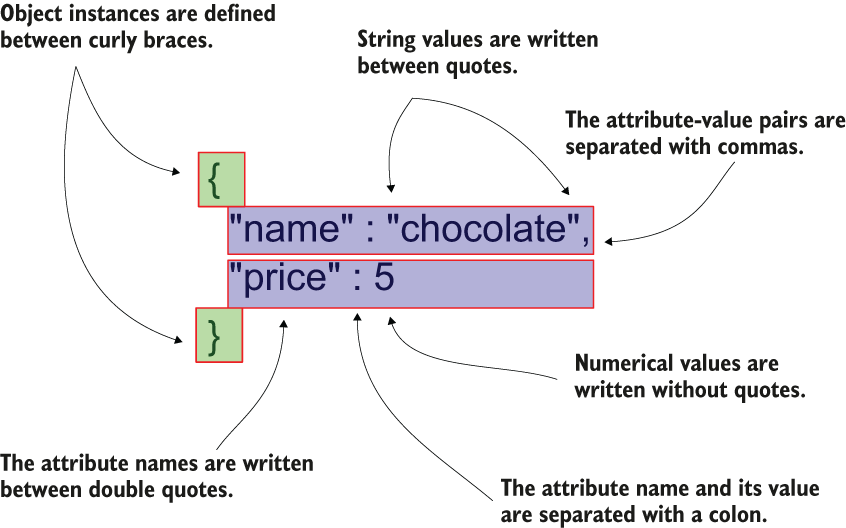 Figure D.2 Describing an object instance in JSON. We surround the attribute-value pairs with curly braces. A colon separates the attribute name and its value. The attribute-value pairs are separated with commas.
This figure provides a visual representation of how an object instance is described in JSON, highlighting the use of curly braces, colons, and commas to structure the data.
Key Points
- JSON is a widely-used format for data exchange, especially in web applications.
- It is easy to understand and follows simple rules for representing data.
- JSON can represent complex data structures, including nested objects.
- Understanding JSON is crucial for implementing and testing REST endpoints.
FAQ (Frequently asked questions)
What is JSON used for?
Why is JSON widely used?
What are the characteristics of JSON?
How do you describe an object instance in JSON?
How do you represent nested objects in JSON?