List in Java
A "list" in Java is a versatile and fundamental data structure used to store ordered collections of elements. Lists can be implemented in various forms, such as linked lists or arrays, and are a key component in both functional and object-oriented programming paradigms. They are used extensively in Java for their ability to maintain order and provide efficient access and manipulation of elements.
List in Functional Programming
In functional programming, a list is a fundamental data structure used to store sequences of elements. Lists are linear collections where elements are related along a single dimension, and they can be classified by access type, ordering, and implementation. They are immutable and persistent, meaning they cannot be changed after creation and maintain their state across operations. This immutability allows for efficient data sharing and manipulation without directly accessing elements.
Types and Implementations
Lists can be implemented in various ways, with the singly linked list being a common choice. A singly linked list is composed of a head (the first element) and a tail (the rest of the list). It is implemented as an abstract class with two subclasses: Nil for an empty list and Cons for a non-empty list. Lists are created using static factory methods.
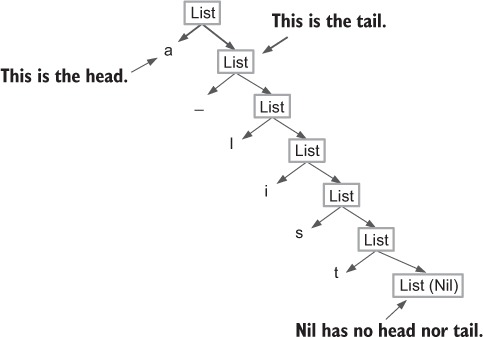 Figure 5.3. The representation of the singly linked list implementation
Operations on Lists
- Creating Lists: Methods are defined to generate lists with different initial conditions, such as empty lists, lists with one element, or lists from a collection of elements.
- Mapping: Applying a function to each element to produce a new list of transformed elements using the
mapmethod. - Appending: Creating a new list with an additional element using the
appendmethod. - Reducing and Folding: Combining elements into a single value using fold operations like
foldLeftorfoldRight. - Reversing: Creating a new list with elements in reverse order.
- Effects: Performing side effects on each element of a list using the
forEachmethod. - Corecursive Lists: Generating lists by starting from an initial element and applying a function to generate subsequent elements.
Advanced List Operations
- Concatenation: Adding elements of one list to another.
- Dropping Elements: Removing elements from the end of a list.
- Zipping and Unzipping: Combining two lists into one by pairing elements of the same index.
- Splitting and Sublists: Dividing a list into two parts at a specific position.
Performance and Optimization
- Memoization: Storing computed values in the list itself to improve performance.
- Automatic Parallel Processing: Dividing a list into sublists and processing these in parallel using multiple threads.
List in Modern Java
In Java 9, the introduction of the List.of factory method marked a significant enhancement in the way lists are created. This method allows for the creation of immutable lists, which means that once a list is created, it cannot be modified. This immutability is beneficial as it simplifies list creation and ensures that the list's contents remain constant, preventing any accidental modifications such as adding or replacing elements.
Implementation Example
Below is an example of how a list can be implemented in Java using interfaces and classes, demonstrating a simple linked list structure:
interface MyList<T> {
    T head();
    MyList<T> tail();
    default boolean isEmpty() {
        return true;
    }
}

class MyLinkedList<T> implements MyList<T> {
    private final T head;
    private final MyList<T> tail;

    public MyLinkedList(T head, MyList<T> tail) {
        this.head = head;
        this.tail = tail;
    }

    public T head() {
        return head;
    }

    public MyList<T> tail() {
        return tail;
    }

    public boolean isEmpty() {
        return false;
    }
}

class Empty<T> implements MyList<T> {
    public T head() {
        throw new UnsupportedOperationException();
    }

    public MyList<T> tail() {
        throw new UnsupportedOperationException();
    }
}
List in Java Persistence with Spring Data and Hibernate
In the context of Java Persistence, particularly when using Spring Data and Hibernate, a list is a type of collection that is used to maintain the order of its elements. This is crucial when the sequence of elements is significant and needs to be preserved both in the application and in the database.
Characteristics of a List
- Order Maintenance: A list inherently maintains the order of its elements.
- Database Mapping: When a list is mapped to a database table, an additional index column is used to preserve the order of elements.
- Hibernate Management: Hibernate automatically updates the index column whenever elements are added or removed from the list.
List in Clojure
In Clojure, a list is a fundamental data structure that is used to store ordered collections of elements. Lists in Clojure are immutable and are implemented as singly linked lists. This means that once a list is created, it cannot be changed. Any operation that seems to modify a list will actually create a new list with the desired changes.
Characteristics of Clojure Lists
- Immutability: Clojure lists are immutable, promoting safer and more predictable code by avoiding side effects.
- Singly Linked: Allows for efficient access to the first element and easy construction of new lists by adding elements to the front.
- Ordered Collection: Lists maintain the order of elements, which is important for operations that depend on the sequence of elements.
Syntax and Usage
Lists in Clojure are typically surrounded by parentheses and are used to represent function calls. For example, the expression (add 1 2) is a list where add is a function and 1 and 2 are arguments.
Creating Lists
Lists can be created using the quote form or its shorthand, '. The quote form prevents the evaluation of the list, treating it as a data structure rather than a function call.
'(1 2 3 4)
Clojure lists are a powerful and flexible tool for both data representation and function invocation, making them a central part of the language's syntax and functionality.
| Book Title | Usage of list | Technical Depth | Connections to Other Concepts | Examples Used | Practical Application |
|------------|---------------|-----------------|-------------------------------|---------------|-----------------------|
| [Functional Programming in Java: How functional techniques improve your Java programs](https://www.manning.com/books/functional-programming-in-java) | Lists are immutable and persistent, used for efficient data sharing and manipulation. [more](https://livebook.manning.com/book/functional-programming-in-java/chapter-8/1) | Discusses singly linked lists, operations like mapping, appending, reducing, and advanced operations like zipping. [more](https://livebook.manning.com/book/functional-programming-in-java/chapter-5/55) | Connects lists to functional programming concepts like immutability and recursion. [more](https://livebook.manning.com/book/functional-programming-in-java/chapter-3/144) | Uses static factory methods, fold operations, and figures to illustrate list operations. [more](https://livebook.manning.com/book/functional-programming-in-java/chapter-5/20) | Emphasizes performance optimization and parallel processing. [more](https://livebook.manning.com/book/functional-programming-in-java/chapter-8/33) |
| [Modern Java in Action: Lambdas, streams, reactive and functional programming](https://www.manning.com/books/modern-java-in-action) | Introduces `List.of` for creating immutable lists in Java 9. [more](https://livebook.manning.com/book/modern-java-in-action/chapter-8/26) | Provides a simple linked list implementation using interfaces and classes. [more](https://livebook.manning.com/book/modern-java-in-action/chapter-19/149) | Discusses lists in the context of Java's functional programming features. [more](https://livebook.manning.com/book/modern-java-in-action/chapter-19/149) | Demonstrates list implementation with code examples. [more](https://livebook.manning.com/book/modern-java-in-action/chapter-19/149) | Focuses on immutability and its benefits in list creation and management. [more](https://livebook.manning.com/book/modern-java-in-action/chapter-8/26) |
| [Java Persistence with Spring Data and Hibernate epub](https://www.manning.com/books/java-persistence-with-spring-data-and-hibernate) | Lists maintain order and are mapped to database tables with an index column. [more](https://livebook.manning.com/book/java-persistence-with-spring-data-and-hibernate/chapter-8/11) | Explains Hibernate's role in managing lists and maintaining order. [more](https://livebook.manning.com/book/java-persistence-with-spring-data-and-hibernate/chapter-8/11) | Connects lists to database management and ORM tools like Hibernate. [more](https://livebook.manning.com/book/java-persistence-with-spring-data-and-hibernate/chapter-8/11) | Discusses practical implications of using lists in Java Persistence. [more](https://livebook.manning.com/book/java-persistence-with-spring-data-and-hibernate/chapter-8/11) | Highlights the importance of order in database applications. [more](https://livebook.manning.com/book/java-persistence-with-spring-data-and-hibernate/chapter-8/11) |
| [The Well-Grounded Java Developer, Second Edition](https://www.manning.com/books/the-well-grounded-java-developer-second-edition) | Lists in Clojure are immutable and used for ordered collections. [more](https://livebook.manning.com/book/the-well-grounded-java-developer-second-edition/chapter-10/140) | Describes lists as singly linked and their role in function calls. [more](https://livebook.manning.com/book/the-well-grounded-java-developer-second-edition/chapter-10/140) | Links lists to Clojure's syntax and functional programming paradigm. [more](https://livebook.manning.com/book/the-well-grounded-java-developer-second-edition/chapter-10/140) | Provides syntax examples and usage in function calls. [more](https://livebook.manning.com/book/the-well-grounded-java-developer-second-edition/chapter-10/140) | Emphasizes immutability and functional programming in Clojure. [more](https://livebook.manning.com/book/the-well-grounded-java-developer-second-edition/chapter-10/140) |
FAQ (Frequently asked questions)
What is a list in Java Persistence?
How is a list mapped in a database using Java Persistence?
How does Hibernate manage the order of elements in a list?
What is the purpose of a list in one-to-many associations?
What is required to store the position of each element in a list?
What is a unidirectional mapping in the context of lists?
What does the @OrderColumn annotation do in a list mapping?
Why should the index column be NOT NULL in a list mapping?
What are Clojure lists?
How are Clojure lists typically represented?
How can Clojure lists be created?
How can lists be created in Java 9?
What type of lists does the List.of method produce?
What are the benefits of using the List.of factory method?
What is a lazy list in Java?
What are the components of a list in this context?
Can a list be empty in this context?
What operations can be performed on a list?
What is the MyList interface in Java?
How does the MyLinkedList class implement the MyList interface?
What does the isEmpty() method return in the MyLinkedList class?
What exception is thrown by the Empty class methods?
What does mapping a list involve?
How can you perform mapping on a list in Java?
How can you create lists in Java?
How do you append to a list in a functional way?
Which method is used to append elements to a list functionally?
What does reducing a list mean?
What is folding a list?
What are foldLeft and foldRight?
How can you reverse a list?
What does applying effects to lists mean?
Which method is used to apply effects to each element of a list?
What is a corecursive list?
What is a common use of corecursive lists?
What are lists used for in functional programming?
What are lists in functional programming?
How can lists be classified?
What do different types of lists offer?
What is a list in terms of data collection?
How are lists classified?
What is a singly linked list?
How is a singly linked list represented?
What does Listing 5.1 show?
How is a singly linked list implemented?
What methods are included in a singly linked list?
What are the characteristics of lists in functional programming?
How are operations on lists performed in functional programming?
How can you drop elements from a list without mutating it?
What is data sharing in list operations?
How does data sharing affect list operations?
How are lists concatenated in a singly linked list?
How do you drop elements from the end of a list?
How can lists be folded using recursion?
How does the List data type compare to the Option type?
What operations can be performed on a list?
How is the length of a list calculated?
What is memoization in the context of lists?
How does memoization improve list operations?
What functional operations are supported by lists?
How can lists be composed with results?
How are lists manipulated in functional programming?
What does abstracting common list use cases involve?
What is zipping lists?
What does the unzip method do?
How do you split a list?
What is a sublist?
How can you check if a list contains a sublist?
What are some miscellaneous functions for working with lists?
How are lists processed in functional programming?
How can list processing be improved on multicore processors?
What is automatic parallel processing of lists?
How is parallel processing of lists managed?