Lock in Java
In Java, a "lock" is a fundamental concept used in concurrent programming to control access to shared resources. Locks ensure that only one thread can execute a block or method at a time, preventing race conditions and ensuring data consistency. They are crucial for maintaining data integrity and avoiding issues such as race conditions in multithreaded applications.
Overview of Locks
Locks are essential mechanisms in multithreaded Java applications, designed to prevent multiple threads from accessing a shared resource simultaneously. This is crucial for maintaining data integrity and avoiding race conditions. When a thread holds a lock, other threads attempting to enter the synchronized block are blocked until the lock is released. While locks are necessary for controlling thread execution, improper implementation can lead to performance issues or application freezes. Profilers are tools that help ensure optimal lock implementation by identifying the number of locks and their impact on thread execution.
The Lock Interface
Java provides a more flexible alternative to the synchronized keyword through the Lock interface, found in the java.util.concurrent.locks package. This interface allows for more sophisticated locking mechanisms, such as ReentrantLock and ReentrantReadWriteLock. These locks offer additional features like tryLock() and timed lock attempts, which are not available with the intrinsic locks provided by the synchronized keyword. The Lock interface is crucial for implementing advanced synchronization patterns and can replicate block-structured concurrency.
Example: Using ReentrantLock
Below is an example of rewriting a deadlock-prone code to use ReentrantLock, which is part of the Lock interface. This example demonstrates how to maintain a consistent lock acquisition order to prevent deadlocks.
private final Lock lock = new ReentrantLock();

public boolean transferTo(SafeAccount other, int amount) {
    // We also need code to check to see amount > 0, throw if not
    // ...

    if (accountId == other.getAccountId()) {
        // Can't transfer to your own account
        return false;
    }

    var firstLock = accountId < other.getAccountId() ?
            lock : other.lock;
    var secondLock = firstLock == lock ? other.lock : lock;

    firstLock.lock();             #1
    try {
        secondLock.lock();        #2
        try {
            if (balance >= amount) {
                balance = balance - amount;
                other.deposit(amount);
                return true;
            }
            return false;
        } finally {
            secondLock.unlock();
        }
    } finally {
        firstLock.unlock();
    }
}
#1 The firstLock object has a lower account ID.
#2 The secondLock object has a higher account ID.
In this example, a ReentrantLock is used to manage access to the transferTo method. The locks are acquired in a consistent order based on account IDs to prevent deadlocks. The pattern of acquiring a lock with lock() and releasing it in a finally block is a robust approach to ensure that locks are always released, even if an exception occurs.
Analyzing Locks and Waiting Threads
In the context of analyzing waiting threads, a lock refers to a thread being blocked at the entrance of a synchronized block. The monitor, which is a synchronization construct, prevents a thread from entering a synchronized block while another thread is actively running inside it. This is different from a waiting thread, which is explicitly set to a blocked state by the monitor and can only continue execution after being notified.
Profiling Locks
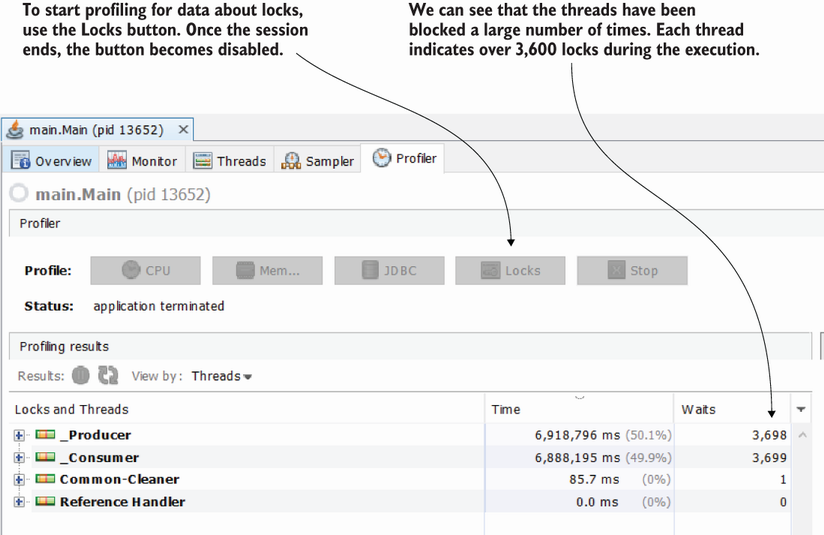
Profiling is a critical step in understanding and optimizing lock usage in Java applications. Tools like VisualVM and JProfiler provide insights into how locks affect thread execution. For instance, VisualVM allows users to start lock monitoring through the Profiler tab, as shown in Figure 9.7. This figure illustrates the process of starting profiling for locks and shows the results of more than 3,600 locks on each of the producer and consumer threads.
Example: Producer and Consumer Threads
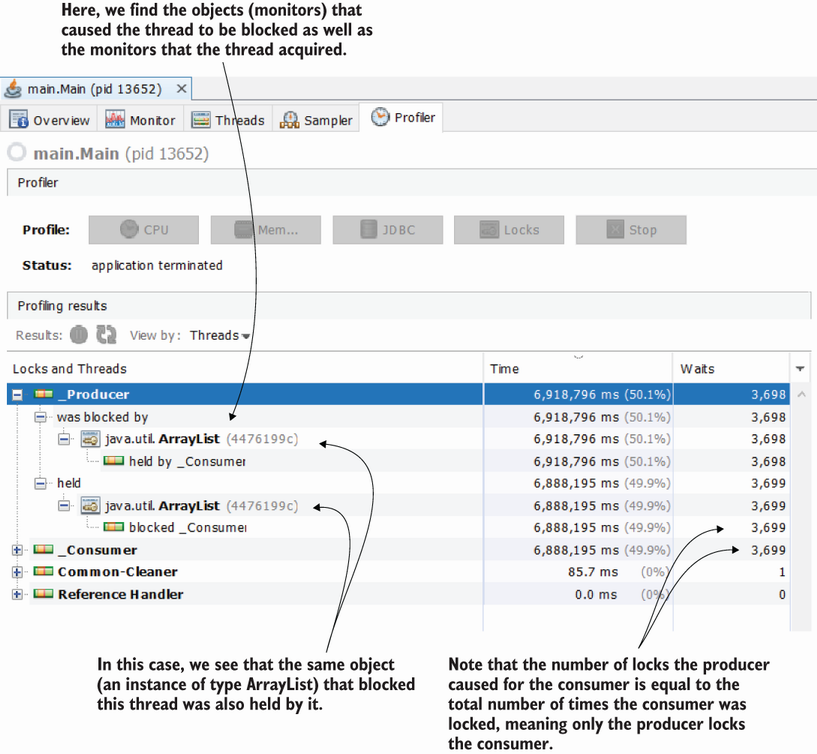
An example of lock usage is demonstrated through the analysis of producer and consumer threads. Profiling results, as depicted in Figure 9.8, show that the producer thread was blocked by the consumer thread 3,698 times using a monitor, and vice versa, the consumer was blocked 3,699 times. This figure provides a detailed understanding of what creates locks and what is affected by them.
Visualizing Lock Events
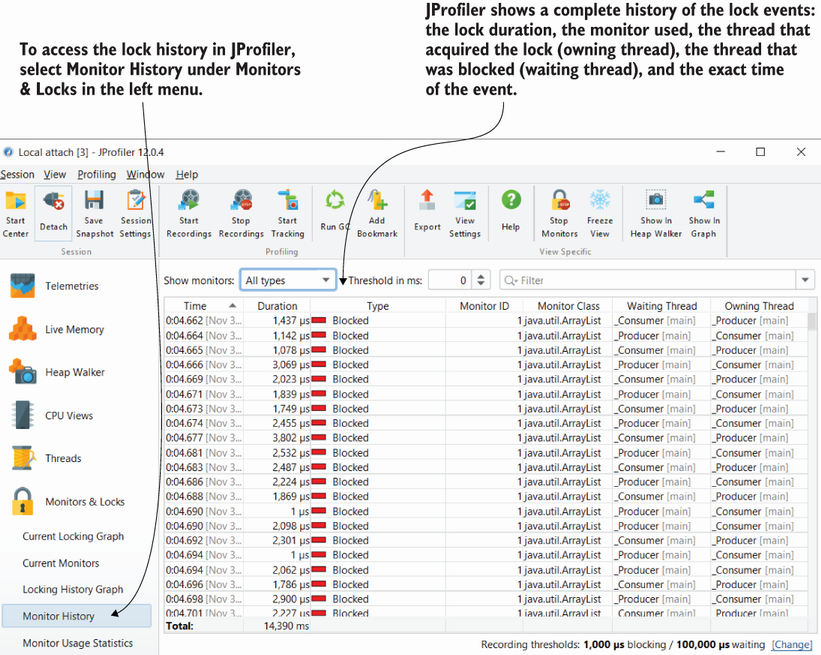
JProfiler offers multiple perspectives for visualizing lock events, providing a detailed history of all the locks encountered by an application's threads. Figure 9.11 shows the Monitor History view report, which includes the exact time of the event, the event duration, the monitor that caused the lock, and the threads involved.
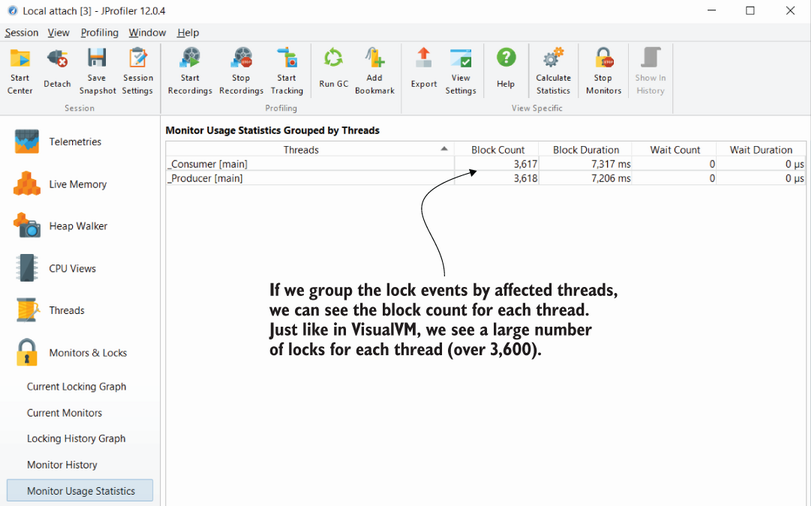
Additionally, JProfiler allows users to group lock events by threads or monitors, as shown in Figure 9.12. This aggregated view helps understand which threads are more affected and what affects them, or which monitor causes the threads to stop more often.
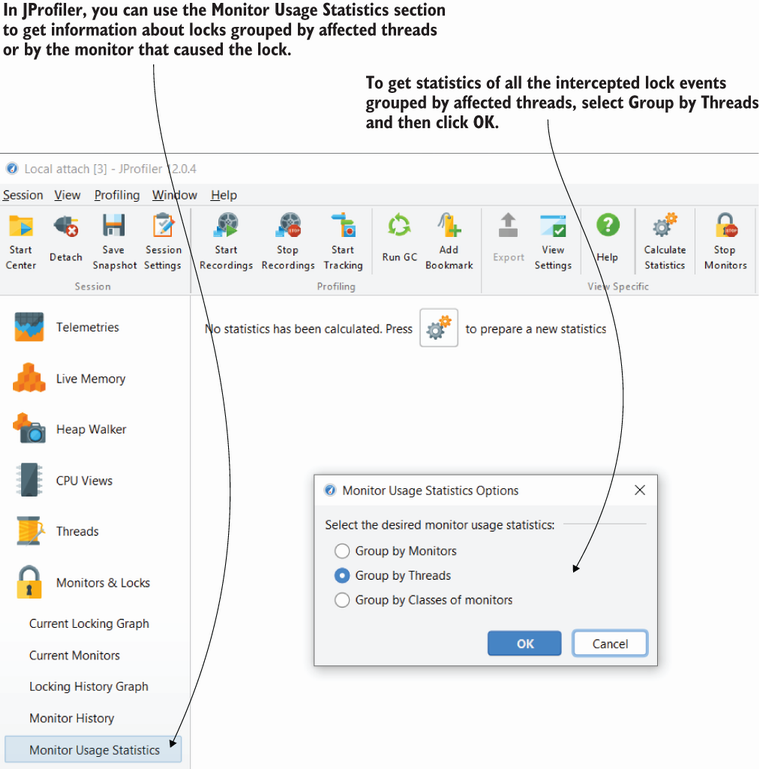
Figure 9.13 further illustrates how grouping lock events by threads provides an aggregated view showing how many times each thread was locked during its execution.
Conclusion
Understanding and managing locks is crucial for optimizing the performance of Java applications. Profiling tools like VisualVM and JProfiler provide valuable insights into lock behavior, helping developers identify and resolve potential issues. By analyzing lock events and their impact on thread execution, developers can ensure that their applications run efficiently and effectively.
| Book Title | Usage of lock | Technical Depth | Connections to Other Concepts | Examples Used | Practical Application |
|------------|---------------|-----------------|-------------------------------|---------------|-----------------------|
| [Troubleshooting Java: Read, debug, and optimize JVM applications](https://www.manning.com/books/troubleshooting-java) | Discusses locks as mechanisms to prevent race conditions and maintain data integrity in multithreaded applications. [more](https://livebook.manning.com/book/troubleshooting-java/chapter-9/1) | Explores profiling tools like VisualVM and JProfiler to analyze lock usage and optimize performance. [more](https://livebook.manning.com/book/troubleshooting-java/chapter-9/1) | Connects locks to thread execution and synchronization constructs like monitors. [more](https://livebook.manning.com/book/troubleshooting-java/chapter-9/78) | Uses producer and consumer threads to demonstrate lock usage and profiling results. [more](https://livebook.manning.com/book/troubleshooting-java/chapter-9/1) | Provides insights into managing locks to optimize Java application performance. [more](https://livebook.manning.com/book/troubleshooting-java/chapter-9/1) |
| [The Well-Grounded Java Developer, Second Edition](https://www.manning.com/books/the-well-grounded-java-developer-second-edition) | Introduces locks as a fundamental concept in concurrent programming to control access to shared resources. [more](https://livebook.manning.com/book/the-well-grounded-java-developer-second-edition/chapter-5/124) | Discusses the `Lock` interface and advanced synchronization patterns like `ReentrantLock`. [more](https://livebook.manning.com/book/the-well-grounded-java-developer-second-edition/chapter-6/35) | Explores the use of condition objects for implementing complex wait/notify patterns. [more](https://livebook.manning.com/book/the-well-grounded-java-developer-second-edition/chapter-6/60) | Provides examples using `synchronized` and `ReentrantLock` to prevent deadlocks. [more](https://livebook.manning.com/book/the-well-grounded-java-developer-second-edition/chapter-6/54) | Demonstrates practical use of locks in methods like `withdraw` and `transferTo` to ensure thread safety. [more](https://livebook.manning.com/book/the-well-grounded-java-developer-second-edition/chapter-5/124) |
FAQ (Frequently asked questions)
What causes thread locks in multithreaded architectures?
Why are thread locks necessary?
What issues can arise from incorrect implementation of thread locks?
How can profilers help with thread locks?
What is the purpose of locks in multithreaded applications?
How does profiling help with locks?
How do threads block each other using the same monitor?
How many times were the threads locked in the example?
What example is provided to illustrate locks in multithreaded architectures?
How many times was the producer thread blocked by the consumer thread?
How many times was the consumer thread blocked by the producer thread?
What is a lock in the context of multithreaded programming?
What happens when a thread holds a lock?
What does a lock refer to in the context of analyzing waiting threads?
How does a monitor affect thread execution in synchronized blocks?
What is the difference between a locked thread and a waiting thread?
Why are locks used in synchronized code blocks?
What problems can arise from improper lock management?
How can profilers assist with lock management?
What is the purpose of locks in concurrent programming?
How are locks acquired in Java?
What is an example of using a lock in Java?
What is the Lock interface in Java?
What types of locks does the Lock interface support?
What features does the Lock interface provide?
How does the Lock interface benefit advanced synchronization patterns?
How can ReentrantLock be used to prevent deadlock?
What is the purpose of using firstLock and secondLock in the transferTo method?
What is a condition object in Java?
How do condition objects provide flexibility in Java concurrency?