Metaspace in Java
Metaspace is a memory area in the Java Virtual Machine (JVM) responsible for storing class metadata. This includes essential information such as method definitions, data types' descriptors, and virtual method tables (vtables) necessary for the execution of Java applications. Introduced in Java 8 as a replacement for the permanent generation (permgen) space, metaspace offers a more flexible and robust solution for managing class metadata, enhancing the performance and reliability of Java applications.
Definition and Functionality
Metaspace is a critical component of the JVM, tasked with managing the class metadata required for the JVM to understand the structure and behavior of classes used in a Java application. This metadata is essential for the JVM to allocate memory for objects, manage method calls, and perform other vital operations. Unlike the heap, which stores the actual objects, the metaspace holds the blueprints or metadata that define these objects.
For more details, refer to the Troubleshooting Java book.
Key Characteristics
-
Storage of Class Metadata: Metaspace is specifically designed to hold metadata about classes, including the structure and definitions of methods and vtables used for method dispatch in object-oriented programming.
-
Replacement of Permgen: Prior to Java 8, the permgen space was used to store class metadata. Permgen had several limitations, such as a fixed maximum size that could lead to
OutOfMemoryErrorif exceeded. Metaspace addresses these issues by allowing for more flexible memory management. -
Dynamic Memory Management: Unlike permgen, which had a fixed size, metaspace can dynamically grow to accommodate the needs of the application, reducing the likelihood of running into memory constraints related to class metadata storage.
For more insights, see The Well-Grounded Java Developer, Second Edition.
Visualizing Metaspace Usage
In tools like VisualVM, you can observe the allocation of the metaspace through the memory allocation widget. This tool provides insights into how much of the metaspace is being used and can help identify potential issues related to memory allocation. The Metaspace tab in VisualVM's memory allocation widget is particularly useful for evaluating metadata allocation.
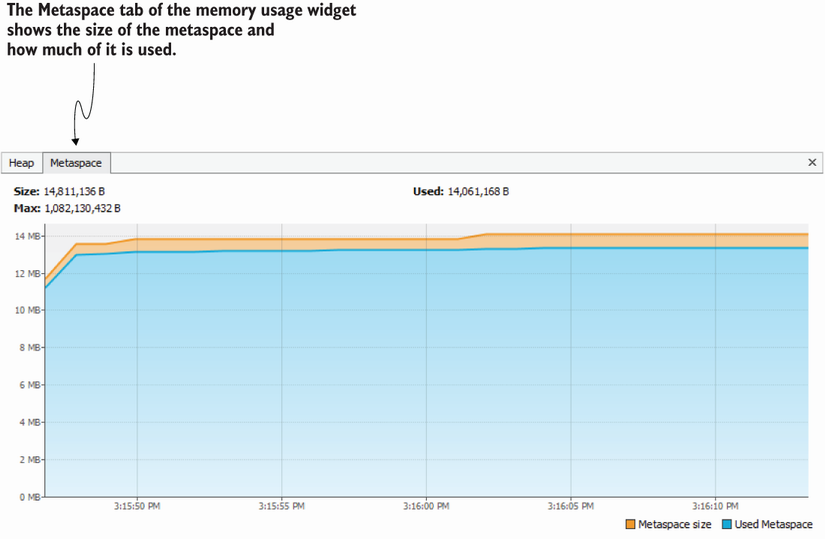 Figure 6.13 The metaspace is a part of the memory used to store class metadata. In particular cases, the metaspace can be overflowed. A VisualVM memory allocation widget also shows the usage of the metaspace.
Potential Issues
While the metaspace is generally robust, it can encounter issues such as OutOfMemoryError if it becomes full. This is a rare occurrence but can happen under specific conditions, such as when a framework like Hibernate is misused, leading to excessive metadata storage. Frameworks and libraries that use Java reflection are particularly prone to causing such issues if not used correctly, as they often rely on dynamic proxies and indirect calls.
An example of this is when an application misuses a data persistence framework, leading to an overflow of the metaspace. This can result in an OutOfMemoryError, indicating that there is no more space to store new data types.
 Figure E.14 The metaspace is a memory location where the app stores the data types’ descriptors. It holds the blueprints used to define the instances stored in the heap.
Understanding and monitoring the metaspace is essential for maintaining the performance and stability of Java applications, especially those that heavily utilize frameworks and libraries that dynamically generate classes.
| Book Title | Usage of Metaspace | Technical Depth | Connections to Other Concepts | Examples Used | Practical Application |
|------------|--------------------|-----------------|-------------------------------|---------------|-----------------------|
| [Troubleshooting Java: Read, debug, and optimize JVM applications](https://www.manning.com/books/troubleshooting-java) | Discusses metaspace as a memory location for class metadata, crucial for JVM operations. [more](https://livebook.manning.com/book/troubleshooting-java/chapter-6/102) | Explains the role of metaspace in memory management and potential issues like `OutOfMemoryError`. [more](https://livebook.manning.com/book/troubleshooting-java/chapter-6/38) | Connects metaspace usage to frameworks like Hibernate and tools like VisualVM. [more](https://livebook.manning.com/book/troubleshooting-java/chapter-6/119) | Provides examples of metaspace overflow and its impact on applications. [more](https://livebook.manning.com/book/troubleshooting-java/chapter-6/38) | Emphasizes monitoring metaspace for maintaining application performance. [more](https://livebook.manning.com/book/troubleshooting-java/chapter-6/38) |
| [The Well-Grounded Java Developer, Second Edition](https://www.manning.com/books/the-well-grounded-java-developer-second-edition) | Describes metaspace as a replacement for permgen, storing class metadata. [more](https://livebook.manning.com/book/the-well-grounded-java-developer-second-edition/chapter-17/14) | Details the transition from permgen to metaspace and its benefits. [more](https://livebook.manning.com/book/the-well-grounded-java-developer-second-edition/chapter-17/14) | Highlights the importance of metaspace in dynamic memory management. [more](https://livebook.manning.com/book/the-well-grounded-java-developer-second-edition/chapter-17/14) | Discusses the role of metaspace in applications with dynamic class loading. [more](https://livebook.manning.com/book/the-well-grounded-java-developer-second-edition/chapter-17/14) | Focuses on metaspace's impact on performance and reliability. [more](https://livebook.manning.com/book/the-well-grounded-java-developer-second-edition/chapter-17/14) |
FAQ (Frequently asked questions)
What is stored in the metaspace?
What error can occur if the metaspace is full?
What role does the metaspace play in Java memory management?
Is it common for the metaspace to run out of memory?
What is metaspace in Java?
What does the metaspace store in Java?
Can the metaspace overflow?
How can you monitor metaspace usage?
What can cause an OutOfMemoryError in the metaspace?
What is metaspace in Java?
What did metaspace replace in Java 8?
What kind of information does metaspace hold?