Microservices
Overview
Microservices architecture is a design approach that structures applications as a collection of loosely coupled services. This architecture style is particularly beneficial for complex projects that require scalability and flexibility. Each service in a microservices architecture is designed to perform a specific business function and can be developed, deployed, and scaled independently.
The Java Platform Module System (JPMS) can complement microservices by promoting modularity and clear boundaries. This is especially useful when transitioning from a monolithic architecture to microservices. By using the module system, developers can ensure that their codebase is well-organized and that each module has a clear purpose and interface. This modularity can make the migration to microservices smoother and more efficient.
JPMS vs. Microservices
While the module system's benefits are more pronounced in larger projects, microservices architecture is often used for scalability in complex projects. The module system can lay the groundwork for a successful migration to microservices by promoting careful design, modularity, and clear boundaries. These properties are crucial in a microservice architecture, where service dependencies should be clear and ideally decoupled. All requests in a microservices architecture must go through public APIs, ensuring strong encapsulation.
Even small services can benefit from embracing modules, as the principles of careful design and clear boundaries are universally applicable. The module system's emphasis on these principles can help create a robust foundation for any application, regardless of its size.
Importance of Modularity in Migration
The transition from a monolithic application to a microservices architecture can be challenging. A well-modularized codebase can significantly ease this process. Figure 15.6 illustrates the difference between starting a migration with a "sizable square of mud" versus a "properly modularized code base." The latter is clearly preferable, as it provides a structured and organized starting point for breaking down the application into microservices.
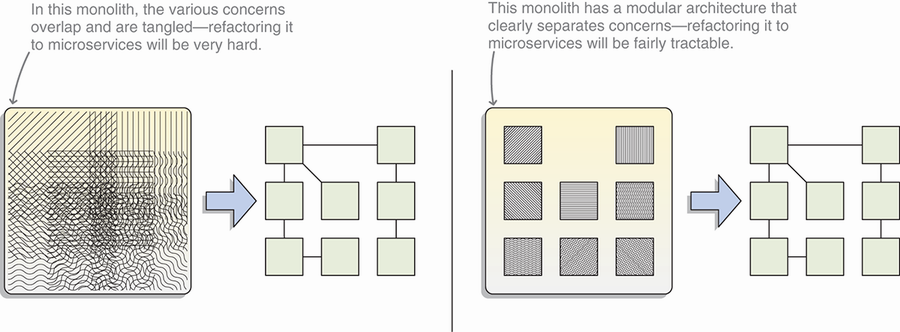 Figure 15.6 Given two hypothetical migrations of a monolithic application to microservices, would you rather start with a sizable square of mud (left) or a properly modularized code base (right)?
By focusing on modularity and clear boundaries from the outset, developers can ensure that their applications are well-prepared for future architectural changes, such as the adoption of microservices.
FAQ (Frequently asked questions)
What is microservices architecture?
How can the module system complement microservices?
What is the advantage of starting with a modularized code base when migrating to microservices?
When are the module system's benefits more pronounced?
Why is microservices architecture often used?
How can the module system aid in migrating to microservices?