Option Data Type
The Option data type is a functional programming construct designed to represent optional values in a safe and expressive manner. It is particularly useful in scenarios where data may be absent, such as querying a map or handling user input. By using the Option data type, developers can avoid the pitfalls of null references, which are a common source of errors in many programming languages, including Java.
Overview
The Option data type is implemented as an abstract class with two private subclasses: Some and None. These subclasses are used to indicate the presence or absence of data, respectively. The Some class represents a value that is present, while the None class represents the absence of a value. This design allows for safe composition of functions without the risk of encountering null references.
Option Class
The Option class provides a functional way to handle optional values. It is an abstract class with two private subclasses, Some and None, which represent the presence and absence of data, respectively. This structure allows developers to work with optional values without resorting to null checks, thereby reducing the likelihood of null pointer exceptions.
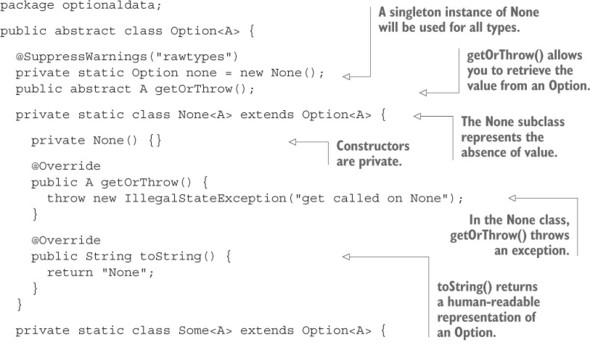 Listing 6.1. The Option data type
Applying Functions to Optional Values
Functions can be applied to optional values using methods such as map and flatMap. These methods enable the transformation and composition of optional values without the need for manual checks for data presence. The map method is used to apply a function to the value inside a Some, while flatMap is used for chaining operations that return Option values.
Dealing with Option Data Type
When dealing with the Option data type, several methods are available to safely handle optional values. The getOrElse method allows for the extraction of a value, providing a default if the value is absent. The map and flatMap methods facilitate the transformation and composition of values, ensuring that operations are performed safely without risking null references.
Use Cases
The Option data type is particularly useful in situations where data may or may not be present. Common use cases include:
- Safely handling optional values without null references.
- Composing functions that may or may not return a value.
- Querying data structures like maps where a key may not have an associated value.
- Handling user input where a value may be optional.
Composition
Composition with the Option data type involves chaining functions that return Option values. By using methods like map and flatMap, developers can build complex computations that handle optional values gracefully. This approach allows for the creation of robust and error-resistant code that can elegantly manage the presence or absence of data.
FAQ (Frequently asked questions)
How does the Option class handle optional values?
What is the Option data type in functional programming?
How does the Option data type help in function composition?
What subclasses does the Option data type use?
What is the purpose of the Option type in functional programming?
What are the subclasses of the Option type?
What is the structure of the Option class?
How can you apply functions to optional values in the Option data type?
What methods are used to handle Option composition?
How do these methods help in dealing with Option data type?
What are some use cases for the Option data type?
In what scenarios is the Option data type particularly useful?
How can you combine options using the Option data type?
What is the benefit of using map and flatMap with Option data type?