Primary in Java
The term "primary" in Java can refer to different concepts depending on the context in which it is used. Below, we explore two primary contexts: database management and the Spring Framework.
Primary in Database Management
In the context of databases, the term "primary" typically refers to the primary key. A primary key is a unique identifier for each record in a database table. It plays a crucial role in ensuring data integrity and establishing relationships between tables.
Importance of Primary Keys
-
Uniqueness: Each primary key value must be unique across the table. This uniqueness ensures that each record can be distinctly identified, which is essential for retrieving, updating, or deleting records without ambiguity.
-
Data Integrity: By enforcing uniqueness, primary keys help maintain data integrity. They prevent duplicate records and ensure that each entry in the table is distinct.
-
Relationships: Primary keys are fundamental in establishing relationships between tables in a relational database. They are often used as foreign keys in other tables, creating links between related data. This relational structure allows for complex queries and data manipulation across multiple tables.
-
Indexing: Most database systems automatically create an index on the primary key column. This indexing improves the speed and efficiency of data retrieval operations, as the database can quickly locate records based on the primary key.
In summary, the primary key is a foundational element in database design, critical for maintaining the integrity and relational structure of the data. For more details, refer to Java Persistence with Spring Data and Hibernate.
Primary in the Spring Framework
In the Spring Framework, the @Primary annotation is a powerful tool used to resolve ambiguity when multiple beans of the same type are present in the application context. It designates a bean as the default choice for autowiring, ensuring that Spring selects it when no specific bean name is provided.
Usage of @Primary
Bean Definition
When you have multiple beans of the same type, you can use the @Primary annotation to specify which bean should be preferred by default. This is particularly useful in scenarios where you want to avoid specifying bean names explicitly in your code. The following code snippet demonstrates how to define a primary bean:
@Bean
@Primary
Parrot parrot2() {
  var p = new Parrot();
  p.setName("Miki");
  return p;
}
In this example, if you refer to a Parrot without specifying a name, Spring will select the bean named "Miki" by default. It is important to note that only one bean of a particular type can be marked as primary.
Component Definition
The @Primary annotation can also be used in conjunction with the @Component annotation to mark a class's implementation as the default for dependency injection. This is particularly useful when you have multiple implementations of an interface and want to specify which one should be injected by default. Here is an example:
@Component
@Primary
public class CommentPushNotificationProxy
  implements CommentNotificationProxy {

  @Override
  public void sendComment(Comment comment) {
    System.out.println(
      "Sending push notification for comment: "
          + comment.getText());
  }
}
By adding @Primary to the CommentPushNotificationProxy class, it becomes the default implementation for the CommentNotificationProxy interface. This ensures that Spring injects this implementation unless another is explicitly specified.
Real-World Scenario
In real-world applications, you might encounter situations where a dependency provides an implementation for a specific interface, but it does not meet your requirements. In such cases, you can define your custom implementation and use @Primary to make it the default choice for dependency injection. This approach is illustrated in Figure 4.10:
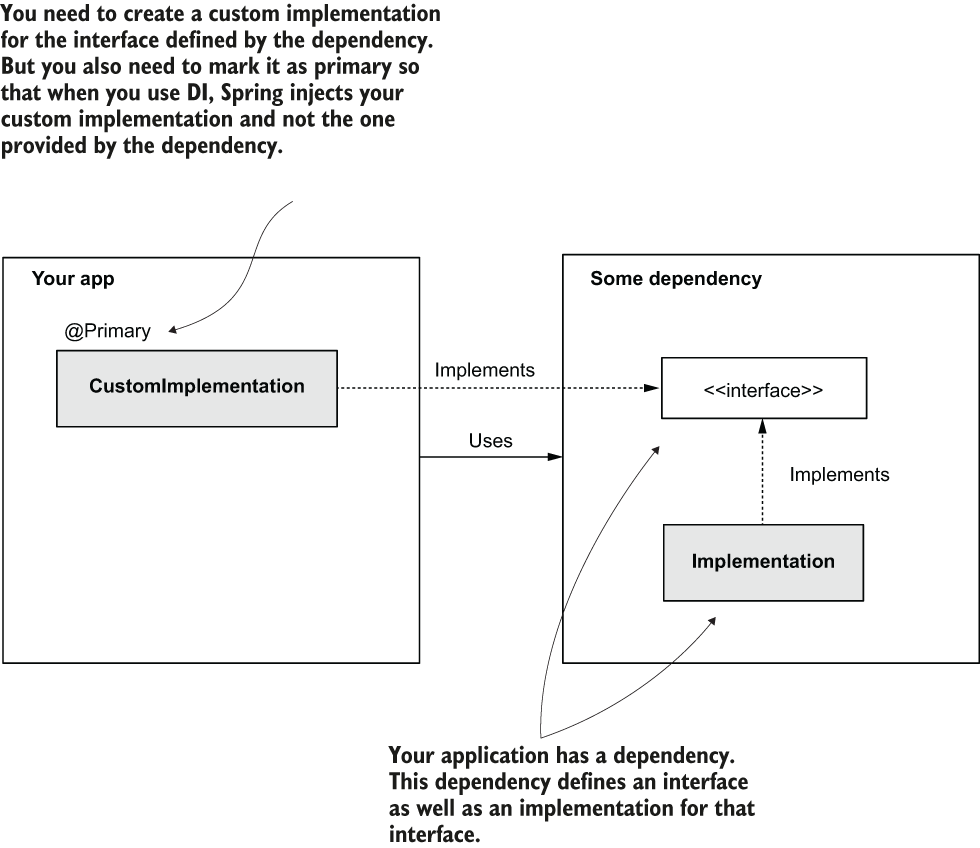 Figure 4.10 Sometimes you use dependencies that already provide implementations for specific interfaces. When you need to have custom implementations of those interfaces, you can use @Primary to mark your implementation as a default for DI. This way, Spring knows to inject the implementation you define and not the one provided by the dependency.
By using @Primary, you can ensure that your custom implementation is used by default, providing greater control over the behavior of your application. For more insights, see Spring Start Here.
| Book Title | Usage of primary | Technical Depth | Connections to Other Concepts | Examples Used | Practical Application |
|------------|------------------|-----------------|-------------------------------|---------------|-----------------------|
| [Java Persistence with Spring Data and Hibernate](https://www.manning.com/books/java-persistence-with-spring-data-and-hibernate) | Discusses the term "primary" in the context of databases, specifically focusing on primary keys as unique identifiers for records. [more](https://livebook.manning.com/book/java-persistence-with-spring-data-and-hibernate/chapter-9/19) | Explains the importance of primary keys in ensuring data integrity and establishing relationships between tables. [more](https://livebook.manning.com/book/java-persistence-with-spring-data-and-hibernate/chapter-9/19) | Connects primary keys to concepts like data integrity, relationships, and indexing in databases. [more](https://livebook.manning.com/book/java-persistence-with-spring-data-and-hibernate/chapter-9/19) | Provides examples of how primary keys are used to maintain uniqueness and establish relationships. [more](https://livebook.manning.com/book/java-persistence-with-spring-data-and-hibernate/chapter-9/19) | Highlights the practical application of primary keys in database design and management. [more](https://livebook.manning.com/book/java-persistence-with-spring-data-and-hibernate/chapter-9/19) |
| [Spring Start Here](https://www.manning.com/books/spring-start-here) | Explores the `@Primary` annotation in Spring Framework to resolve bean ambiguity by designating a default choice for autowiring. [more](https://livebook.manning.com/book/spring-start-here/chapter-2/46) | Details the use of `@Primary` in bean and component definitions to manage dependency injection. [more](https://livebook.manning.com/book/spring-start-here/chapter-2/46) | Links `@Primary` to dependency injection and interface implementation selection in Spring. [more](https://livebook.manning.com/book/spring-start-here/chapter-2/46) | Includes code snippets demonstrating the use of `@Primary` in bean and component definitions. [more](https://livebook.manning.com/book/spring-start-here/chapter-2/46) | Discusses real-world scenarios where `@Primary` is used to ensure custom implementations are injected by default. [more](https://livebook.manning.com/book/spring-start-here/chapter-2/46) |
FAQ (Frequently asked questions)
What does 'primary' refer to in the context of databases?
Why is a primary key important in databases?
What is the purpose of the @Primary annotation in Spring?
How does the @Primary annotation affect autowiring in Spring?