Providing in the Java Module System
Overview
In the Java Module System, providing a service involves a module declaring a provides directive in its module descriptor. This directive specifies the service type and the implementing class, allowing the module system to instantiate the provider at runtime. This mechanism is crucial for enabling service-oriented architecture within Java applications, allowing for a clean separation between service interfaces and their implementations.
Example: ServiceObserverFactory
To illustrate the concept of providing a service, consider the example of a ServiceObserverFactory interface. This interface is part of the monitor.observer module and includes a single method, createIfMatchingService, which expects a service URL and returns an Optional<ServiceObserver>.
In the modules monitor.observer.alpha and monitor.observer.beta, implementations of this interface are created. These implementations replace the static factory methods previously found in AlphaServiceObserver and BetaServiceObserver. This setup allows the modules to provide the ServiceObserverFactory as a service.
Module Graph
The module graph, as shown in Figure 10.5, demonstrates how the monitor module depends only on the module defining the service, which is observer. The providing modules, alpha and beta, are no longer directly required by monitor. This decoupling is a direct result of using the service provider mechanism in the Java Module System.
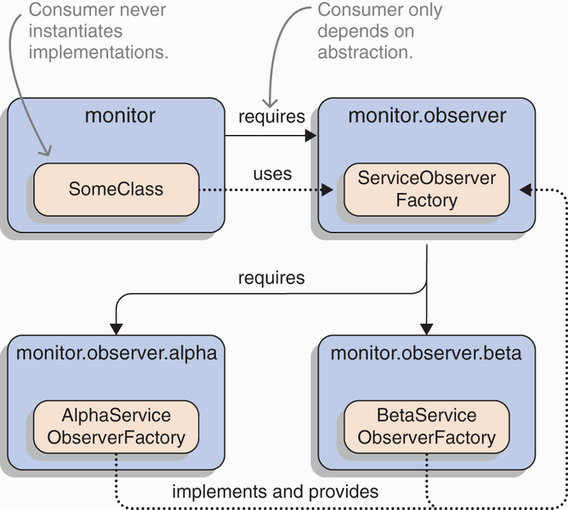 Figure 10.5 With services, monitor only depends on the module defining the service: observer. The providing modules, alpha and beta, are no longer directly required.
This approach not only simplifies the module dependencies but also enhances the modularity and flexibility of the application, allowing for easier maintenance and scalability.
FAQ (Frequently asked questions)
How do you provide a service in the Java Module System?
What does the provides directive specify in the Java Module System?
What is the role of the module system when a service is provided?