Proxy in Java
A "proxy" in Java is a design pattern and a concept used across various frameworks and libraries to control access to objects, manage method calls, and implement additional functionality such as lazy loading, method interception, and more. Below, we explore how proxies are utilized in different contexts within Java, as described in several Java books.
Proxy in Hibernate
In Hibernate, a proxy is a runtime-generated placeholder for an entity instance, primarily used to implement lazy loading. It acts as a stand-in for the actual entity and is initialized only when a non-identifier method is called, which triggers a database hit to load the data. This mechanism allows Hibernate to defer the loading of data until it is actually needed, optimizing performance and resource usage.
How Proxies Work
When an entity is loaded as a proxy, Hibernate creates a subclass of the entity class at runtime. This subclass carries the identifier value of the entity instance it represents. The proxy is initialized only when a method other than the identifier getter is called.
Item item = em.getReference(Item.class, ITEM_ID);      // No database hit
assertEquals(ITEM_ID, item.getId());                   // Identifier access doesn't trigger initialization
Persistence Context and Proxies
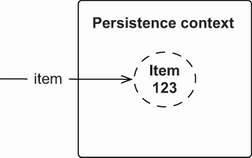
In the persistence context, proxies are maintained in a persistent state. Figure 12.1 illustrates how the persistence context, under the control of Hibernate, contains an Item proxy.
Initialization of Proxies
Hibernate provides utility methods for initializing proxies. The Hibernate.initialize() method can be used to manually initialize a proxy.
Hibernate.initialize(item); // Triggers database query to load Item data
Handling LazyInitializationException
A LazyInitializationException can occur if a method other than the identifier getter is called on a proxy in a detached state.
Item item = em.find(Item.class, ITEM_ID);
em.detach(item);
assertEquals(USER_ID, item.getSeller().getId());  // Safe in detached state
Proxy in Java and Clojure
In both Java and Clojure, proxies serve as a mechanism to provide access to methods, often as an alternative to reflection. They can be simpler to understand for basic use cases, but method handles offer a more efficient and flexible approach.
Java Proxies
In Java, proxies can be used to access private methods from outside a class through various techniques, including reflection, inner classes acting as proxies, and method handles.
public class ExamplePrivate {
    private void callThePrivate() {
        System.out.println("Private method");
    }
    // Methods to access the private method
}
Clojure Proxies
Clojure's (proxy) macro allows for the creation of Clojure objects that extend Java classes or implement interfaces, facilitating integration with Java code.
(def msgRdr (proxy [Runnable] [] (run [] (.println System/out (.toString (.poll lbq))))))
Proxy in Spring AOP
In the context of Spring AOP (Aspect-Oriented Programming), a proxy is a crucial concept that facilitates the weaving of aspects into the application. A proxy is essentially an object that Spring provides in place of the actual bean. This proxy object intercepts method calls and applies the aspect logic before delegating the call to the real method.
Weaving and Proxy Objects
When you define an aspect for a method, Spring provides a proxy object instead of a direct reference to the real bean. This proxy intercepts the method calls, applies the aspect logic, and then manages the call to the actual method.
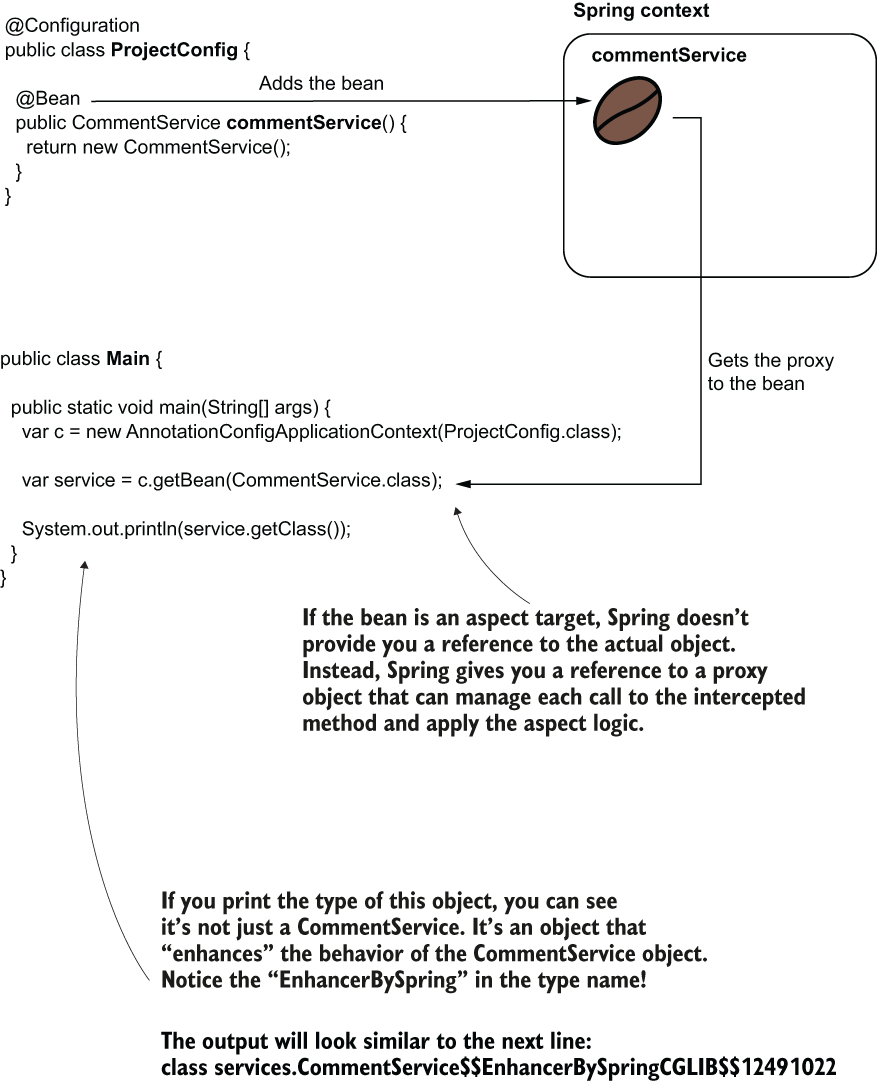
Method Call Interception: Method Call Interception](https://livebook.manning.com/book/spring-start-here/chapter-6/20)
When a method is aspected, the call is routed through the proxy object, which applies the logic defined by the aspect and then delegates the call to the real method.
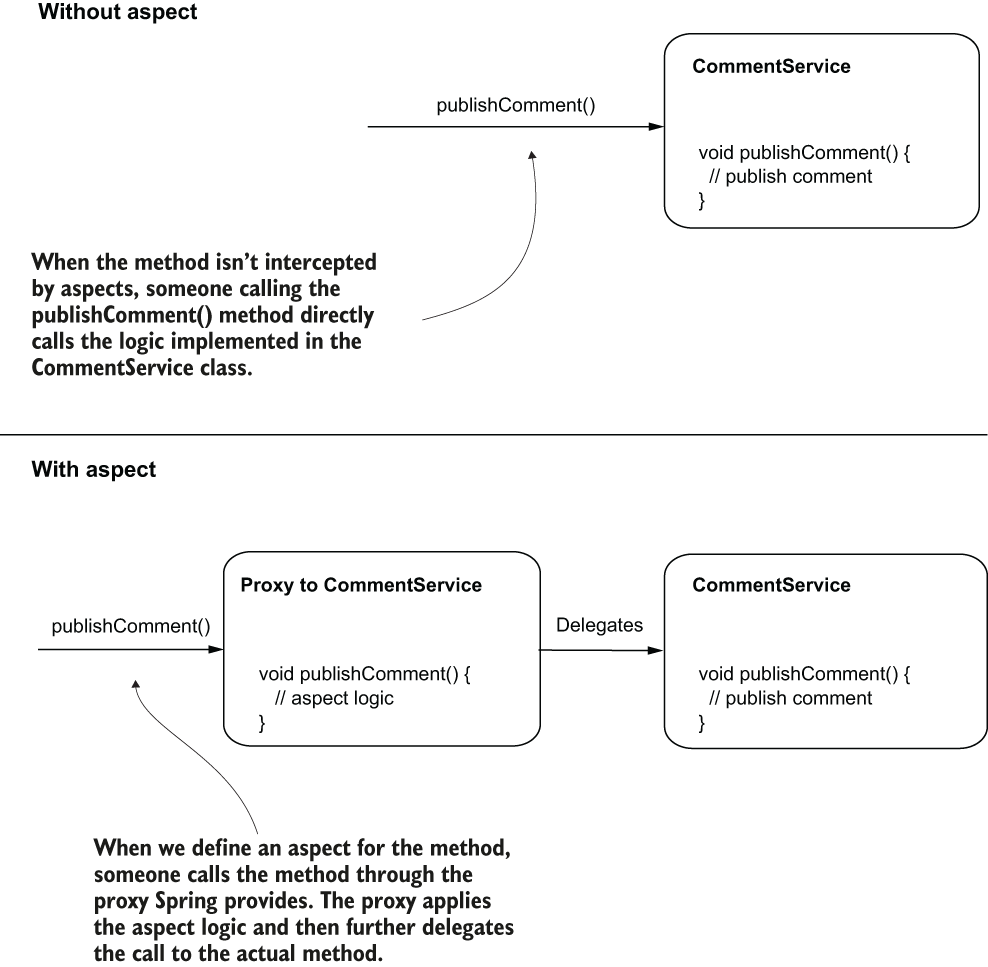
Understanding the role of proxies in Spring AOP is essential for effectively implementing aspects and managing cross-cutting concerns in a Spring application. The proxy mechanism ensures that aspect logic is applied consistently and transparently, enhancing the modularity and maintainability of the code.
In summary, proxies in Java are a versatile tool used across various frameworks to manage object access, implement lazy loading, and apply cross-cutting concerns. They provide a powerful mechanism for optimizing performance and enhancing the modularity of applications.
| Book Title | Usage of Proxy | Technical Depth | Connections to Other Concepts | Examples Used | Practical Application |
|------------|----------------|-----------------|-------------------------------|---------------|-----------------------|
| [Java Persistence with Spring Data and Hibernate](https://www.manning.com/books/java-persistence-with-spring-data-and-hibernate) | Proxies are used for lazy loading in Hibernate, acting as placeholders for entity instances. | Discusses runtime-generated subclasses and lazy loading mechanisms. | Connects to persistence context and lazy initialization exceptions. | Includes code snippets demonstrating proxy initialization and handling exceptions. | Focuses on optimizing performance and resource usage in data retrieval. [more](https://livebook.manning.com/book/java-persistence-with-spring-data-and-hibernate/chapter-12/23) |
| [The Well-Grounded Java Developer, Second Edition](https://www.manning.com/books/the-well-grounded-java-developer-second-edition) | Proxies provide access to methods, serving as an alternative to reflection in Java and Clojure. | Explores method handles and reflection techniques. | Links to method access and integration with Clojure. | Provides Java and Clojure code examples for method access. | Highlights seamless integration and experimentation with Java code in Clojure. [more](https://livebook.manning.com/book/the-well-grounded-java-developer-second-edition/chapter-10/370) |
| [Spring Start Here](https://www.manning.com/books/spring-start-here) | Proxies in Spring AOP intercept method calls to apply aspect logic. | Details the weaving process and method call interception. | Relates to aspect-oriented programming and cross-cutting concerns. | Illustrates with figures showing method call interception. | Emphasizes modularity and maintainability in Spring applications. [more](https://livebook.manning.com/book/spring-start-here/chapter-6/10) |
FAQ (Frequently asked questions)
What is a proxy in Hibernate?
How does a proxy act in Hibernate?
What does Figure 12.1 illustrate in the context of Hibernate?
What happens when you call em.getReference in Hibernate?
Does calling the identifier getter trigger initialization in Hibernate?
What is the purpose of Clojure's (proxy) macro?
How does Clojure's (proxy) macro support Java integration?
How do proxies compare to reflection in Java?
What are the advantages of method handles over proxies?
What is a proxy in Spring AOP?
How does a proxy work in Spring AOP?
What does Spring provide instead of a real bean?
How does Spring manage aspect logic?