Race Condition
Definition
A race condition occurs when multiple threads access shared resources simultaneously, leading to unpredictable results. This situation arises when multiple threads attempt to change the same resource concurrently, which can result in unexpected outcomes or exceptions. Proper synchronization, such as using locks, is necessary to prevent race conditions and ensure that only one thread can modify the shared resource at a time.
Example
Race conditions are a common issue in multithreaded applications. Consider the following example illustrated in Figure D.12:
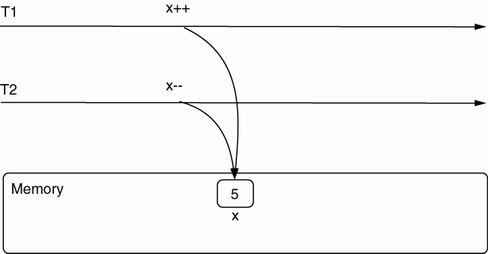 Figure D.12 A race condition. Multiple threads concurrently try to change a shared resource. In this example, threads T1 and T2 try to change the value of variable x simultaneously, which can result in different outputs.
In this scenario, threads T1 and T2 both attempt to modify the value of a shared variable x at the same time. Depending on the timing of their operations, the final value of x can vary. For instance, if both threads read the value of x simultaneously, but thread T1 writes its value last, the final value of x might be 6 (assuming T1 read the value 5 and added 1).
Such situations often lead to unexpected outputs. In a multithreaded architecture where multiple execution flows are possible, these scenarios can be challenging to reproduce. They may only occur in specific environments, complicating the investigation and resolution of the issue. Proper synchronization mechanisms are essential to avoid these unpredictable behaviors and ensure the correct functioning of the application.
FAQ (Frequently asked questions)
What is a race condition?
How can race conditions be prevented?
What happens when multiple threads change the same resource concurrently?
What is an example of a race condition?