Redis in Java
Redis is a powerful, in-memory key-value store that is widely used in Java applications for caching and other data storage needs. Its speed and efficiency make it an ideal choice for scenarios where quick access to data is crucial. Redis is often employed in microservices architectures and integration testing to simulate real-world caching scenarios, providing a reliable and high-performance solution for managing temporary data.
Redis in Spring Microservices
Redis is frequently used in microservices to enhance performance by caching data that would otherwise require repeated access to slower data sources. In the context of Spring Microservices, Redis is often employed as a distributed cache. For example, in the EagleEye application, Redis is used to cache organization data for the licensing service, reducing the need to repeatedly call the organization service for the same data. This setup is managed through Amazon ElastiCache, which provides a scalable and highly available Redis cluster.
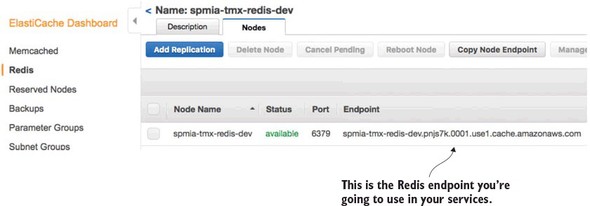 Figure 10.7. The Redis endpoint is the key piece of information your services need to connect to Redis.
Configuring Redis in Spring Applications
To integrate Redis with a Spring application, specific dependencies must be included in the pom.xml file, such as spring-data-redis, jedis, and commons-pool2. A JedisConnectionFactory is exposed as a Spring Bean to establish a connection to the Redis server, which is then used to create a RedisTemplate object for executing queries and saving data.
<dependency>
   <groupId>org.springframework.data</groupId>
   <artifactId>spring-data-redis</artifactId>
   <version>1.7.4.RELEASE</version>
</dependency>

<dependency>
  <groupId>redis.clients</groupId>
  <artifactId>jedis</artifactId>
  <version>2.9.0</version>
</dependency>

<dependency>
  <groupId>org.apache.commons</groupId>
  <artifactId>commons-pool2</artifactId>
  <version>2.0</version>
</dependency>
Spring Data Redis Repositories
Spring Data Redis repositories facilitate interaction with Redis by providing methods for saving, updating, deleting, and finding data. For instance, the OrganizationRedisRepository interface defines these methods, and its implementation uses the RedisTemplate to perform CRUD operations on the Redis server.
public interface OrganizationRedisRepository {
    void saveOrganization(Organization org);
    void updateOrganization(Organization org);
    void deleteOrganization(String organizationId);
    Organization findOrganization(String organizationId);
}
Redis in Java Applications
Redis can be accessed in Java applications using libraries such as Jedis. This allows developers to cache data efficiently, as demonstrated in the CachedPrice class, which uses Redis to cache price data.
public class CachedPrice implements Price {
    private final Price priceLookup;
    private final Jedis cacheClient;

    private static final String priceKey = "price";

    CachedPrice(Price priceLookup, Jedis cacheClient) {
        this.priceLookup = priceLookup;
        this.cacheClient = cacheClient;
    }

    @Override
    public BigDecimal getInitialPrice() {
        String cachedPrice = cacheClient.get(priceKey);
        if (cachedPrice != null) {
            return new BigDecimal(cachedPrice);
        }

        BigDecimal price = priceLookup.getInitialPrice();
        cacheClient.set(priceKey, price.toPlainString());
        return price;
    }
}
Docker and Redis
Docker can be used to manage the lifecycle of a Redis instance, making it easy to integrate Redis into an application. A simple Docker Compose configuration can set up a Redis service alongside an application, allowing seamless interaction with Redis for caching and data storage.
version: "3.9"
services:
  app:
    build: .
    ports:
      - "8080:8080"
  redis:
    image: "redis:alpine"
Testing with Redis
Testing the interaction between Redis and an application can be achieved using Testcontainers, which allows for testing against a real Redis instance. This approach ensures that the application behaves correctly in a production-like environment.
@Testcontainers
public class CachedPriceTest {
    private static final DockerImageName imageName = DockerImageName.parse("redis:6.2.3-alpine");

    @Container
    public static GenericContainer redis = new GenericContainer(imageName).withExposedPorts(6379);

    @Test
    public void cached() {
        var jedis = getJedisConnection();
        jedis.set("price", "20");

        CachedPrice price = new CachedPrice(new StubPrice(), jedis);
        BigDecimal result = price.getInitialPrice();

        assertEquals(new BigDecimal("20"), result);
    }

    private Jedis getJedisConnection() {
        HostAndPort hostAndPort = new HostAndPort(redis.getHost(), redis.getFirstMappedPort());
        return new Jedis(hostAndPort);
    }
}
Redis is a versatile tool in the Java ecosystem, providing fast and efficient data storage solutions for a variety of applications, from microservices to integration testing. Its integration with Java is facilitated by libraries like Jedis and frameworks like Spring, making it a valuable asset for developers seeking to optimize data access and performance.
| Book Title | Usage of redis | Technical Depth | Connections to Other Concepts | Examples Used | Practical Application |
|------------|----------------|-----------------|-------------------------------|---------------|-----------------------|
| [Spring Microservices in Action](https://www.manning.com/books/spring-microservices-in-action) | Redis is used as a distributed cache for microservices, specifically for caching organization data in the licensing service. [more](https://livebook.manning.com/book/spring-microservices-in-action/chapter-8/162) | Discusses integration with Spring, using `spring-data-redis`, `jedis`, and `commons-pool2`. [more](https://livebook.manning.com/book/spring-microservices-in-action/chapter-8/162) | Connects Redis with Kafka for cache invalidation and data consistency. [more](https://livebook.manning.com/book/spring-microservices-in-action/chapter-8/156) | Provides code examples for setting up Redis connections and repositories. [more](https://livebook.manning.com/book/spring-microservices-in-action/chapter-8/165) | Focuses on using Redis for performance improvement in microservices. [more](https://livebook.manning.com/book/spring-microservices-in-action/chapter-8/156) |
| [The Well-Grounded Java Developer, Second Edition](https://www.manning.com/books/the-well-grounded-java-developer-second-edition) | Redis is used for caching and integration testing, simulating real-world scenarios. [more](https://livebook.manning.com/book/the-well-grounded-java-developer-second-edition/chapter-14/15) | Covers using Redis with Docker and Java libraries like Jedis. [more](https://livebook.manning.com/book/the-well-grounded-java-developer-second-edition/chapter-14/18) | Integrates Redis with Docker for lifecycle management and testing with Testcontainers. [more](https://livebook.manning.com/book/the-well-grounded-java-developer-second-edition/chapter-12/178) | Includes code snippets for caching with Redis and testing with Testcontainers. [more](https://livebook.manning.com/book/the-well-grounded-java-developer-second-edition/chapter-14/18) | Demonstrates Redis usage in Java applications for caching and testing. [more](https://livebook.manning.com/book/the-well-grounded-java-developer-second-edition/chapter-14/18) |
FAQ (Frequently asked questions)
What happens if the price is not found in the Redis cache?
How can I set up a Redis service using Docker Compose?
What is Redis used for?
Why is Redis often used in integration testing?
How does the CachedPrice class use Redis?
What library is used to access Redis in the CachedPrice class?
How do you construct a database connection to a Redis server in Spring?
How is Redis used in the licensing service?
What happens when data is updated in the organization service?
What dependencies are needed to configure the licensing service with Redis?
What is Redis and how is it used in the licensing service?
Why is Redis used as a distributed cache in the licensing service?
How are Spring Data Redis repositories used to interact with Redis?
What classes are used to perform CRUD operations on Redis data?
How does the licensing service use Redis to manage organization data?
What happens when an organization is updated or deleted in the licensing service?
How is Redis used in the EagleEye licensing service?
What does the chapter cover regarding Redis cluster setup?
How is a Redis cluster set up using Amazon ElastiCache?