Relationship in Java
In Java, the concept of "relationship" is fundamental when dealing with object-oriented programming and database management. Relationships define how entities or objects interact with each other, and they are crucial for modeling real-world scenarios in software applications. This entry synthesizes information from various Java books to provide a comprehensive understanding of how relationships are managed in Java, particularly in the context of Spring Data JDBC and Spring Data JPA.
Relationship Management in Spring Data JDBC
Spring Data JDBC offers a streamlined approach to managing relationships between entities. It simplifies the process by using specific annotations and design patterns, providing an alternative to the more complex Java Persistence API (JPA).
Overview of Relationships
Spring Data JDBC uses the @MappedCollection annotation to manage one-to-one and one-to-many relationships. This annotation is applied to collections within an entity class to define the relationship with another entity. For many-to-many relationships, intermediary classes are used to represent join tables, which simplifies the management of complex relationships.
Associations with Spring Data JDBC
- One-to-One and One-to-Many Relationships: Managed using the
@MappedCollectionannotation, which specifies the foreign key column in the 'many' side table. - Many-to-Many Relationships: Handled by creating an intermediary class to represent the join table, with the main entity class using the
@MappedCollectionannotation to manage the relationship.
Embedded Entities
Spring Data JDBC supports embedded entities through the @Embedded annotation. This allows the fields of one entity to be included within another entity's table, reducing the number of tables in the database schema and improving performance by minimizing joins.
Relationship Management in Spring Data JPA
In Spring Data JPA, managing domain object relationships is essential for working with relational databases. This involves defining and handling various types of relationships between entities, such as one-to-one, one-to-many, many-to-one, and many-to-many.
Many-to-Many Relationships
Many-to-many relationships are common in database management, where multiple records in one table are associated with multiple records in another table. For example, the relationship between Course and Author entities, where an author can write multiple courses, and a course can be written by multiple authors.
Entity-Relationship Diagram
To manage a many-to-many relationship, three tables are typically needed: one for each entity and a third to manage the relationship between them. Below is an entity-relationship (ER) diagram illustrating this setup:
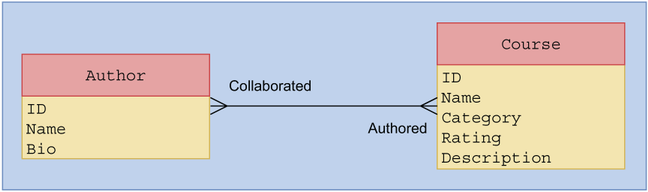 Figure 3.7 Author and Course entity–relationship diagram.
Implementing Many-to-Many Relationships
In Spring Data JPA, a many-to-many relationship is implemented using the @ManyToMany annotation, in conjunction with @JoinTable to specify the relationship table and the join columns.
Testing Many-to-Many Relationships
To ensure that many-to-many relationships are correctly implemented, unit tests can be written. Below is a test case that validates the many-to-many relationship between authors and courses:
package com.manning.sbip.ch03;

// Import Statements are excluded as a matter of readability

@SpringBootTest
class CourseTrackerSpringBootApplicationTests {

    @Autowired
    private AuthorRepository authorRepository;

    @Test
    public void whenCountAllCoursesThenExpectFiveCourses() {
        assertThat(authorRepository.getAuthorCourseInfo(2)).hasSize(3));
    }
}
This test case uses the getAuthorCourseInfo(..) method of the AuthorRepository to fetch courses authored by a specific author, confirming that the relationship is correctly established and managed.
By understanding and utilizing these concepts, developers can effectively manage relationships in Java applications, ensuring robust and efficient data handling.
| Book Title | Usage of Relationship | Technical Depth | Connections to Other Concepts | Examples Used | Practical Application |
|------------|-----------------------|-----------------|-------------------------------|---------------|-----------------------|
| [Java Persistence with Spring Data and Hibernate](https://www.manning.com/books/java-persistence-with-spring-data-and-hibernate) | Discusses managing relationships using annotations like `@MappedCollection` for one-to-one and one-to-many relationships, and intermediary classes for many-to-many relationships. [more](https://livebook.manning.com/book/java-persistence-with-spring-data-and-hibernate/chapter-15/94) | Focuses on simplifying relationship management compared to JPA, emphasizing clarity and ease of use. [more](https://livebook.manning.com/book/java-persistence-with-spring-data-and-hibernate/chapter-15/94) | Connects to concepts like embedded entities using `@Embedded` to reduce table count and improve performance. [more](https://livebook.manning.com/book/java-persistence-with-spring-data-and-hibernate/chapter-15/111) | Provides examples of using `@MappedCollection` for defining foreign keys in relationships. [more](https://livebook.manning.com/book/java-persistence-with-spring-data-and-hibernate/chapter-15/123) | Highlights practical use in simplifying the data access layer while maintaining relational database flexibility. [more](https://livebook.manning.com/book/java-persistence-with-spring-data-and-hibernate/chapter-15/94) |
| [Spring Boot in Practice](https://www.manning.com/books/spring-boot-in-practice) | Covers managing domain object relationships using annotations like `@ManyToMany`, `@JoinTable`, and `@JoinColumn`. [more](https://www.manning.com/books/spring-boot-in-practice) | Provides detailed explanation of many-to-many relationships and their implementation in Spring Data JPA. [more](https://www.manning.com/books/spring-boot-in-practice) | Discusses entity-relationship diagrams and the use of relationship tables in database management. [more](https://www.manning.com/books/spring-boot-in-practice) | Includes a unit test example to validate many-to-many relationships between entities like `Author` and `Course`. [more](https://www.manning.com/books/spring-boot-in-practice) | Demonstrates practical testing of relationships to ensure correct implementation in applications. [more](https://www.manning.com/books/spring-boot-in-practice) |
FAQ (Frequently asked questions)
How are relationships managed in Spring Data JDBC?
What is an alternative to JPA for managing database relationships?
How does Spring Data JDBC model a one-to-one relationship?
Does Spring Data JDBC use JPA annotations for relationships?
How are embedded entities modeled in Spring Data JDBC?
What is the benefit of using embedded entities in Spring Data JDBC?
How is a one-to-many relationship modeled in Spring Data JDBC?
What does the @MappedCollection annotation specify in a one-to-many relationship?
How are many-to-many relationships modeled in Spring Data JDBC?
What role does an intermediary class play in a many-to-many relationship in Spring Data JDBC?