Run in Functional Programming in Java
In the context of functional programming in Java, the concept of "run" is utilized in various ways to execute or manage the flow of a program. Below are the different contexts and implementations where "run" is applied:
Stack-Safe Run Method
The stack-safe run method is illustrated in the figure below. This method is designed to prevent stack overflow errors by managing the execution stack efficiently.
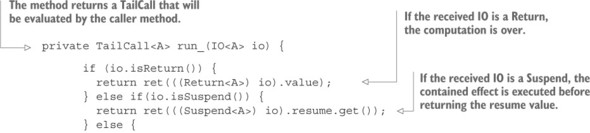 Listing 13.16. The stack-safe run method
Executing a Program
To execute a program, you can use the run method as follows:
program.run();
However, it is important to note that many code-checker programs may not approve of calling run on a Runnable. To address this, an Executable interface was introduced in previous chapters to perform similar operations.
IO Interface
A new interface named IO is introduced, which includes a run method. This interface is initially similar to Runnable:
public interface IO {
  void run();
}
The IO interface is designed to provide more powerful capabilities than Runnable, allowing for more complex operations and interactions.
State Class and Run Function
In functional programming, composition is often preferred over inheritance. The State class is defined using a delegate, which includes a run function:
public class State<S, A> {

  public final Function<S, Tuple<A, S>> run;

  public State(Function<S, Tuple<A, S>> run) {
    super();
    this.run = run;
  }
}
This run function is a core component of the State class, enabling the execution of state transformations.
Random Class as a Specific Case of State
The Random class is redefined as a specific case of the State class, utilizing the run function:
public class Random<A> extends State<RNG, A> {

  public Random(Function<RNG, Tuple<A, RNG>> run) {
    super(run);
  }
}
This implementation demonstrates how the run function can be adapted for specific use cases, such as generating random numbers within a functional programming paradigm.
FAQ (Frequently asked questions)
What is the purpose of the stack-safe run method in functional programming?
How does the stack-safe run method improve Java programs?