Scala
Scala is a versatile programming language that seamlessly integrates object-oriented and functional programming paradigms. It offers a rich set of features that make it a powerful tool for developers looking to leverage both styles of programming.
Overview
Scala is designed to be a full object-oriented language while also supporting functional programming features. It includes first-class functions, anonymous functions, closures, and currying, providing a richer set of features for functions compared to Java. Scala's syntax is concise, especially when working with collections, and it supports constructs like Option and Stream for functional-style programming.
Functional Programming in Scala
Scala's functional programming capabilities are extensive. Functions in Scala are first-class citizens, meaning they can be passed as arguments, returned from functions, and assigned to variables. This is similar to other data types like integers and strings. Scala also supports closures, which are functions that capture the environment in which they were created, allowing them to access and modify nonlocal variables. This is a step beyond Java, where lambda expressions can only capture final or effectively final variables.
Anonymous Functions
Anonymous functions in Scala are akin to Java's lambda expressions. They allow developers to define functions without naming them, and these functions can capture variables themselves, not just their values.
Currying
Currying is a technique in Scala where a function of multiple arguments is transformed into a series of functions, each taking a single argument. Scala provides syntax to easily define curried functions, enhancing the flexibility and reusability of code.
Data Structures and Collections
Scala supports a variety of data structures such as List, Set, Map, Tuple, Stream, and Option. These structures are designed to be concise and support both mutable and immutable types. Collections in Scala are immutable by default, meaning they cannot be changed after creation. This immutability helps reduce implicit data dependencies and ensures consistent access to collection elements.
Creating Collections
Creating collections in Scala is straightforward and concise. For example, a Map can be created with Map("Raoul" -> 23, "Mario" -> 40, "Alan" -> 53), and a List with List("Raoul", "Mario", "Alan").
Streams
Scala's Stream is a lazily evaluated data structure that can represent infinite sequences. Unlike Java's Stream, Scala's Stream can remember computed values and is indexed, but it is less memory-efficient.
Option
Scala's Option is a data structure used to represent optional values, similar to Java's Optional. It provides methods like filter, flatMap, map, and getOrElse to handle optional values safely.
Object-Oriented Features
Scala is a full object-oriented language that supports implicit constructors, getters, and setters, reducing the need for boilerplate code compared to Java. Scala classes are similar to Java classes but offer more flexibility. They can have implicit constructors, getters, and setters, and Scala supports traits, which are more powerful than Java interfaces. Traits can define both abstract methods and methods with default implementations, and they can be multiply inherited.
Example of a Scala Class
An example of a Scala class is class Student(var name: String, var id: Int), which automatically provides a constructor, getters, and setters.
Example Code
Here is an example of Scala code that demonstrates filtering and processing a list of tweets:
def isJavaMentioned(tweet: String) : Boolean = tweet.contains("Java")
def isShortTweet(tweet: String) : Boolean = tweet.length() < 20

val tweets = List(
    "I love the new features in Java",
    "How's it going?",
    "An SQL query walks into a bar, sees two tables and says 'Can I join you?'"
)
tweets.filter(isJavaMentioned).foreach(println)
tweets.filter(isShortTweet).foreach(println)
Figure
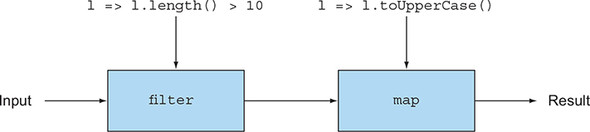 Figure 20.1. Streamlike operations with Scala’s List
This figure illustrates how Scala's List can be used to perform streamlike operations, showcasing the language's ability to handle collections in a functional style.
FAQ (Frequently asked questions)
What is Scala's Option used for?
What methods does Scala's Option provide?
What programming paradigms does Scala combine?
What features does Scala support?
What does the 'Hello beer' example in Scala demonstrate?
How does the 'Hello beer' example use a while loop?
How does the 'Hello beer' example use a range with foreach?
How can the 'Hello beer' example be written functionally in Scala?
What programming style does Scala use in the 'Hello beer' example?
What data structures does Scala support?
Are Scala's data structures mutable or immutable?
How can you create a Map in Scala?
How can you create a List in Scala?
Are Scala collections mutable or immutable by default?
What is the benefit of immutability in Scala collections?
What is the difference between unmodifiable collections in Java and immutable collections in Scala?
Why are immutable collections in Scala beneficial?
How are Scala collections similar to Java's collections?
What operations do Scala collections support?
What are tuples in Scala?
How can you create a tuple in Scala?
How do you access elements in a Scala tuple?
What is Scala's Stream?
How does Scala's Stream differ from Java's Stream?
What functional programming features does Scala support?
How does Scala's support for functions compare to Java's?
How can you filter a list of tweets in Scala?
What is an example of a Scala function to check if a tweet mentions Java?
What does it mean for functions to be first-class citizens in Scala?
What are closures in Scala?
How do closures in Scala differ from Java's lambda expressions?
What are anonymous functions in Scala?
Can anonymous functions in Scala capture variables?
What is currying in Scala?
How does Scala support curried functions?
What kind of language is Scala?
What features does Scala offer for object-oriented programming?
What is an example of a Scala class?
How do Scala classes reduce verbosity compared to Java?
What are traits in Scala?
How are getters generated in Scala classes?
Why does Scala reduce the need for boilerplate code?
How are setters generated in Scala classes?
What are Scala traits used for?
How do Scala traits differ from Java interfaces?