Sequence in Java
In Java, the concept of a "sequence" is a versatile abstraction used in various programming paradigms, particularly in functional programming. It provides a way to handle collections and iterators efficiently, often emphasizing immutability and lazy evaluation. Sequences are integral to both functional programming and languages that support functional paradigms, such as Clojure and Kotlin.
Sequences in Functional Programming
In functional programming, sequences are used to transform and combine lists of computational contexts into a single context that contains a list. This is particularly useful when dealing with types like Option, Result, and Random, which encapsulate computations that may fail, succeed, or produce random values, respectively.
Sequence with Option
The sequence function for Option transforms a List<Option<T>> into an Option<List<T>>. It returns Some<List<T>> if all elements in the list are Some, and None if any element is None. This ensures that the entire operation is successful only if all individual computations are successful.
Implementation
<A> Option<List<A>> sequence(List<Option<A>> list) {
  return list.foldRight(some(List.list()),
                             x -> y -> map2(x, y, a -> b -> b.cons(a)));
}
Sequence with Result
Similarly, the sequence function for Result transforms a List<Result<T>> into a Result<List<T>>. It results in a Success<List<T>> if all values in the original list are Success instances, or a Failure<List<T>> otherwise. This is useful for error handling, as it aggregates results and propagates the first encountered failure.
Implementation
public static <A> Result<List<A>> sequence(List<Result<A>> list) {
  return list.foldRight(Result.success(List.list()),
                  x -> y -> Result.map2(x, y, a -> b -> b.cons(a)));
}
Sequence with Random
The sequence method for Random instances transforms a list of Random computations into a single Random instance that produces a list of results. This abstracts the process of combining multiple random computations into one, allowing for the generation of complex random structures.
Implementation
static <A> Random<List<A>> sequence(List<Random<A>> rs) {
  return rs.foldLeft(unit(List.list()), acc -> r ->
                              map2(r, acc, x -> y -> y.cons(x)));
}
Sequences in Clojure and Kotlin
Clojure Sequences
In Clojure, a sequence (or seq) is a core abstraction that combines features of collections and iterators in Java. Sequences are immutable and support lazy sequences, meaning elements are generated on demand rather than stored in memory. This allows for efficient handling of potentially infinite sequences.
Clojure's ISeq Interface
interface ISeq {
    Object first();      #1
    ISeq rest();         #2
}
#1 Returns the object that is first in the seq
#2 Returns a new seq that contains all the elements of the old seq, except the first
Example: Lazy Sequence in Clojure
(defn next-big-n [n] (let [new-val (+ 1 n)]
  (lazy-seq                                         #1
    (cons new-val (next-big-n new-val))             #2
  )))

(defn natural-k [k]
  (concat [k] (next-big-n k)))                      #3

1:57 user=> (take 10 (natural-k 3))
(3 4 5 6 7 8 9 10 11 12)
#1 lazy-seq marker
#2 Infinite recursion
#3 concat constrains recursion.
Kotlin Sequences
In Kotlin, sequences provide a way to handle potentially infinite or large collections lazily. They allow for operations to be performed on elements as they are needed, rather than eagerly processing the entire collection at once.
Example: Lazy Sequence in Kotlin
val seq = sequenceOf(1, 2, 3)
val result = seq
    .map { println("1@ $it"); it.toString() }
    .map { println("2@ $it"); it + it }           #1
    .map { println("3@ $it"); it.toInt() }
    .toList()
#1 Note that + here is string concatenation, not numeric addition.
Sequence Execution
The execution of sequences can be visualized as each element going through the map chain individually. This is depicted in Figure 15.2:
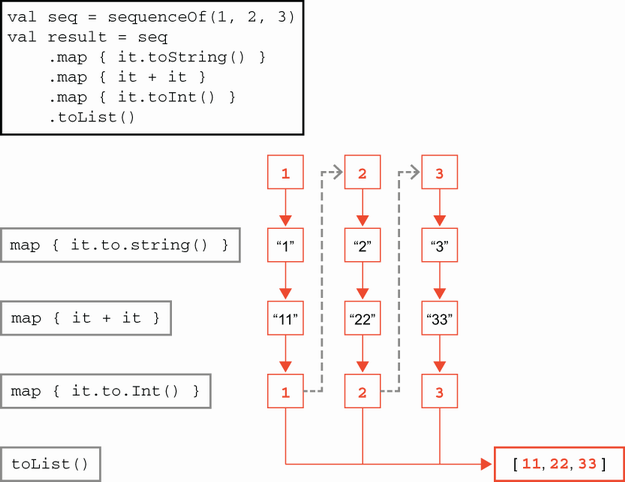 Figure 15.2 Sequence execution
Each element of the sequence is processed through the map operations one by one, demonstrating the lazy nature of sequences.
In summary, sequences in Java and related languages provide a powerful abstraction for handling collections, enabling efficient and expressive code through lazy evaluation and functional programming techniques.
| Book Title | Usage of Sequence | Technical Depth | Connections to Other Concepts | Examples Used | Practical Application |
|------------|-------------------|-----------------|-------------------------------|---------------|-----------------------|
| [The Well-Grounded Java Developer, Second Edition](https://www.manning.com/books/the-well-grounded-java-developer-second-edition) | Discusses sequences as a powerful abstraction in Clojure and Kotlin, emphasizing immutability and lazy evaluation. [more](https://livebook.manning.com/book/the-well-grounded-java-developer-second-edition/chapter-10/281) | Explores the `ISeq` interface in Clojure and lazy sequences in Kotlin, providing a deep dive into sequence execution. [more](https://livebook.manning.com/book/the-well-grounded-java-developer-second-edition/chapter-15/350) | Connects sequences to functional programming principles, collections, and iterators. [more](https://livebook.manning.com/book/the-well-grounded-java-developer-second-edition/chapter-15/298) | Provides examples of lazy sequences in both Clojure and Kotlin, demonstrating their creation and execution. [more](https://livebook.manning.com/book/the-well-grounded-java-developer-second-edition/chapter-10/281) | Highlights practical applications in handling potentially infinite sequences and efficient memory usage. [more](https://livebook.manning.com/book/the-well-grounded-java-developer-second-edition/chapter-15/350) |
| [Functional Programming in Java: How functional techniques improve your Java programs](https://www.manning.com/books/functional-programming-in-java) | Describes sequence as a tool for transforming and combining lists of computational contexts like `Option`, `Result`, and `Random`. [more](https://livebook.manning.com/book/functional-programming-in-java/chapter-12/106) | Provides detailed implementations of sequence functions for `Option`, `Result`, and `Random`, using `foldRight` and `map2`. [more](https://livebook.manning.com/book/functional-programming-in-java/chapter-6/240) | Links sequences to error handling, optional data processing, and random computations. [more](https://livebook.manning.com/book/functional-programming-in-java/chapter-8/86) | Includes Java code examples for sequence functions, demonstrating their use in functional programming. [more](https://livebook.manning.com/book/functional-programming-in-java/chapter-12/124) | Emphasizes the role of sequences in simplifying error handling and enhancing code expressiveness. [more](https://livebook.manning.com/book/functional-programming-in-java/chapter-12/106) |
FAQ (Frequently asked questions)
What is a sequence in Clojure?
How do Clojure sequences handle immutability?
What programming principles are Clojure sequences based on?
What are sequences in Kotlin used for?
How do Kotlin sequences improve performance?
How can you create a sequence in Kotlin?
What operations can be performed on a Kotlin sequence?
How do you convert a Kotlin sequence to a list?
What is the purpose of sequences in Clojure?
How do lazy sequences work in Clojure?
What is an example of a lazy sequence in Clojure?
How does the next-big-n function in Clojure work?
What does the natural-k function do in Clojure?
What does the sequence function do with a List<Option>?
How is the sequence function implemented for List<Option> in Java?
How does the sequence function work with List<Result>?
What is the Java implementation of the sequence function for List<Result>?
What is the purpose of the sequence method in composing state operations?
How is the sequence method implemented for List<Random> in Java?