Service in Java
In Java, the term "service" is used in various contexts, each with its own specific meaning and application. Generally, a service is a software component designed to perform specific tasks and is capable of communicating with other services. This concept is central to several Java frameworks and architectures, including microservices, the Java Module System, and Spring Boot. Below, we explore the concept of a service in these different contexts.
Service in Microservices Architecture
In a microservices architecture, a service is a self-contained, independently deployable unit that encapsulates specific business logic and data. These services are designed to perform specific business functions and interact with other services through well-defined interfaces. The architecture promotes configurability, transparency, and healthy communication among services, which are typically small in size and scope. However, this distributed nature introduces more moving parts, requiring effective management tools.
-
Service Responsibilities: As new functionalities are requested, the responsibilities of a service may evolve. This often leads to a single service growing into multiple services, with the original service potentially acting as an orchestration layer. A service with too many responsibilities may have a complicated flow of business logic and manage data across many tables, indicating that it may need to be broken down into smaller, more manageable services.
-
Service Communication: Services can communicate either synchronously or asynchronously to fulfill business processes. Tools like Spring Cloud Stream allow services to produce or consume messages through a message broker, enabling decoupled and scalable interactions. Service discovery and load balancing are facilitated by tools like Eureka, which enable automatic discovery and load balancing of services.
-
Security and Configuration: Services can be protected using OAuth2 authentication, requiring tokens for access. Configuration management is also crucial, with services calling configuration service endpoints to retrieve configuration data during the bootstrapping phase.
-
Service Implementation Example: The
LicenseServiceclass in a Spring application encapsulates business logic and interacts with repositories to perform operations. It uses Spring's dependency injection to manage components. -
Deployment and Monitoring: Services can be started in environments like Amazon ECS using command-line tools. Distributed tracing and tools like Zipkin help in monitoring and analyzing service interactions.
Service in the Java Module System
In the Java Module System, a service is a type, typically an interface or an abstract class, that defines a contract for functionality. This contract allows for multiple implementations, known as providers, to be developed independently of the consumers that use them. The primary goal of services is to decouple consumers from specific implementations, which can also help in breaking dependency cycles.
-
Key Concepts:
- Service Interface: Defined as an interface or an abstract class, allowing for multiple providers to implement the service.
- Providers: Implementations of the service interface, declared using the
providesdirective in a module declaration. - Consumers: Modules that use a service, declared with the
usesdirective, and utilize theServiceLoaderto load and access implementations.
-
ServiceLoader API: Facilitates the dynamic loading of service implementations at runtime, allowing for flexible and decoupled application architectures.
-
Figures:
 - Demonstrates the use of services with the
providesandusesdirectives.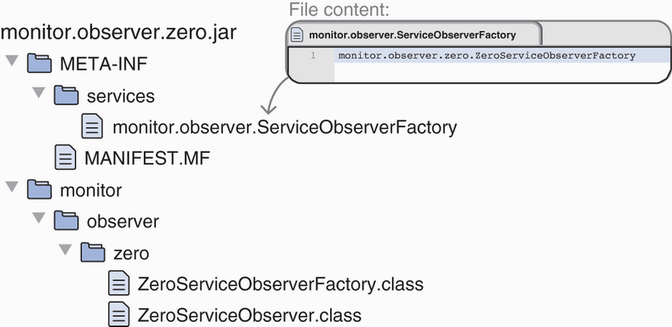 - Shows how to declare service providers without module declarations.
Service in Spring Boot
In Spring Boot, a service is a component that encapsulates the business logic of an application. It acts as an intermediary between the controller and the data access layer, processing data and making decisions based on the application's requirements. Services are typically annotated with @Service, which is a specialization of the @Component annotation, indicating that the class is a service provider.
-
Example: CourseServiceImpl Class: This class implements the
CourseServiceinterface and manages course-related operations. It is annotated with@Serviceto indicate its role and uses@Autowiredto inject theCourseRepositoryfor database operations. -
Key Annotations and Methods:
- @Service Annotation: Marks the class as a service component in the Spring context.
- @Autowired Annotation: Injects dependencies like repositories to perform database operations.
- CRUD Operations: Methods to create, read, update, and delete courses, demonstrating how a service can handle business logic and interact with the data access layer.
Service in Troubleshooting Java
In the context of troubleshooting Java applications, a service is often used interchangeably with "app" or "application," particularly when referring to microservices. Microservices are a popular architectural style that structures an application as a collection of loosely coupled services, each responsible for a distinct function or process within the larger system. This approach allows for greater flexibility, scalability, and ease of maintenance, as each service can be developed, deployed, and scaled independently.
In summary, the concept of a service in Java is versatile and integral to various frameworks and architectures, each leveraging the idea of encapsulating functionality and promoting modular, scalable, and maintainable software design.
| Book Title | Usage of Service | Technical Depth | Connections to Other Concepts | Examples Used | Practical Application |
|------------|------------------|-----------------|-------------------------------|---------------|-----------------------|
| [Spring Microservices in Action](https://www.manning.com/books/spring-microservices-in-action) | Discusses services as self-contained units in microservices architecture, focusing on business logic and data encapsulation. [more](https://livebook.manning.com/book/spring-microservices-in-action/chapter-4/1) | Covers service discovery, configuration, communication, and security in depth. [more](https://livebook.manning.com/book/spring-microservices-in-action/chapter-3/27) | Connects services to concepts like service discovery, load balancing, and OAuth2 protection. [more](https://livebook.manning.com/book/spring-microservices-in-action/chapter-4/39) | Provides examples like the `LicenseService` class and its implementation. [more](https://livebook.manning.com/book/spring-microservices-in-action/chapter-3/106) | Discusses deployment in Amazon ECS and monitoring with Zipkin. [more](https://livebook.manning.com/book/spring-microservices-in-action/chapter-10/275) |
| [The Java Module System](https://www.manning.com/books/the-java-9-module-system) | Defines services as interfaces or abstract classes in the Java Module System, focusing on decoupling consumers from implementations. [more](https://livebook.manning.com/book/the-java-9-module-system/chapter-10/1) | Explores service declaration, usage, and the ServiceLoader API. [more](https://livebook.manning.com/book/the-java-9-module-system/chapter-10/171) | Links services to module declarations and the ServiceLoader utility. [more](https://livebook.manning.com/book/the-java-9-module-system/chapter-10/29) | Uses examples like `ServiceObserver` interface and its implementations. [more](https://livebook.manning.com/book/the-java-9-module-system/chapter-10/1) | Focuses on modular and flexible design in Java applications. [more](https://livebook.manning.com/book/the-java-9-module-system/chapter-10/1) |
| [Spring Boot in Practice](https://www.manning.com/books/spring-boot-in-practice) | Describes services as components encapsulating business logic, acting as intermediaries between controllers and data layers. [more](https://livebook.manning.com/book/spring-boot-in-practice/chapter-7/4) | Discusses annotations like `@Service` and `@Autowired` for service components. [more](https://livebook.manning.com/book/spring-boot-in-practice/chapter-7/4) | Connects services to Spring Boot's dependency injection and repository patterns. [more](https://livebook.manning.com/book/spring-boot-in-practice/chapter-7/4) | Provides the `CourseServiceImpl` class as an example of service implementation. [more](https://livebook.manning.com/book/spring-boot-in-practice/chapter-7/4) | Demonstrates CRUD operations and service interactions with repositories. [more](https://livebook.manning.com/book/spring-boot-in-practice/chapter-7/4) |
| [Troubleshooting Java: Read, debug, and optimize JVM applications](https://www.manning.com/books/troubleshooting-java) | Uses the term "service" interchangeably with "app" or "application," focusing on microservices architecture. [more](https://livebook.manning.com/book/troubleshooting-java/chapter-12/8) | Provides a general overview of services in the context of microservices. [more](https://livebook.manning.com/book/troubleshooting-java/chapter-12/8) | Discusses services in relation to microservices architecture. [more](https://livebook.manning.com/book/troubleshooting-java/chapter-12/8) | No specific examples provided. [more](https://livebook.manning.com/book/troubleshooting-java/chapter-12/8) | Focuses on the flexibility and scalability of microservices. [more](https://livebook.manning.com/book/troubleshooting-java/chapter-12/8) |
FAQ (Frequently asked questions)
What is a service in the context of software?
How is the term 'service' used in the context of microservices?
What is a service in the Java Module System?
How do modules use and provide services in the Java Module System?
What is the role of ServiceLoader in the Java Module System?
How do modules declare the use and provision of services?
How can modules get instances of service providers at runtime?
What is the purpose of a service in the Java Module System?
How can service providers be declared without module declarations?
What is an example of a service in the Java Module System?
What is a service in the context of the ServiceLoader API?
What is a service in a service architecture?
What are the design considerations for services in a service architecture?
What are services in a microservice architecture?
What tools does Spring Cloud provide for microservices?
What is a service in a microservice architecture?
How can service responsibilities change over time?
What indicates that a service is too coarse-grained?
How many tables should a microservice ideally own?
What does having too many test cases indicate about a service?
What do heavily interdependent microservices indicate?
What is a service in the context of microservices?
What is an example of a service in configuration management?
What is a service in the context of Spring applications?
What does the LicenseService class do?
What is the purpose of the LicenseService class?
What is a service in a microservices architecture?
What is an example of a service in service discovery?
What is a service in the context of Eureka service discovery?
What is Netflix's Feign client used for?
What is a service in the context of Zuul?
How does Zuul manage service timeouts?
What is a service in the context of OAuth2?
How can a service be protected in a microservices architecture?
What is a service in the context of OAuth2 authentication?
What is a service in microservices architecture?
How can messaging address service communication challenges?
What is a service in the context of message production and consumption?
What is a service in the context of distributed tracing?
How do you configure a service to point to Zipkin?
What is a service in the context of microservices architecture?