Servlet
A servlet is a Java programming language class that extends the capabilities of servers hosting applications accessed via a request-response programming model. Servlets are primarily used to process requests and generate responses in web applications, acting as the entry point to the application's logic. They are managed by a servlet container, which handles their lifecycle and routes requests to them.
Overview
A servlet is a Java object that serves as the entry point to a web application's logic. It interacts with a servlet container to process HTTP requests and prepare responses. The servlet container, such as Tomcat, is responsible for managing servlet instances, translating HTTP requests into a format that can be processed by the servlet, and converting the servlet's response back into an HTTP response. This allows developers to focus on writing Java objects and methods without worrying about the underlying network communication protocols.
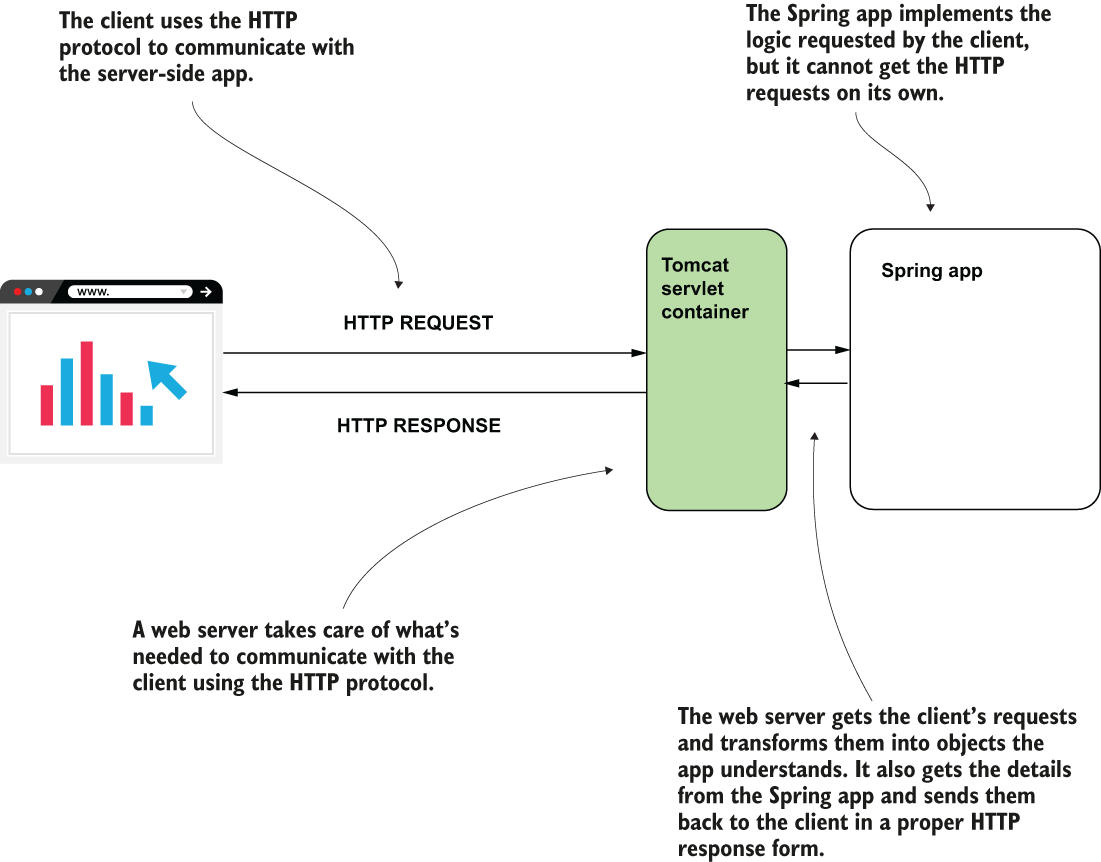 Figure 7.6 A servlet container (e.g., Tomcat) speaks HTTP. It translates the HTTP request to our Spring app and the app’s response into an HTTP response.
How Servlets Work
When a servlet container receives an HTTP request, it calls a method of the servlet object, providing the request as a parameter. The servlet processes the request and prepares a response, which is then sent back to the client. This interaction is depicted in the following figure:
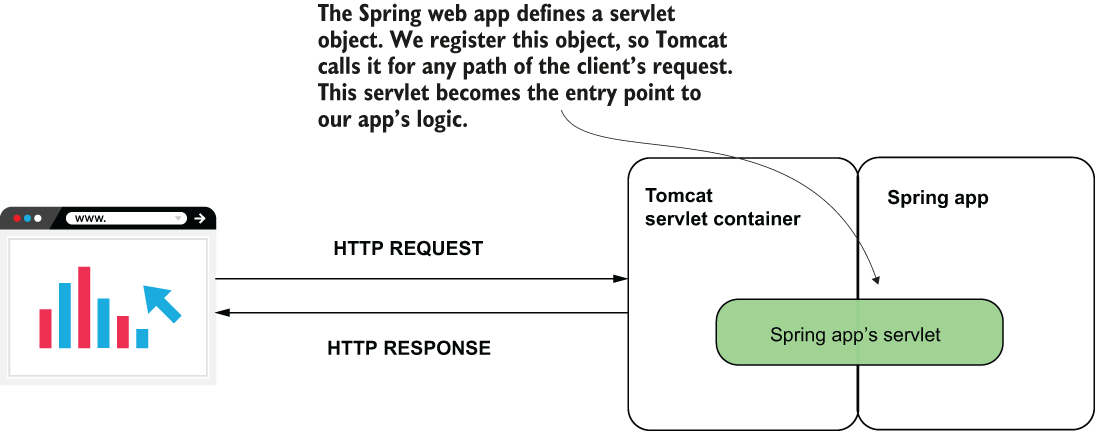 Figure 7.8 The Spring app defines a servlet object and registers it into the servlet container.
Historical Context
Historically, servlets were a critical component of backend web applications. Developers would create servlet instances, configure them in the servlet container, and assign them to specific URL paths. Each servlet contained the logic to handle user requests and prepare responses.
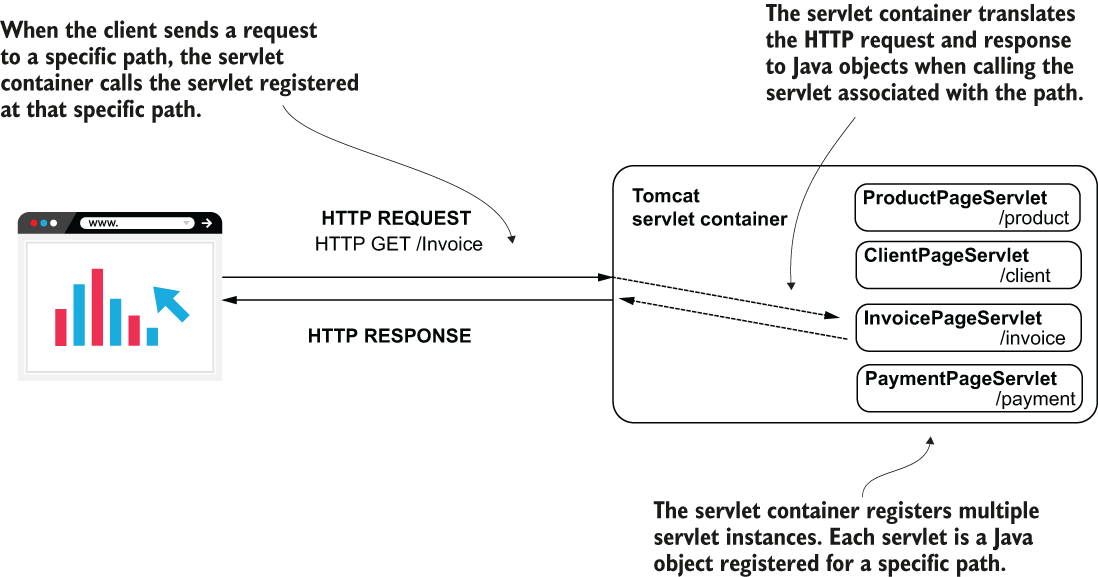 Figure 7.7 The servlet container (Tomcat) registers multiple servlet instances.
Modern Usage
In modern web applications, especially those using frameworks like Spring, developers typically do not create servlet instances directly. Instead, the framework handles the creation and management of servlets, allowing developers to focus on the application logic. However, it is important to understand that the servlet remains the entry point to the application's logic, interacting directly with the servlet container to handle requests and responses.
Servlet in Spring Boot
In Spring Boot, servlets can be initialized using the SpringBootServletInitializer class. This class is part of the Spring Boot framework and is used to configure the application when it is launched by a servlet container. The ServletInitializer class extends SpringBootServletInitializer and overrides the configure method to specify the sources for the application.
Example: ServletInitializer Class
package com.manning.sbip.ch09;

import org.springframework.boot.builder.SpringApplicationBuilder;
import org.springframework.boot.web.servlet.support.SpringBootServletInitializer;

public class ServletInitializer extends SpringBootServletInitializer {

  @Override
  protected SpringApplicationBuilder configure(SpringApplicationBuilder application) {
    return application.sources(CourseTrackerSpringBootApplication.class);
  }

}
In this example, the ServletInitializer class is used to configure the CourseTrackerSpringBootApplication class as the source for the Spring application.
Configuring DispatcherServlet
In a typical Spring MVC application, the DispatcherServlet is a central component that dispatches requests to the appropriate handlers. It can be configured either in the application's deployment descriptor file (web.xml) or programmatically in a class that implements the ServletContainerInitializer interface.
Example: Programmatic Configuration of DispatcherServlet
public class CourseCourtServletContainerInitializer implements ServletContainerInitializer {
    @Override
    public void onStartup(Set<Class<?>> set, ServletContext servletContext) throws ServletException {

        AnnotationConfigWebApplicationContext applicationContext = new AnnotationConfigWebApplicationContext();
        applicationContext.register(CourseConfiguration.class);
        DispatcherServlet dispatcherServlet = new DispatcherServlet(applicationContext);
        ServletRegistration.Dynamic servletRegistration = servletContext.addServlet("course", dispatcherServlet);
        servletRegistration.setLoadOnStartup(1);
        servletRegistration.addMapping("/");
    }
}
In this example, the CourseCourtServletContainerInitializer class implements the ServletContainerInitializer interface. The onStartup method is overridden to create an AnnotationConfigWebApplicationContext, register the CourseConfiguration class, and create a DispatcherServlet with the application context. The DispatcherServlet is then dynamically registered with the ServletContext, and a mapping is added to handle requests.
| Book Title | Usage of servlet | Technical Depth | Connections to Other Concepts | Examples Used | Practical Application |
|------------|------------------|-----------------|-------------------------------|---------------|-----------------------|
| [Spring Start Here](https://www.manning.com/books/spring-start-here) | Discusses servlets as Java objects that serve as entry points to web applications, managed by servlet containers like Tomcat. [more](https://livebook.manning.com/book/spring-start-here/chapter-7/34) | Explains the lifecycle management by servlet containers and the interaction with HTTP requests and responses. [more](https://livebook.manning.com/book/spring-start-here/chapter-7/42) | Connects servlets to the broader context of web application frameworks like Spring, emphasizing the abstraction of network protocols. [more](https://livebook.manning.com/book/spring-start-here/chapter-7/34) | Provides figures illustrating servlet interactions and historical context of servlet usage. [more](https://livebook.manning.com/book/spring-start-here/chapter-7/42) | Highlights the shift from direct servlet creation to framework-managed servlets in modern applications. [more](https://livebook.manning.com/book/spring-start-here/chapter-7/34) |
| [Spring Boot in Practice](https://www.manning.com/books/spring-boot-in-practice) | Describes servlets as Java classes extending server capabilities, particularly in web servers. [more](https://livebook.manning.com/book/spring-boot-in-practice/chapter-9/77) | Details servlet initialization in Spring Boot using `SpringBootServletInitializer` and programmatic configuration of `DispatcherServlet`. [more](https://livebook.manning.com/book/spring-boot-in-practice/chapter-9/77) | Links servlets to Spring Boot's application configuration and deployment processes. [more](https://livebook.manning.com/book/spring-boot-in-practice/chapter-9/77) | Includes code examples for `ServletInitializer` and `DispatcherServlet` configuration. [more](https://livebook.manning.com/book/spring-boot-in-practice/chapter-9/77) | Focuses on practical setup and configuration of servlets within Spring Boot applications. [more](https://livebook.manning.com/book/spring-boot-in-practice/chapter-9/77) |
FAQ (Frequently asked questions)
What is the purpose of the ServletInitializer class in a Spring Boot application?
How do you configure a Spring Boot application for deployment as a WAR file?
What method is overridden in the ServletInitializer class for a Spring Boot WAR deployment?
What is a servlet in web app development?
How does a servlet interact with a servlet container?
How is a servlet object used in a Spring app?
What role does the servlet container play in managing a servlet?
What happens when a servlet container receives an HTTP request?
Can you give an example of how a servlet functions?