Spring Eureka
Spring Eureka is a component of the Spring Cloud Netflix project that facilitates service registration and discovery for Spring Boot applications. By integrating Netflix Eureka with Spring Boot, it allows microservices to register themselves with a Eureka server and discover other registered services, enabling seamless communication and interaction between distributed components.
Overview
Spring Eureka provides a robust mechanism for service registration and discovery, which is crucial in a microservices architecture. It allows services to dynamically register themselves with a central Eureka server, which maintains a registry of all available services and their instances. This registry can then be queried by other services to discover and communicate with each other, thus enabling load balancing and failover capabilities.
Setting Up Spring Eureka
To integrate Spring Eureka into a Spring Boot application, you need to add the necessary dependency to your project's pom.xml file:
<dependency>
  <groupId>org.springframework.cloud</groupId>
  <artifactId>spring-cloud-starter-eureka</artifactId>           #1
</dependency>
#1 - Includes the Eureka libraries so that the service can register with Eureka
This dependency includes the necessary libraries for the service to interact with the Eureka server.
Configuring the Application
Once the dependency is added, you need to configure your application to register with the Eureka server. This is done by modifying the application.yml file of your service:
spring:
 application:
  name: organizationservice                                #1
 profiles:
  active:
   default
 cloud:
  config:
   enabled: true
eureka:
 instance:
  preferIpAddress: true                                    #2
 client:
  registerWithEureka: true                                 #3
  fetchRegistry: true                                      #4
  serviceUrl:
    defaultZone: http://localhost:8761/eureka/             #5
#1 - Logical name of the service that will be registered with Eureka
#2 - Register the IP of the service rather than the server name.
#3 - Register the service with Eureka.
#4 - Pull down a local copy of the registry.
#5 - Location of the Eureka Service
In this configuration:
- The
spring.application.nameproperty sets the logical name of the service. - The
eureka.instance.preferIpAddressproperty ensures the IP address is registered instead of the server name. - The
eureka.client.registerWithEurekaandeureka.client.fetchRegistryproperties enable the service to register with Eureka and fetch the registry. - The
eureka.client.serviceUrl.defaultZonespecifies the location of the Eureka server.
Interacting with Eureka
Eureka provides a REST API that can be used to interact with the service registry. For example, to view all instances of a registered service, you can use the following endpoint:
http://<eureka service>:8761/eureka/apps/<APPID>
For the organization service, this would be:
http://localhost:8761/eureka/apps/organizationservice
Viewing Registered Services
The default response format from the Eureka service is XML, but it can also return JSON if the Accept HTTP header is set to application/json. The following figures illustrate the response formats:
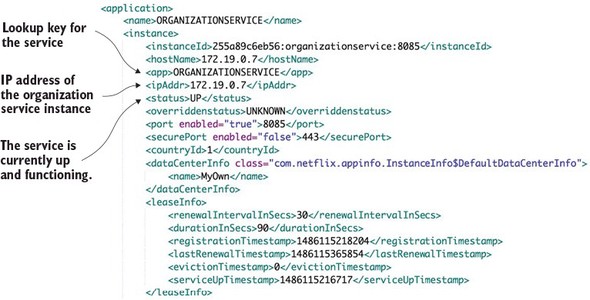 Figure 4.5. Calling the Eureka REST API to see the organization will show the IP address of the service instances registered in Eureka, along with the service status.
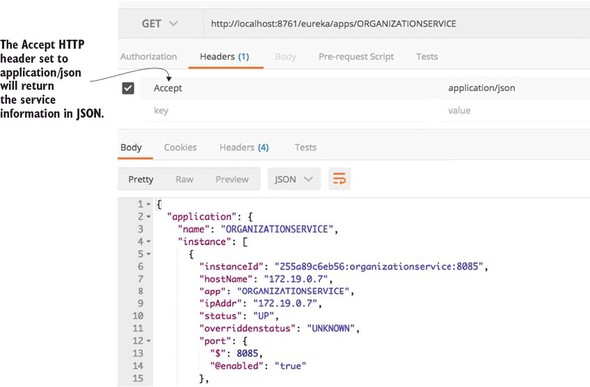 Figure 4.6. Calling the Eureka REST API with the results being JSON
Considerations
When a service registers with Eureka, there is a warm-up period where Eureka waits for three successive health checks over 30 seconds before the service becomes available. This delay can lead to initial 404 errors if you attempt to access the service immediately after startup. It is advisable to wait for this period to elapse before making service calls.
FAQ (Frequently asked questions)
What is Spring Eureka?
How does Spring Eureka benefit Spring Boot applications?
What is the role of Spring Eureka in the Spring Cloud Netflix project?
How do Spring Boot microservices use Spring Eureka?
What information can be obtained by calling the Eureka REST API?
How do you configure a Spring Boot application to register with Eureka?
What does the 'preferIpAddress' setting do in Eureka configuration?
What is the purpose of 'registerWithEureka' in the application.yml?
Why is 'fetchRegistry' set to true in Eureka configuration?
Where is the Eureka service located according to the configuration?