Spring Framework
The Spring Framework is a comprehensive programming and configuration model designed for modern Java-based enterprise applications. It provides a robust infrastructure to support the development of Java applications, emphasizing the principles of decoupling and modularity. The framework is widely used in various types of applications, including backend systems, automation testing, desktop applications, and mobile apps.
Key Features
Dependency Injection
One of the core features of the Spring Framework is dependency injection, which promotes loose coupling between components. This design pattern allows developers to build more modular and testable applications by injecting dependencies at runtime rather than at compile time. This feature is central to Spring's ability to create loosely coupled applications.
Aspect-Oriented Programming
Spring supports aspect-oriented programming (AOP), which enables the separation of cross-cutting concerns such as logging, security, and transaction management. AOP allows developers to define these concerns separately from the business logic, leading to cleaner and more maintainable code.
Transaction Management
The framework provides comprehensive transaction management capabilities, allowing developers to manage transactions declaratively. This feature simplifies the process of ensuring data integrity and consistency across various operations within an application.
Integration and Security
Spring offers tools for integrating with various third-party systems and message brokers, simplifying complex implementations. Additionally, it provides comprehensive security features to protect applications, making it a robust choice for enterprise-level security needs.
Spring Framework as a Solar System
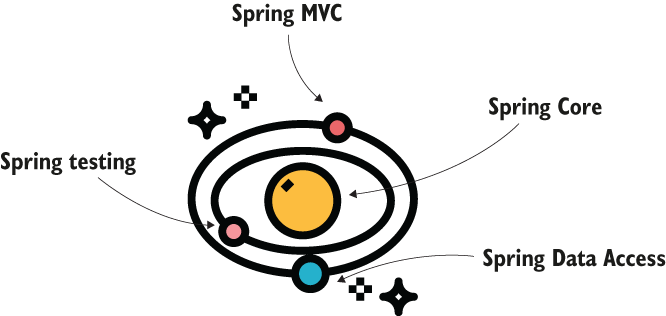 Figure 1.3 You can imagine the Spring framework as a solar system with the Spring Core in the center. The software capabilities are planets around Spring Core kept close to it by its gravitational field.
The Spring Framework can be visualized as a solar system, with the Spring Core at the center. The various software capabilities, such as Spring MVC and Spring Data Access, orbit around the core, held in place by its gravitational pull. This metaphor illustrates how the different components of the Spring Framework are interconnected and revolve around the central core, providing a cohesive and integrated development environment.
Endless Possibilities in Backend Applications
 Figure 1.6 The possibilities of using Spring in a backend application are endless, from exposing functionalities that other applications can call to managing the database access, and from securing the application to managing integration though third-party message brokers.
The Spring Framework offers endless possibilities for backend applications. It can be used to expose functionalities that other applications can call, manage database access, secure applications, and handle integration through third-party message brokers. This flexibility makes Spring a popular choice for developing robust and scalable backend systems.
In summary, the Spring Framework is a versatile and powerful tool for building Java-based enterprise applications, offering a wide range of features that facilitate the development of scalable, maintainable, and high-performance applications. Its modular architecture and extensive ecosystem make it suitable for a wide range of applications, from simple web apps to complex enterprise systems.
For more detailed insights, you can refer to Spring Boot in Practice and Spring Start Here.
| Book Title | Usage of Spring Framework | Technical Depth | Connections to Other Concepts | Examples Used | Practical Application |
|------------|---------------------------|-----------------|-------------------------------|---------------|-----------------------|
| [Spring Boot in Practice](https://www.manning.com/books/spring-boot-in-practice) | Discusses the Spring Framework as a comprehensive programming and configuration model for Java-based enterprise applications, emphasizing decoupling and modularity. [more](https://www.manning.com/books/spring-boot-in-practice) | Covers core features like dependency injection, aspect-oriented programming, and transaction management. [more](https://www.manning.com/books/spring-boot-in-practice) | Highlights the separation of cross-cutting concerns and the integration of various features. [more](https://www.manning.com/books/spring-boot-in-practice) | Provides examples of building scalable and maintainable applications. [more](https://www.manning.com/books/spring-boot-in-practice) | Focuses on building high-performance Java applications with practical tools and techniques. [more](https://www.manning.com/books/spring-boot-in-practice) |
| [Spring Start Here](https://www.manning.com/books/spring-start-here) | Describes the Spring Framework as a versatile ecosystem aiding Java-based enterprise application development, focusing on business logic. [more](https://livebook.manning.com/book/spring-start-here/chapter-2/1) | Explores specialized frameworks like Spring Core, MVC, Data Access, and Testing. [more](https://livebook.manning.com/book/spring-start-here/chapter-6/1) | Uses a solar system metaphor to explain the interconnectedness of Spring components. [more](https://livebook.manning.com/book/spring-start-here/chapter-1/48) | Illustrates endless possibilities in backend applications, including database management and security. [more](https://livebook.manning.com/book/spring-start-here/chapter-1/92) | Emphasizes the flexibility and scalability of Spring for backend systems. [more](https://livebook.manning.com/book/spring-start-here/chapter-1/92) |
FAQ (Frequently asked questions)
What is the Spring framework ecosystem?
How is the Spring framework structured?
What types of applications can use the Spring framework?
What tools does Spring provide?
What are the possibilities of using Spring in a backend application?
In what types of applications is Spring used?
What does Spring provide for application development?
What is the Spring Framework?
What support does Spring provide for Java applications?
What features does the Spring Framework include?