Stack in Java
In Java, a stack is a fundamental memory structure used to manage the execution of threads and the storage of local variables. It operates on a Last In, First Out (LIFO) principle, meaning the last element added to the stack is the first one to be removed. This structure is crucial for method call management, recursion, and efficient memory usage in Java applications.
Stack in Java Applications
In Java applications, each thread has its own stack, which is used to store locally declared variables and method call information. This separation ensures thread safety, as the data in one thread's stack is isolated from others. The stack is distinct from the heap, which is a shared memory area used for storing object instances. This distinction is vital for understanding data management and access during Java program execution.
 Figure E.2 T1, T2, and T3 are all threads of a Java app. All these threads use the same heap. The heap is a memory location where the app stores object instances’ data. However, each thread uses its own memory location, called a stack, to store data locally declared.
How the Stack Works
The stack's LIFO nature is mirrored in Java's management of method calls and local variables. When a method is called, a new frame is pushed onto the stack to hold its local variables. As methods return, these frames are popped off the stack, freeing up memory.
 Figure E.4 Adding and removing values from a stack. The stack is an ordered collection working on the LIFO principle. When you add a value to the stack it becomes the top layer—the only one you can remove.
Example of Stack Usage
Consider the following method:
public int sum(int x, int y) {  #1
   int sum = x + y;             #1
   return sum;
}
#1 Variables x, y, and sum will be stored in the stack.
In this example, the parameters x and y, along with the local variable sum, are stored in the stack. When the method is called, a new layer is created in the stack to hold these variables. Once the method execution is complete, this layer is removed, freeing up the memory.
Execution Flow and Stack Layers
When a method is called, a new layer is added to the stack to store its local variables. This layer is removed once the method execution is complete. This dynamic allocation and deallocation of memory help manage resources efficiently during program execution.
 Figure E.5 When the execution reaches the start of a block of code, a new layer is created in the thread’s stack. All the variables the block of code defines are stored in this new layer. The layer is removed when the block of code ends. This way, we know that the values in this part of the memory are released when they’re no longer needed.
 Figure E.6 Another block of code can be called from one in execution. In this case, method main() calls method a(). Since main() didn’t finish, its layer is still part of the stack. Method a() creates its own layer where the local values it defines are stored.
Stack Management in Functional Programming
In functional programming, managing the stack efficiently is crucial to prevent overflow, especially with recursive methods. Techniques such as using constructs like Return, Suspend, and Continue help manage execution flow without heavily relying on the stack, thus avoiding stack overflow.
Stack and Heap
The stack and heap are two distinct areas of memory in the JVM. The stack is used for storing local variables, while the heap is where objects are created and stored. Local variables of reference type in the stack point to locations in the heap, where the actual objects reside.
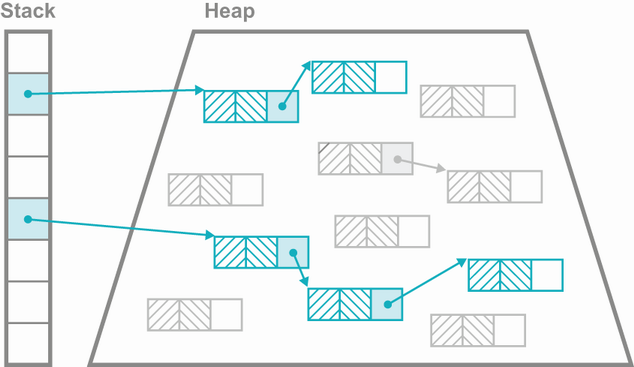 Figure 7.4 Variables in the stack and heap
This relationship allows for efficient memory management and access during program execution, ensuring that resources are used effectively and that memory is allocated and deallocated dynamically as needed.
| Book Title | Usage of Stack | Technical Depth | Connections to Other Concepts | Examples Used | Practical Application |
|------------|----------------|-----------------|-------------------------------|---------------|-----------------------|
| [Troubleshooting Java: Read, debug, and optimize JVM applications](https://www.manning.com/books/troubleshooting-java) | Discusses stack as a memory location for local variables and method calls, emphasizing thread safety. [more](https://livebook.manning.com/book/troubleshooting-java/appendix-e/10) | Explains stack vs. heap, LIFO principle, and execution flow. [more](https://livebook.manning.com/book/troubleshooting-java/appendix-e/10) | Connects stack management to thread safety and memory management. [more](https://livebook.manning.com/book/troubleshooting-java/appendix-e/10) | Provides code examples and figures illustrating stack operations. [more](https://livebook.manning.com/book/troubleshooting-java/appendix-e/12) | Highlights stack's role in efficient resource management during execution. [more](https://livebook.manning.com/book/troubleshooting-java/appendix-e/10) |
| [Functional Programming in Java: How functional techniques improve your Java programs](https://www.manning.com/books/functional-programming-in-java) | Focuses on stack's role in managing method calls, especially in recursion. [more](https://livebook.manning.com/book/functional-programming-in-java/chapter-4/76) | Discusses stack overflow risks and stack-safe techniques in functional programming. [more](https://livebook.manning.com/book/functional-programming-in-java/chapter-13/235) | Links stack management to recursion and functional programming techniques. [more](https://livebook.manning.com/book/functional-programming-in-java/chapter-13/235) | No specific examples provided, but discusses abstract constructs for stack management. [more](https://livebook.manning.com/book/functional-programming-in-java/chapter-13/235) | Emphasizes stack-safe techniques to prevent overflow in recursive functions. [more](https://livebook.manning.com/book/functional-programming-in-java/chapter-13/235) |
| [The Well-Grounded Java Developer, Second Edition](https://www.manning.com/books/the-well-grounded-java-developer-second-edition) | Describes stack as a memory area for local variables and JVM operations. [more](https://livebook.manning.com/book/the-well-grounded-java-developer-second-edition/chapter-7/233) | Covers stack and heap memory management, including bytecode operations. [more](https://livebook.manning.com/book/the-well-grounded-java-developer-second-edition/chapter-7/233) | Explores stack and heap relationship, and memory allocation. [more](https://livebook.manning.com/book/the-well-grounded-java-developer-second-edition/chapter-7/233) | Includes figures and bytecode examples for stack operations. [more](https://livebook.manning.com/book/the-well-grounded-java-developer-second-edition/chapter-4/212) | Discusses dynamic memory allocation and deallocation for efficient execution. [more](https://livebook.manning.com/book/the-well-grounded-java-developer-second-edition/chapter-7/233) |
FAQ (Frequently asked questions)
What is the stack in Java memory management?
Do threads share the stack in Java?
What memory location do Java threads use to store locally declared data?
Do all threads in a Java application share the same heap?
Where are local variables stored in Java?
Can you provide an example of local variables stored in the stack?
How is the stack used in performing an addition operation?
What is stored in the stack in the JVM?
What does Figure 7.4 illustrate?
What is the role of a stack in recursion?
What can cause a stack overflow in recursive methods?
Why is managing the stack important in functional programming?
How can computations be made stack-safe in functional programming?