State in Java
In Java, the concept of "state" is pivotal across various programming paradigms and frameworks. It refers to the data or condition of an object or system at a particular point in time. Understanding how state is managed and manipulated is crucial for developing robust and efficient Java applications. Below, we explore the concept of state in different contexts as discussed in various Java books.
State in Functional Programming
In functional programming, the concept of "state" is often abstracted to manage data that changes over time without compromising the principles of immutability and pure functions. This abstraction is crucial for operations like random number generation, where the state (e.g., the seed) evolves as new values are generated.
The State Class
The State class is a functional programming abstraction that encapsulates state transitions. It manages state by transforming an input state into a new state and a value, allowing for composable and reusable logic. This approach is a hallmark of functional programming, promoting cleaner and more maintainable code.
Implementation of the State Class
The State class is implemented as follows:
public class State<S, A> {

  public final Function<S, Tuple<A, S>> run;

  public State(Function<S, Tuple<A, S>> run) {
    super();
    this.run = run;
  }

  public static <S, A> State<S, A> unit(A a) {
    return new State<>(state -> new Tuple<>(a, state));
  }

  public <B> State<S, B> map(Function<A, B> f) {
    return flatMap(a -> State.unit(f.apply(a)));
  }

  public <B, C> State<S, C> map2(State<S, B> sb, Function<A, Function<B, C>> f) {
    return flatMap(a -> sb.map(b -> f.apply(a).apply(b)));
  }

  public <B> State<S, B> flatMap(Function<A, State<S, B>> f) {
    return new State<>(s -> {
      Tuple<A, S> temp = run.apply(s);
      return f.apply(temp._1).run.apply(temp._2);
    });
  }

  public static <S, A> State<S, List<A>> sequence(List<State<S, A>> fs) {
    return fs.foldRight(State.unit(List.<A>list()), f -> acc -> f.map2(acc, a -> b -> b.cons(a)));
  }
}
Key Methods
unit: Wraps a value into aStatewithout changing the state.map: Transforms the value inside theStateusing a function, without altering the state.map2: Combines twoStateinstances using a binary function.flatMap: Chains operations onState, allowing for sequential transformations.sequence: Converts a list ofStateinstances into a singleStatethat returns a list of results.
Redefining Random as a Specific Case of State
The Random class can be redefined as a specific case of the State class, focusing on random number generation. This is achieved by extending the State class with a specific type for the state, such as RNG:
public class Random<A> extends State<RNG, A> {

  public Random(Function<RNG, Tuple<A, RNG>> run) {
    super(run);
  }
}
This redefinition allows the Random class to leverage the state management capabilities of the State class, while still focusing on the specific needs of random number generation.
Interface Redefinition
The State interface can be defined to handle any kind of state, not just random number generation:
interface State<S, A> extends Function<S, Tuple<A, S>> {}
This interface highlights the flexibility of the State abstraction, allowing it to be applied to various domains where state management is required.
For more details, refer to Functional Programming in Java: How functional techniques improve your Java programs.
State in JPA
In the Java Persistence API (JPA), the concept of "state" is integral to understanding the lifecycle of an entity. An entity's state determines how it interacts with the database and how changes to the entity are managed. The primary states defined by JPA are transient, persistent, detached, and removed.
Entity States Overview
-
Transient State: An entity is in the transient state when it is instantiated but not yet associated with any persistence context. In this state, the entity is not tracked by the database, and any changes made to it will not be persisted unless it transitions to another state.
-
Persistent State: An entity enters the persistent state when it is associated with a persistence context. In this state, the entity is managed by the EntityManager, and any changes made to it are automatically synchronized with the database during a transaction commit.
-
Detached State: An entity becomes detached when it is no longer associated with a persistence context. This can happen when the persistence context is closed or when the entity is explicitly detached. In this state, changes to the entity are not automatically synchronized with the database.
-
Removed State: An entity is in the removed state when it is marked for deletion from the database. The actual removal occurs when the transaction is committed.
State Transitions
The transitions between these states are managed through specific method calls to the EntityManager and Query API. These transitions are crucial for the lifecycle management of entities.
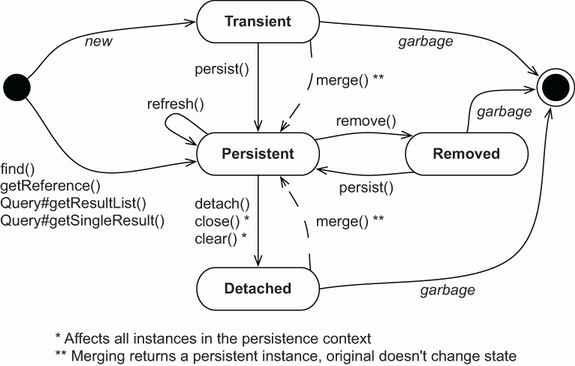 Figure 10.1 Entity instance states and their transitions
Understanding these states and their transitions is essential for effectively managing the persistence lifecycle of entities in a JPA-based application. By leveraging these concepts, developers can ensure that their applications maintain data integrity and perform efficiently.
For more details, refer to Java Persistence with Spring Data and Hibernate epub.
| Book Title | Usage of state | Technical Depth | Connections to Other Concepts | Examples Used | Practical Application |
|------------|----------------|-----------------|-------------------------------|---------------|-----------------------|
| [Functional Programming in Java: How functional techniques improve your Java programs](https://www.manning.com/books/functional-programming-in-java) | Discusses state in the context of functional programming, focusing on data that changes over time, such as random number generation. [more](https://livebook.manning.com/book/functional-programming-in-java/chapter-12/1) | Provides a detailed explanation of the `State` class and its methods, such as `map`, `flatMap`, and `sequence`. [more](https://livebook.manning.com/book/functional-programming-in-java/chapter-12/163) | Connects state management to functional programming principles, emphasizing modularity and composability. [more](https://livebook.manning.com/book/functional-programming-in-java/chapter-12/1) | Uses the `Random` class as an example to demonstrate state management in functional programming. [more](https://livebook.manning.com/book/functional-programming-in-java/chapter-12/1) | Highlights the practical application of state management in creating cleaner and more maintainable code. [more](https://livebook.manning.com/book/functional-programming-in-java/chapter-12/1) |
| [Java Persistence with Spring Data and Hibernate epub](https://www.manning.com/books/java-persistence-with-spring-data-and-hibernate) | Explores state in the context of JPA, focusing on entity lifecycle states like transient, persistent, detached, and removed. [more](https://livebook.manning.com/book/java-persistence-with-spring-data-and-hibernate/chapter-8/226) | Offers an in-depth look at state transitions and their management through the `EntityManager` and `Query` API. [more](https://livebook.manning.com/book/java-persistence-with-spring-data-and-hibernate/chapter-8/226) | Links state management to ORM solutions and standardizes states across different implementations. [more](https://livebook.manning.com/book/java-persistence-with-spring-data-and-hibernate/chapter-8/226) | Provides visual aids like [Figure 10.1](https://livebook.manning.com/java-persistence-with-spring-data-and-hibernate/chapter-10/figure--10-1) to illustrate entity state transitions. [more](https://livebook.manning.com/java-persistence-with-spring-data-and-hibernate/chapter-10/figure--10-1) | Emphasizes maintaining data integrity and efficient performance in JPA-based applications. [more](https://livebook.manning.com/book/java-persistence-with-spring-data-and-hibernate/chapter-8/226) |
FAQ (Frequently asked questions)
What does the state of an entity refer to in JPA?
Why is managing entity state important in JPA?
What does 'state' refer to in functional programming?
How does functional programming handle state?
What is an example of state handling in functional programming?
Why is abstracting the RNG state beneficial in functional programming?
What is the State class in functional programming?
How does the State class manage state transitions?
What is the purpose of the State class in Java?
How does the State class in Java work?
What is the unit method in the State class?
What does the map method do in the State class?
What is the purpose of the flatMap method in the State class?
How does the sequence method work in the State class?