Stub in Java
In Java, a "stub" is a concept widely used in software testing and application troubleshooting. It refers to a simplified implementation of a component that is used to replace a real system component. Stubs are primarily used to create a controlled and predictable environment for testing or debugging purposes. They allow developers to isolate the code under test from external dependencies, ensuring that the behavior of the code can be evaluated without interference from other components.
Overview of Stubs in Software Testing
A stub object is a type of test double used in software testing. It serves as a replacement for a real implementation, providing a consistent and predetermined response every time it is called. The primary purpose of using a stub is to isolate the code under test from external dependencies, ensuring that the test environment is controlled and predictable. This is particularly useful for focusing on the behavior of the code itself without being affected by the variability or complexity of external systems or components. By using stubs, developers can create a stable testing environment that facilitates the identification and resolution of issues within the code under test.
For more details, refer to The Well-Grounded Java Developer, Second Edition.
Stubs in Java Application Troubleshooting
In the context of Java application troubleshooting, a stub is a crucial tool used to replace real system components with controlled, fake applications. This technique is particularly useful for identifying and resolving issues in application interactions. A stub serves as a stand-in for a real system component, allowing developers to control and monitor the interactions between different parts of an application. By using a stub, developers can block requests and determine their origin, which is essential for diagnosing and fixing issues within the application.
Example Usage
A stub can be employed to replace a real system component temporarily. This allows developers to control the environment and quickly identify where requests are being sent from within the application. Once the issue is identified and corrected, the stub can also be used to test the solution, ensuring that the problem has been resolved effectively.
Visual Representation
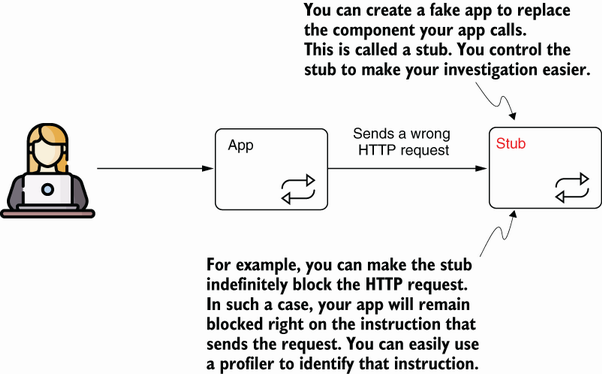 Figure 1.8 You can replace the system component your app calls with a stub. You control the stub to quickly determine where your app sends the request from. You can also use the stub to test your solution after you correct the issue.
This figure illustrates how a stub can be used to replace a system component that an application calls. By controlling the stub, developers can quickly determine the source of requests and use the stub to test solutions after issues have been corrected.
For more insights, see Troubleshooting Java: Read, debug, and optimize JVM applications.
| Book Title | Usage of stub | Technical Depth | Connections to Other Concepts | Examples Used | Practical Application |
|------------|---------------|-----------------|-------------------------------|---------------|-----------------------|
| [The Well-Grounded Java Developer, Second Edition](https://www.manning.com/books/the-well-grounded-java-developer-second-edition) | A stub is used as a test double to replace real implementations, providing consistent responses to isolate code under test. [more](https://livebook.manning.com/book/the-well-grounded-java-developer-second-edition/chapter-13/163) | Discusses the role of stubs in creating a stable testing environment, focusing on isolating code from external dependencies. [more](https://livebook.manning.com/book/the-well-grounded-java-developer-second-edition/chapter-13/163) | Connects stubs to the broader concept of test doubles, emphasizing their importance in software testing. [more](https://livebook.manning.com/book/the-well-grounded-java-developer-second-edition/chapter-13/163) | Provides a conceptual overview without specific examples. [more](https://livebook.manning.com/book/the-well-grounded-java-developer-second-edition/chapter-13/163) | Focuses on the use of stubs to ensure a controlled and predictable test environment. [more](https://livebook.manning.com/book/the-well-grounded-java-developer-second-edition/chapter-13/163) |
| [Troubleshooting Java: Read, debug, and optimize JVM applications](https://www.manning.com/books/troubleshooting-java) | Stubs are used to replace real system components with controlled, fake applications for troubleshooting. [more](https://livebook.manning.com/book/troubleshooting-java/chapter-1/41) | Explains how stubs help in controlling and monitoring application interactions to diagnose issues. [more](https://livebook.manning.com/book/troubleshooting-java/chapter-1/41) | Highlights the use of stubs in application troubleshooting, linking them to debugging and optimization. [more](https://livebook.manning.com/book/troubleshooting-java/chapter-1/41) | Includes visual representation and examples of using stubs to identify and fix application issues. [more](https://livebook.manning.com/book/troubleshooting-java/chapter-1/41) | Demonstrates practical use of stubs in identifying request origins and testing solutions post-correction. [more](https://livebook.manning.com/book/troubleshooting-java/chapter-1/41) |
FAQ (Frequently asked questions)
What is a stub in the context of system components?
How can a stub be used after correcting an issue?
What is the purpose of using a stub in application interactions?
What is a stub object in testing?
Why are stub objects used in testing?
What is the purpose of a stub in testing?
How does a stub help in testing?