Traversal
Overview
Tree traversal refers to the process of visiting all the nodes in a tree in a specific order. This is a fundamental operation in computer science, particularly in the context of data structures like trees. Traversal is essential for various operations such as searching, sorting, and modifying tree data. There are several common traversal orders, each serving different purposes and providing different insights into the tree's structure.
Traversal Orders
Depth-First Traversal
Depth-first traversal is a method of exploring a tree by prioritizing the height of the tree. This means that the traversal goes as deep as possible along each branch before backtracking. There are three main orders in which depth-first traversal can be applied:
-
Pre-order Traversal: In this order, the node is processed before its child nodes. The traversal sequence is: visit the root, traverse the left subtree, and then traverse the right subtree.
-
In-order Traversal: This order processes the left subtree first, then the node itself, and finally the right subtree. In binary search trees, this traversal results in nodes being visited in ascending order.
-
Post-order Traversal: Here, the node is processed after its child nodes. The sequence is: traverse the left subtree, traverse the right subtree, and then visit the root node.
These depth-first traversal methods are visually represented in Figure 10.6, which illustrates how the tree is traversed by giving priority to height.
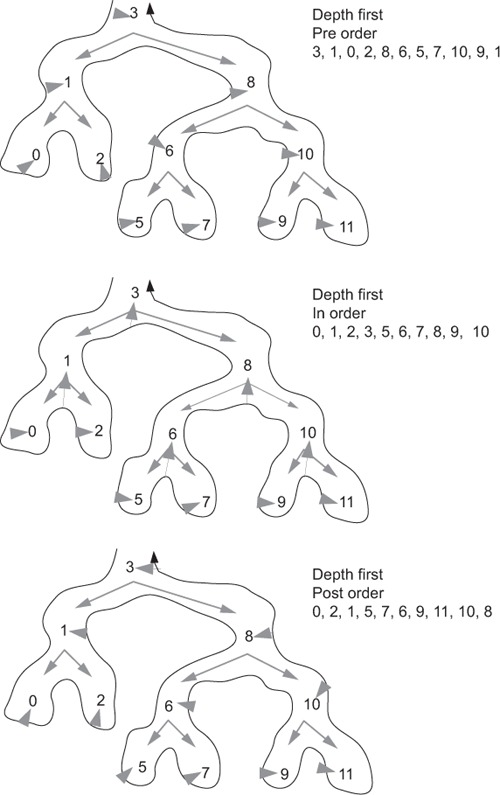 Figure 10.6. Depth-first traversal consists in traversing the tree while giving priority to height. There are three main orders in which this may be applied.
Breadth-First Traversal
Breadth-first traversal, also known as level-order traversal, explores the tree level by level. It starts at the root and visits all nodes at the present depth level before moving on to nodes at the next depth level. This method is particularly useful for finding the shortest path on unweighted graphs and trees.
Nonrecursive Traversal Orders
While traditional traversal methods often use recursion, nonrecursive approaches can also be employed. These methods typically use data structures like stacks and queues to manage the traversal process without relying on the call stack. Nonrecursive traversal can be more efficient in terms of memory usage and can avoid issues related to stack overflow in deep trees.
FAQ (Frequently asked questions)
What is tree traversal?
What are common tree traversal orders?