WebClient in Java
WebClient is a modern, non-blocking, reactive client used for making HTTP requests in Java applications, particularly within the Spring ecosystem. It is part of the Spring WebFlux module and is designed to consume RESTful web services in a reactive manner, allowing for efficient resource utilization and improved application performance.
Overview
WebClient provides a functional, fluent API based on Reactor, which allows for asynchronous logic composition without the need for threads and concurrency. It supports various HTTP client libraries, including Reactor Netty, Jetty Reactive HttpClient, and Apache HttpComponents. This flexibility makes it a powerful tool for developers looking to build reactive applications.
Creating a WebClient Instance
To create a WebClient instance, you can use the create() static factory method for simple use cases or the builder() method for more advanced configurations. The builder() method allows you to set HTTP headers, codecs, or use a specialized HttpClient. Here is an example of building a WebClient instance using the builder() method:
@Configuration
public class ProjectConfig {

  @Bean
  public WebClient webClient() {
    return WebClient
            .builder()
            .build();
  }
}
This example demonstrates how to add a WebClient bean to the Spring context, which can then be injected into other components.
Advanced Configuration
For more complex scenarios, you can configure a custom HTTP client with additional settings, such as timeouts, proxy configuration, and SSL setup. Below is an example of building a WebClient with advanced configurations:
public WebClientApi() {
    this.webClient = WebClient.builder()
            .baseUrl(BASE_URL)
            .clientConnector(getClientConnector())
            .defaultHeader(HttpHeaders.USER_AGENT, USER_AGENT)
            .exchangeStrategies(ExchangeStrategies.builder().codecs(configurer ->
                configurer.defaultCodecs().maxInMemorySize(30 * 1024 * 1024)).build())
            .filter(logRequest()).filter(logResponse()).build();
}
This setup includes setting a default HTTP header for the USER_AGENT, configuring codecs with a custom maximum memory size, and using filters to log HTTP requests and responses.
Implementing a Proxy Class with WebClient
WebClient can be used to implement a proxy class that interacts with external REST endpoints. Here is an example of a proxy class named PaymentsProxy that uses WebClient to make HTTP POST requests to a payment service:
@Component
public class PaymentsProxy {

  private final WebClient webClient;

  @Value("${name.service.url}")
  private String url;

  public PaymentsProxy(WebClient webClient) {
    this.webClient = webClient;
  }

  public Mono<Payment> createPayment(String requestId, Payment payment) {
    return webClient.post()
              .uri(url + "/payment")
              .header("requestId", requestId)
              .body(Mono.just(payment), Payment.class)
              .retrieve()
              .bodyToMono(Payment.class);
  }
}
Explanation of the Proxy Class
- Base URL: The base URL for the service is retrieved from a properties file.
- HTTP Method: The HTTP method (POST in this case) is specified for the request.
- URI: The URI for the request is constructed by appending the endpoint path to the base URL.
- Headers: HTTP headers can be added to the request using the
header()method. - Request Body: The request body is provided using a
Mono, which is a reactive type representing a single value or an empty value. - Response Handling: The response is retrieved and converted to a
Mono<Payment>.
Reactive Programming with WebClient
WebClient leverages reactive programming principles, allowing for asynchronous and non-blocking operations. The use of Mono in the proxy class is an example of this, where the request body is provided as a reactive stream. This approach enables the application to build a flow by linking dependencies between tasks through producers and consumers.
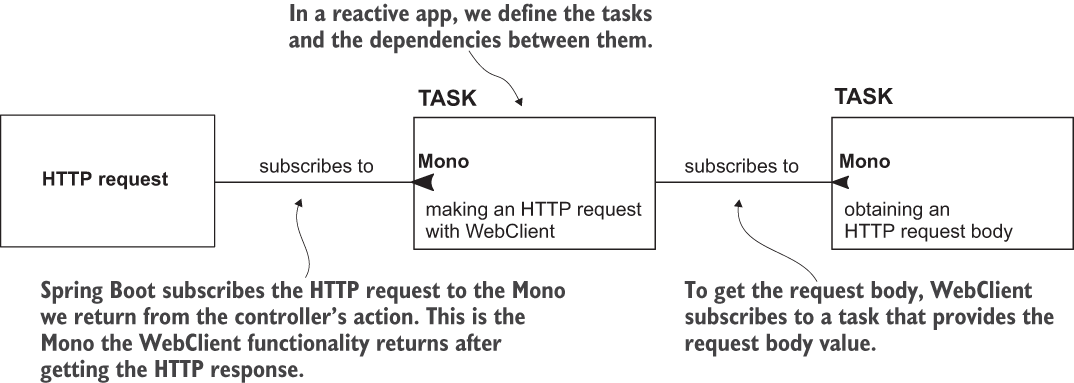 Figure 11.11 The tasks chain in a reactive app. When building a reactive web app, we define the tasks and the dependencies between them. The WebFlux functionality initiating the HTTP request subscribes to the task we create through the producer the controller’s action returns. In our case, this producer is the one we get by sending the HTTP request with WebClient. For WebClient to make the request, it subscribes to another task that provides the request body.
In summary, WebClient is a versatile and powerful tool for building reactive applications in Java, offering a modern approach to handling HTTP requests with efficiency and scalability.
| Book Title | Usage of webclient | Technical Depth | Connections to Other Concepts | Examples Used | Practical Application |
|------------|--------------------|-----------------|-------------------------------|---------------|-----------------------|
| [Spring Boot in Practice](https://www.manning.com/books/spring-boot-in-practice) | Discusses WebClient as a non-blocking, reactive client in Spring WebFlux, focusing on HTTP requests and asynchronous logic composition. [more](https://www.manning.com/books/spring-boot-in-practice) | Provides detailed configuration options using `create()` and `builder()` methods, including setting HTTP headers, codecs, and custom HTTP connectors. [more](https://www.manning.com/books/spring-boot-in-practice) | Connects WebClient usage with reactive programming concepts and HTTP client libraries like Reactor Netty. [more](https://www.manning.com/books/spring-boot-in-practice) | Includes examples of building a WebClient instance, logging HTTP requests/responses, and using various HTTP methods. [more](https://www.manning.com/books/spring-boot-in-practice) | Demonstrates practical use cases like invoking REST APIs with WebClient, showcasing methods like `get()`, `post()`, `put()`, and `delete()`. [more](https://www.manning.com/books/spring-boot-in-practice) |
| [Spring Start Here](https://www.manning.com/books/spring-start-here) | Introduces WebClient as a non-blocking, reactive client for consuming RESTful web services in Spring applications. [more](https://www.manning.com/books/spring-start-here) | Explains setting up WebClient in the Spring context and implementing proxy classes for external REST endpoints. [more](https://www.manning.com/books/spring-start-here) | Highlights the integration of WebClient with Spring's reactive programming model and its role in efficient resource utilization. [more](https://www.manning.com/books/spring-start-here) | Provides examples of adding WebClient to Spring context, implementing proxy classes, and visual representations of WebClient usage. [more](https://www.manning.com/books/spring-start-here) | Focuses on practical scenarios like creating payment services using WebClient, emphasizing reactive programming principles. [more](https://www.manning.com/books/spring-start-here) |
FAQ (Frequently asked questions)
What is WebClient in Spring applications?
Which module is WebClient a part of in Spring?
How does WebClient improve application performance?
How do you implement a proxy class with WebClient in Spring?
How do you specify the base URL in a WebClient proxy class?
How do you specify the HTTP method in a WebClient call?
How do you add headers to a WebClient request?
How do you provide the HTTP request body in a WebClient call?
How do you retrieve the HTTP response body in a WebClient call?