Asynchronous Code in JavaScript
Overview
Asynchronous code in JavaScript is a powerful feature that allows for nonblocking operations. This capability is essential for modern web applications, which often require dynamic data fetching and seamless user interaction without delays. By enabling data to be loaded progressively, asynchronous code ensures that applications remain responsive and efficient, even when dealing with large datasets or complex operations.
A common scenario where asynchronous code is beneficial is in an email client. Here, the inbox can be loaded progressively through multiple asynchronous requests. This approach allows users to interact with recent emails immediately, without having to wait for the entire inbox to load. This enhances the user experience by providing faster access to important information.
Managing Asynchronous Code
JavaScript offers several mechanisms to manage asynchronous code, with Promises being one of the most popular. Promises help in transforming nested callback structures into a more linear and readable flow. They allow developers to chain operations using the then method, which executes a function once a Promise is resolved. Additionally, Promises provide a catch method to handle errors, making error management more straightforward and the code more maintainable.
Challenges with Asynchronous Code
Despite its advantages, asynchronous code can present challenges, particularly when it comes to ensuring that data is available when needed. For instance, consider the scenario depicted in Figure 8.1:
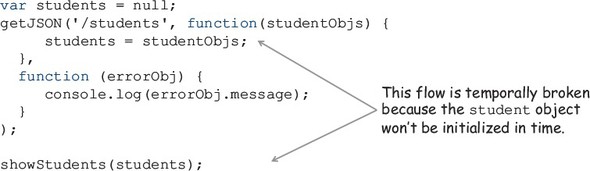 Figure 8.1. This code has a big problem. Can you spot it? Because you need to fetch data asynchronously, the students object will never be populated in time to be added to the roster table.
In this example, the asynchronous nature of data fetching means that the students object may not be populated in time to be added to the roster table. This highlights the importance of carefully managing asynchronous operations to ensure that data dependencies are met and that the application functions correctly.
By understanding and effectively utilizing asynchronous code, developers can create web applications that are both responsive and efficient, providing a better experience for users.
FAQ (Frequently asked questions)
What is the benefit of asynchronous code in JavaScript?
Why is asynchronous code crucial for modern web applications?
What problem can arise when fetching data asynchronously?
How is asynchronous code used in an email client?
How can asynchronous code be managed in JavaScript?
What are the benefits of using Promises in JavaScript?