Chain in JavaScript
In JavaScript, the term "chain" is used to describe a sequence of operations that are linked together, allowing for streamlined and efficient code execution. This concept is prevalent in both functional programming and object-oriented paradigms, as well as in handling asynchronous operations. Below, we explore the different contexts in which chains are utilized in JavaScript.
Chain in Functional Programming
In functional programming, a chain is a technique that involves the sequential invocation of functions, where each function shares a common object return value. This approach allows for writing concise and expressive code, which is particularly useful in functional and reactive programming libraries. Chains are lazily evaluated, meaning that execution is deferred until the result is actually needed, enhancing performance by avoiding unnecessary computations.
Function Chains with Lodash
Libraries like Lodash provide a chain method to facilitate this pattern. For example:
_.chain(enrollment)
  .filter(student => student.enrolled > 1)
  .pluck('grade')
  .average()
  .value(); //-> 90
In this example, a series of operations are chained together to filter students, extract their grades, compute the average, and finally execute the chain with .value(). The call to .value() triggers the execution of all operations in the chain.
Generalized Chain Function
Chains can be generalized to work with any container type:
// map :: (ObjectA -> ObjectB), Monad -> Monad[ObjectB]
const map = R.curry((f, container) => {
    return container.map(f);
});

// chain :: (ObjectA -> ObjectB), Monad -> ObjectB
const chain = R.curry((f, container) => {
    return container.chain(f);
});
These functions allow for the injection of monads into a compose expression, enabling a style of coding known as programmable commas.
Using Chain for Error Handling
Chains are also useful for incorporating error handling in functional programs:
const showStudent = (ssn) =>
   Maybe.fromNullable(ssn)
      .map  (cleanInput)
      .chain(checkLengthSsn)
      .chain(findStudent)
      .map  (R.props(['ssn', 'firstname', 'lastname']))
      .map  (csv)
      .map  (append('#student-info'));
In this example, the chain method is used to transform the value in the monad, maintaining a single monad level flowing through the calls.
Chain in JavaScript
Prototype Chain
In the context of Objects Linked to Other Objects (OLOO), a "chain" refers to an object that is linked to other objects in a prototype chain. This chain is a series of objects connected through their prototypes, allowing for delegation of functionality.
Under the Hood of Object.create
The Object.create method is a fundamental part of creating prototype chains:
Object.create = function(proto, propertiesObject) {
    if (typeof proto !== 'object' && typeof proto !== 'function') {
       throw new TypeError('Object prototype may only be an Object: ' +
          proto);
    }

    function F() {}           #1
    F.prototype = proto;      #2
    return new F();           #3
};
This listing demonstrates how a new object is created with a specified prototype, forming the basis of a prototype chain.
Promise Chain
A promise chain is a sequence of operations performed on promises, where each operation is linked to the next through the use of Promise#then or Promise#catch.
Execution of a Promise Chain
The execution of a promise chain can be visualized as follows:
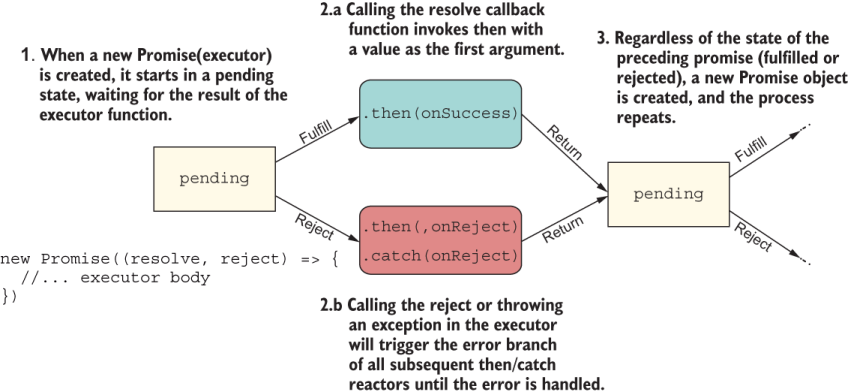 Figure 8.5 A detailed view of the execution of a promise chain.
Fully Linked Chain of Promises
A fully linked chain of promises can be constructed as shown in the following example:
Promise.resolve('aabbcc')
    .then(unique)            #1
    .then(join)              #1
    .then(toUpper);          #1
In this listing, each then method is called only when the preceding promise is fulfilled, demonstrating the sequential nature of promise chains.
In summary, chains in JavaScript provide a powerful mechanism for structuring code in both synchronous and asynchronous contexts, enhancing readability and maintainability.
| Book Title | Usage of chain | Technical Depth | Connections to Other Concepts | Examples Used | Practical Application |
|------------|----------------|-----------------|-------------------------------|---------------|-----------------------|
| [Functional Programming in JavaScript](https://www.manning.com/books/functional-programming-in-javascript) | Discusses chain in the context of functional programming, focusing on sequential invocation of functions and lazy evaluation. | Explores the use of chain with monads, avoiding the need for join after map. | Connects chain to monads, functional and reactive programming. | Provides examples with Lodash and generalized chain functions. | Demonstrates practical use in error handling and data flow management. [more](https://livebook.manning.com/book/functional-programming-in-javascript/chapter-1/142) |
| [The Joy of JavaScript](https://www.manning.com/books/the-joy-of-javascript) | Covers chain in the context of prototype and promise chains, essential for object-oriented and asynchronous programming. | Details the internal workings of Object.create and promise execution. | Links chain to prototype delegation and promise state management. | Includes examples of Object.create and promise chains. | Shows practical use in creating prototype chains and managing asynchronous operations. [more](https://livebook.manning.com/book/the-joy-of-javascript/chapter-3/26) |
FAQ (Frequently asked questions)
What does 'chain' refer to in the context of OLOO?
What functionality does an instance object delegate in OLOO?
How does Object.create work under the hood?
What happens if the prototype in Object.create is not an object or function?
How is a promise chain created?
What happens to each executor in a promise chain?
What occurs if a promise in the chain is successful?
What is the initial state of every Promise object in a promise chain?
How does the state of a Promise object change?
What happens to the result of a Promise object?
What is a fully linked chain of promises?
When are executors called in a promise chain?
What is a chain in functional programming?
Why are chains used in functional and reactive programming libraries?
How does lazy evaluation benefit chains in functional programming?
What is the purpose of calling _.value() in a function chain?
How can function chains be used to process data?
What is the chain method used for in monadic chains?
How does the chain method simplify monadic operations?