Integration Test
Definition
Integration testing is a crucial phase in the software development lifecycle that involves testing the interactions between different components of an application to ensure they work together as expected. Unlike unit testing, which focuses on individual components, integration testing emphasizes the network of components and their interconnections. This approach helps to identify issues that may not be apparent when components are tested in isolation.
Overview
Integration testing provides a redundancy layer that is essential for capturing bugs that might not be evident without executing the application as a whole. By focusing on the interactions between components, integration tests help ensure that the system functions correctly when all parts are combined. This type of testing is particularly important for complex applications where multiple components must work together seamlessly.
To perform integration testing, various tools can be utilized, including:
- Tape: A minimalist JavaScript testing framework for Node.js.
- Sinon: A library for creating spies, mocks, and stubs for JavaScript.
- Proxyquire: A module that allows overriding dependencies during testing.
- Selenium: A tool for browser automation that enables comprehensive client-side testing.
Example
An example of integration testing involves running your application’s web server and sending real HTTP requests to it. The responses are then checked against your assertions to verify that the application behaves as expected. This process can be further enhanced by using Selenium for browser automation, which allows for comprehensive testing of the client-side interactions.
Visual Representation
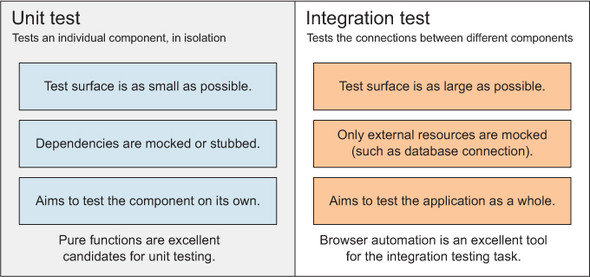 Figure 8.1. Differences between unit and integration testing strategies. Note that a combination of the two should be used. Unit tests and integration tests are not exclusive. Pure functions are discussed in section 8.1.15.
This figure illustrates the differences between unit and integration testing strategies. It is important to note that a combination of both testing strategies should be employed, as they are not mutually exclusive. Each type of testing serves a distinct purpose and together they provide a comprehensive testing approach.
FAQ (Frequently asked questions)
What is the purpose of integration testing?
What does integration testing focus on?
Should unit tests and integration tests be used together?
What does integration testing provide?
What tools can be used for integration testing?
How can integration tests be performed?
What tool can be used for browser automation in integration testing?