Map in JavaScript
The term "map" in JavaScript can refer to both a method used for transforming arrays and a data structure for storing key-value pairs. This entry synthesizes information from various JavaScript books to provide a comprehensive understanding of the concept.
Map Method for Arrays
The map method is a higher-order function that is used to transform arrays. It applies a given function to each element of an array and returns a new array with the transformed elements. This method is fundamental in functional programming and is widely used for data manipulation in JavaScript.
Functional Programming Perspective
In functional programming, the map function is crucial for transforming data in a declarative manner. It applies a function to each element in a container, such as an array, and returns a new container with the transformed values. This operation is side-effect-free and allows for composable data transformations.
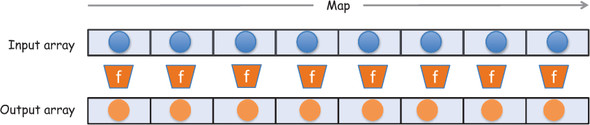 Figure 3.4. The map operation applies an iterator function f to each element in an array and returns an array of equal length.
Practical Examples
The map method can be used to perform various transformations on arrays. For example, doubling each number in an array:
const numbers = [1, 2, 3, 4];
const doubled = numbers.map(number => number * 2);
console.log(doubled); // Output: [2, 4, 6, 8]
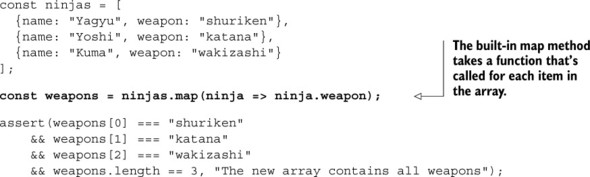 Figure: Mapping an array using the
map method.
Data Wrangling
The map function is also used in data wrangling to transform data sets. It allows for the repair or transformation of data without altering the original array. For instance, fixing date/time values in a data set:
function transformRow(inputRow) {
  const outputRow = Object.assign({}, inputRow);
  outputRow.start_datetime = parseDate(inputRow.start_datetime, inputRow.timezone);
  outputRow.end_datetime = parseDate(inputRow.end_datetime, inputRow.timezone);
  return outputRow;
}

function transformData(inputData) {
  return inputData.map(transformRow);
}
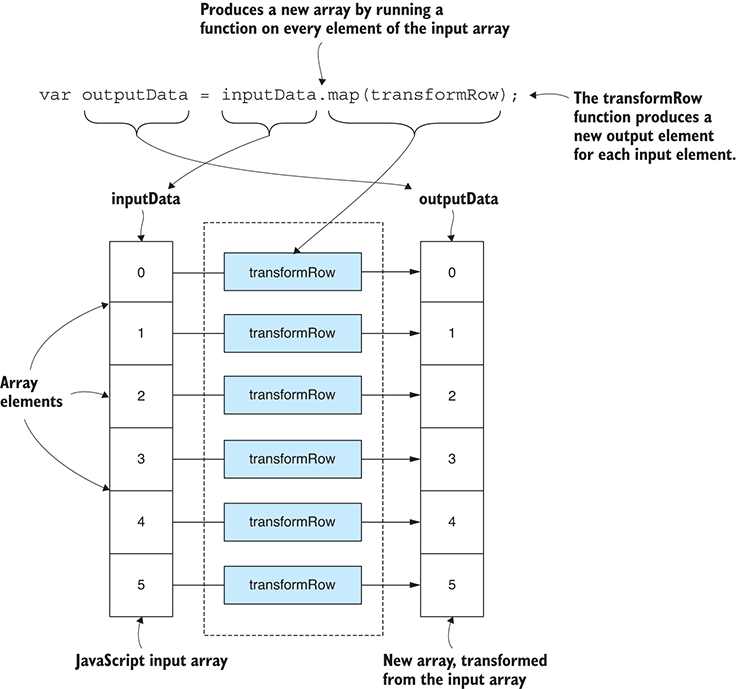 Figure 6.6 Using the JavaScript map function to transform an array of data from one structure to another.
Map as a Data Structure
In addition to the map method for arrays, JavaScript provides a Map object, which is a collection of key-value pairs. Unlike objects, maps allow keys of any type and maintain the order of insertion, making them suitable for scenarios where the order of elements is important or when keys are not limited to strings.
Creating and Using Maps
Maps are created using the Map constructor and provide several methods for managing entries:
const ninjaIslandMap = new Map();
const ninja1 = { name: "Yoshi" };
ninjaIslandMap.set(ninja1, { homeIsland: "Honshu" });
console.log(ninjaIslandMap.get(ninja1).homeIsland); // Output: "Honshu"
Key Equality
Key equality in maps is based on object identity, meaning two different objects with the same content are considered different keys.
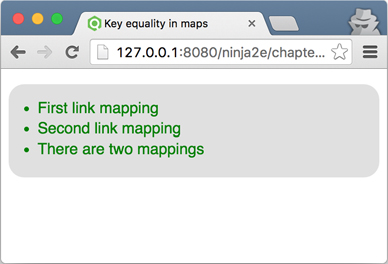 Figure 9.15. If we run the code from listing 9.17, we can see that key equality in maps is based on object equality.
Iterating Over Maps
Maps can be iterated over using for...of loops, which provide access to each key-value pair in the order they were added. Additionally, the keys() and values() methods can be used to iterate over the keys and values, respectively.
Why Not Use Objects as Maps?
While objects can store key-value pairs, they inherit properties from their prototypes and only support string keys, which can lead to unexpected behavior. Maps provide a more robust and predictable way to handle key-value pairs.
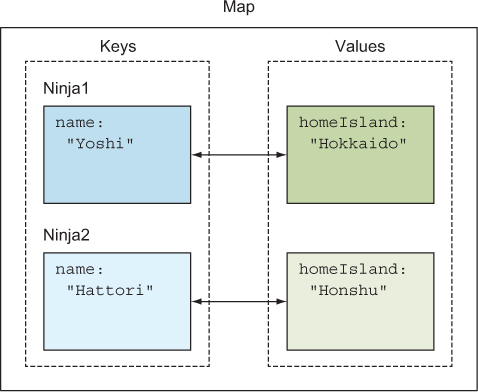 Figure 9.14. A map is a collection of key-value pairs, where a key can be anything—even another object.
In summary, the map function and Map object are versatile tools in JavaScript, each serving distinct purposes in data transformation and storage. They are essential for efficient and effective data manipulation and management in modern JavaScript applications.
Here's a markdown table comparing how different JavaScript books discuss the term 'map':
| Book Title | Usage of map | Technical Depth | Connections to Other Concepts | Examples Used | Practical Application |
|------------|--------------|-----------------|-------------------------------|---------------|-----------------------|
| The Joy of JavaScript | Discusses map as a higher-order function for data transformation, part of the functor interface. | Explores functor and monad mixins, method fusion for performance. | Connects map to functors and monads, emphasizing composability. | Uses array transformations and method fusion examples. | Highlights functional and efficient data transformation. more |
| Secrets of the JavaScript Ninja, Second Edition | Describes Map as a collection for key-value pairs, distinct from objects. | Details map creation, key equality, and iteration methods. | Compares maps to objects, emphasizing key-value storage. | Provides examples of creating and manipulating maps. | Focuses on robust key-value storage and iteration. more |
| Functional Programming in JavaScript | map as a higher-order function for transforming data in functional programming. | Discusses map in arrays and custom data types like Wrapper. | Links map to functional programming principles and monadic containers. | Demonstrates map with arrays and custom data types. | Emphasizes declarative data manipulation. more |
| Designing Scalable JavaScript Applications | Covers map method for arrays and Map object for key-value pairs. | Explains array transformations and map methods like set, get. | Differentiates between map method and Map object. | Examples of array transformations and map creation. | Highlights array transformations and key-value management. more |
| Get Programming with JavaScript | Uses map in the context of a game to represent interconnected places. | Discusses dynamic structure and on-demand loading of map data. | Separates map data from game logic for flexibility. | Illustrates map builder and data separation. | Focuses on game map design and management. more |
| Data Wrangling with JavaScript | map function for transforming data records in arrays. | Details transformation of data without altering original arrays. | Uses map for data repair and transformation tasks. | Examples of fixing bad data and generalizing patterns. | Emphasizes data transformation and repair. more |
Each book provides a unique perspective on the usage and application of the map function in JavaScript, ranging from functional programming to practical data manipulation and game design.
FAQ (Frequently asked questions)
What is a map function in JavaScript?
What role does map play in functional programming?
How does the map function work in a functor?
What is the default function argument for map in a functor?
What does the map function return in a functor?
How can map and chain functions be generalized for any container?
What is the map function in functional programming?
How does the map operation work?
How is the map function implemented in JavaScript?
What does the map function do in functional programming?
How does the Wrapper type use the map function?
How does the Wrapper class implement the map function?
What is the fmap function in the Wrapper class?
What is the purpose of the map function in a monadic context?
What does the map method do in JavaScript?
How does the map method work in JavaScript?
What is the purpose of the map method in JavaScript?
What are maps in JavaScript?
What methods do maps provide in JavaScript?
Why shouldn't objects be used as maps in JavaScript?
How do you create a map in JavaScript?
How can you iterate over maps in JavaScript?
What is the map in The Crypt?
How is map data managed in The Crypt?
What is the purpose of the map builder in The Crypt?
How does The Crypt handle map loading?
What does loading a map on demand mean in The Crypt?
What does the map function do in JavaScript?
How is the map function commonly used?
How can the map function be used to handle bad data?