Mock in JavaScript
In JavaScript, a "mock" is a concept used primarily in the context of unit testing. Mocks are simulated objects that mimic the behavior of real objects in a controlled manner. They are essential tools for developers to isolate the system under test by replacing dependencies with controlled versions that simulate specific behaviors. This allows for testing the behavior of a component without relying on the actual implementations of its dependencies.
Definition
A mock is a type of test double used in unit testing to simulate the behavior of real objects. It implements an interface but does not perform any real operations. Instead, it provides predefined responses to method calls, allowing for testing of a module's behavior without relying on actual implementations of its dependencies. This is crucial for isolating the unit of work being tested, ensuring that tests are not affected by the behavior of external components or systems.
For more details, see the definition of mock in "JavaScript Application Design: A Build First Approach" and definition of mock in "Designing Scalable JavaScript Applications".
Overview
Mocks are primarily used in testing to isolate the system under test by replacing dependencies with controlled versions that simulate specific behaviors. This isolation is crucial for verifying interactions between components and ensuring that the code being tested behaves as expected without interference from external factors. By using mocks, developers can simulate various scenarios and edge cases, ensuring that the module under test behaves as expected in different situations.
Usage in Testing
In scenarios where greater isolation is required, even though two parts of an application cannot be decoupled further, mocks can be particularly useful. For instance, an application might need to query a real database, fetch data using a service, or connect different modules. In such cases, mocks, along with other tools like spies and proxies, can help circumvent the testing issues introduced by tight coupling.
Figure 8.2](https://livebook.manning.com/book/javascript-application-design/chapter-5/125)
The following figure illustrates the issue of testing with tightly coupled code and the solution provided by using mocks:
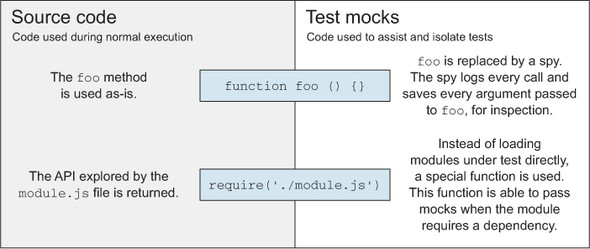 Figure 8.2. Using source code as-is versus using mocks when testing
This figure demonstrates the difference between using the source code as-is and using mocks during testing. By employing mocks, developers can simulate dependencies and focus on testing the specific behavior of the component under test, leading to more reliable and maintainable code.
For more information, refer to the usage of mocks in testing in "JavaScript Application Design: A Build First Approach".
| Book Title | Usage of mock | Technical Depth | Connections to Other Concepts | Examples Used | Practical Application |
|------------|---------------|-----------------|-------------------------------|---------------|-----------------------|
| [JavaScript Application Design: A Build First Approach](https://www.manning.com/books/javascript-application-design) | Mocks are used to simulate dependencies, allowing tests to focus on the behavior of the component being tested without relying on actual implementations. [more](https://livebook.manning.com/book/javascript-application-design/chapter-8/82) | Discusses the importance of isolation in testing and how mocks help achieve it. [more](https://livebook.manning.com/book/javascript-application-design/chapter-8/82) | Connects mocks with other testing tools like spies and proxies. [more](https://livebook.manning.com/book/javascript-application-design/chapter-8/82) | Includes a figure illustrating the use of mocks in testing tightly coupled code. [more](https://livebook.manning.com/book/javascript-application-design/chapter-8/figure--8-2) | Highlights the role of mocks in creating reliable and maintainable code. [more](https://livebook.manning.com/book/javascript-application-design/chapter-8/82) |
| [Designing Scalable JavaScript Applications](https://www.manning.com/books/designing-scalable-javascript-applications) | Mocks provide predefined responses to method calls, allowing for testing of a module's behavior without relying on actual implementations. [more](https://livebook.manning.com/book/designing-scalable-javascript-applications/part-2/146) | Emphasizes the role of mocks in isolating the unit of work being tested. [more](https://livebook.manning.com/book/designing-scalable-javascript-applications/part-2/146) | Highlights the use of mocks in testing complex systems with unavailable or unreliable dependencies. [more](https://livebook.manning.com/book/designing-scalable-javascript-applications/part-2/146) | No specific examples mentioned. [more](https://livebook.manning.com/book/designing-scalable-javascript-applications/part-2/146) | Focuses on writing robust and reliable tests that are independent of the environment. [more](https://livebook.manning.com/book/designing-scalable-javascript-applications/part-2/146) |
FAQ (Frequently asked questions)
What is a mock in unit testing?
How does a mock function in unit testing?
What is a mock in unit testing?
How do mocks function in testing?
Why are mocks used in unit testing?