Ohm
Overview
Ohm is the unit of measurement for resistance in an electrical circuit. It quantifies how much a material resists the flow of electric current. Resistance is a fundamental concept in electronics, as it determines how much current will flow through a component when a voltage is applied across it. The unit is named after Georg Simon Ohm, a German physicist who formulated Ohm's Law.
Ohm's Law
Ohm's Law is a key principle in electronics that relates voltage (V), current (I), and resistance (R) in an electrical circuit. The law is typically expressed with the formula:
[ V = I \times R ]
This equation shows that the voltage across a component is equal to the current flowing through it multiplied by its resistance. Ohm's Law is essential for calculating the values needed in circuit design and analysis.
Practical Application
One of the most common calculation needs in hobby electronics is determining the appropriate resistor value to use in a circuit. This is particularly important when you want to ensure that a component, such as an LED, receives the desired current.
Example Problem
Consider a scenario where you have a 6 V supply voltage and you want to provide an LED with 20 mA of current. The question is: what resistor value is needed?
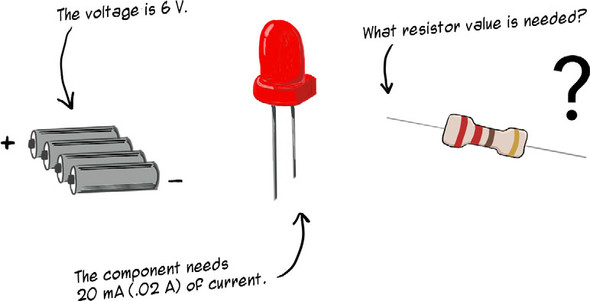 Figure 3.8. A common real-world Ohm’s law problem: what resistor value is needed to provide an LED with 20 mA of current in a circuit with a 6 V supply voltage?
In this problem, the voltage is defined by the power supply, and the desired current is specified. Using Ohm's Law, you can solve for the resistance (R) needed to achieve this current with the given voltage. This type of calculation is fundamental in designing circuits that function correctly and safely.
FAQ (Frequently asked questions)
What is the unit of measurement for resistance in an electrical circuit?
What does an ohm quantify in an electrical circuit?