Ohm's Law
Ohm's Law is a fundamental principle in electronics that describes the relationship between voltage (V), current (I), and resistance (R) in an electrical circuit. This law is crucial for designing and understanding circuits, and it is expressed through the following equations:
- ( V = I \times R )
- ( I = \frac{V}{R} )
- ( R = \frac{V}{I} )
These equations allow you to calculate one of the three variables if the other two are known, making it an essential tool for anyone working with electronic circuits.
Visualizing Ohm's Law
To help visualize and remember these relationships, consider the analogy of a cookie imprinted with the factors of Ohm's Law. By "biting off" the edge of the cookie that represents the factor you want to solve for, you can quickly see the equation you need. For example, if you want to determine resistance (R), you could "bite off" that part and see that ( R = \frac{V}{I} ).
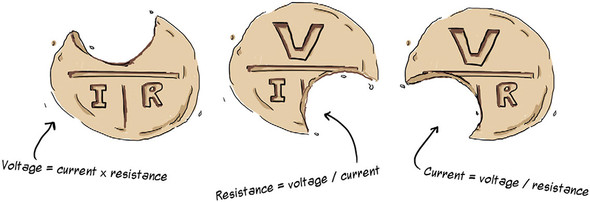 Figure 3.7. By biting off the edge of the cookie imprinted with the factor the cookie-eater wants to figure out, they can quickly see the equation they need to solve. For example, if they want to determine resistance (R), they could bite that off and see that R = voltage (V) divided by current (I).
Practical Application of Ohm's Law
One of the most common applications of Ohm's Law in hobby electronics is determining the appropriate resistor value needed to ensure a component, such as an LED, receives the desired current. For instance, if you have a circuit with a 6 V supply voltage and you want to provide an LED with 20 mA of current, you can use Ohm's Law to calculate the necessary resistance:
[ R = \frac{V}{I} = \frac{6 , \text{V}}{0.02 , \text{A}} = 300 , \text{ohms} ]
This calculation ensures that the LED receives the correct amount of current without being damaged.
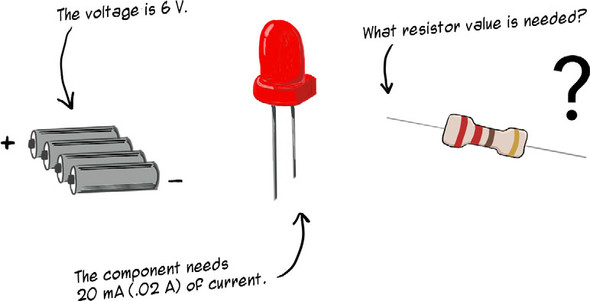 Figure 3.8. A common real-world Ohm’s law problem: what resistor value is needed to provide an LED with 20 mA of current in a circuit with a 6 V supply voltage?
In another example, if you have a 5 V supply and need to provide 20 mA of current, the resistance can be calculated as follows:
[ R = \frac{5 , \text{V}}{0.02 , \text{A}} = 250 , \text{ohms} ]
These examples illustrate how Ohm's Law is applied in real-world scenarios to ensure that electronic components function correctly and safely.
FAQ (Frequently asked questions)
What is Ohm's law?
What are the equations of Ohm's law?
Why is Ohm's law important?
How can you determine resistance using Ohm's law?
What is a creative way to remember Ohm's law equations?
How do you calculate the resistor value for an LED using Ohm's law?
What is a real-world application of Ohm's law?
What is the formula for Ohm's law?
How do you calculate resistance with given voltage and current?