Parallel Communication
Parallel communication is a method of transmitting multiple bits of data simultaneously across multiple channels. This approach contrasts with serial communication, where bits are sent sequentially, one at a time. The primary advantage of parallel communication is its ability to transfer data at a higher rate due to the simultaneous transmission of bits.
Overview
In parallel communication, each bit of data is sent over its own dedicated channel. This means that if you are transmitting an 8-bit byte, you would need eight separate channels to send all bits at once. This method is particularly useful in applications where speed is critical, and the complexity of multiple connections can be managed.
One common example of parallel communication in hardware is the 16x2 LCD module. This type of display uses a parallel interface, which necessitates multiple connections to effectively send data to the display. The parallel interface allows for faster data transfer rates, which is beneficial for updating the display quickly.
Visual Representation
To better understand the difference between serial and parallel communication, consider the following illustration:
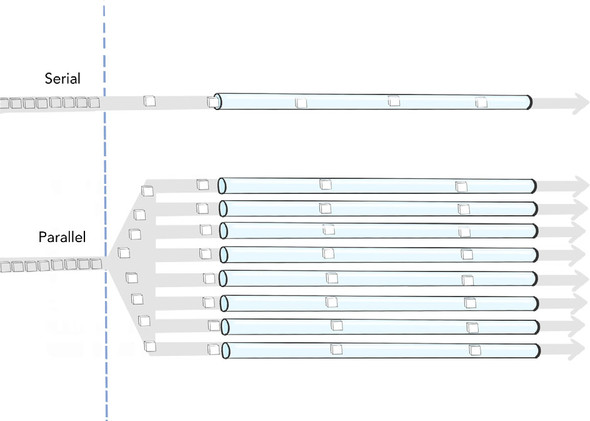 Figure 7.3. In serial communication (top), one bit is sent at a time sequentially. In contrast, parallel communication (bottom) transmits multiple bits at the same time.
In Figure 7.3, the top part of the image shows serial communication, where data is sent one bit at a time. The bottom part illustrates parallel communication, where multiple bits are transmitted simultaneously. This visual representation highlights the fundamental difference in data transmission methods between serial and parallel communication.
FAQ (Frequently asked questions)
What is parallel communication?
How does a 16x2 LCD module use parallel communication?
How does parallel communication differ from serial communication?