Raspberry Pi
Overview
The Raspberry Pi is a widely recognized single-board computer (SBC) platform, celebrated for its power, efficiency, and feature-rich design. Each generation of the Raspberry Pi, from 1 to 3, has seen improvements in performance and capabilities. Despite its versatility, the Raspberry Pi can present challenges for beginners, primarily due to its Linux-based operating system and the complexity of its GPIO (General Purpose Input/Output) pins. The default operating system for the Raspberry Pi is Raspbian, and there is a wealth of resources available to support users in navigating its features.
Raspberry Pi Models
Raspberry Pi 3
The Raspberry Pi 3 is a notable model within the Raspberry Pi lineup, equipped with a quad-core, 64-bit ARM CPU, 1 GB of RAM, and built-in WiFi and Bluetooth capabilities. It operates as a 3.3 V device and features complex GPIO pinouts, making it a robust platform for various hardware projects. The Raspberry Pi 3 can function as a host in a host-client setup, managing connected devices such as an Arduino and running applications, which underscores its utility in hardware development.
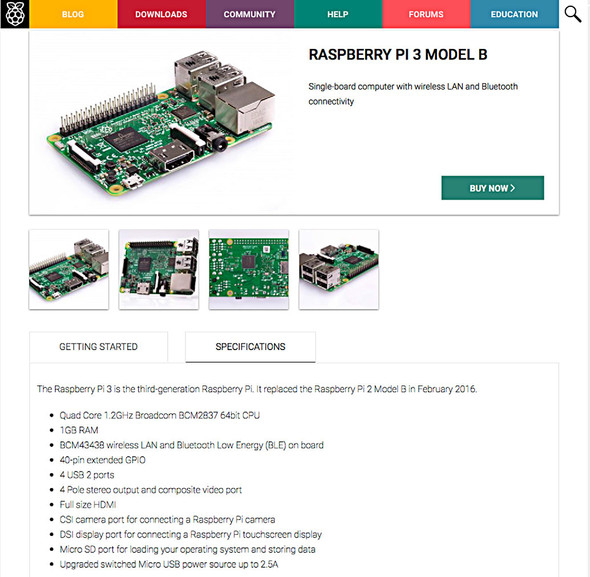 Figure 11.10. Highlights of the Raspberry Pi 3 Model B specs on the Raspberry Pi website
Other Models
The Raspberry Pi family includes several models, each catering to different needs and applications. The Raspberry Pi 2 Model B and the Raspberry Pi Zero are other popular variants. The Raspberry Pi 2 Model B offers a balance of performance and cost, while the Raspberry Pi Zero is known for its compact size and affordability, making it ideal for projects where space and budget are constraints.
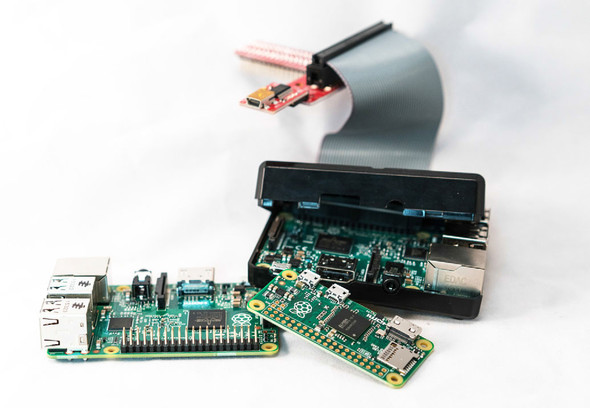 Figure 11.2. Raspberry Pi 2 Model B (left), Raspberry Pi Zero (center foreground), and Raspberry Pi 3 Model B (in a case, with attached SparkFun Pi Wedge)
Single-Board Computers (SBCs)
Single-board computers like the Raspberry Pi are compact yet powerful devices that blend general-purpose computing with the characteristics of embedded systems. These small computers are equipped with multiple USB ports, Bluetooth, WiFi, and Ethernet, offering features typical of a desktop computer. However, their reduced size, lower cost, GPIO support, and relative power efficiency make them particularly suitable for embedded applications.
 Figure 11.1. Single-board computers (SBCs), left to right: Intel Edison module with Arduino breakout, Raspberry Pi 2 Model B, and BeagleBone Black
In summary, the Raspberry Pi stands out as a versatile and powerful tool for both beginners and experienced developers, offering a platform for a wide range of computing and hardware projects.
FAQ (Frequently asked questions)
What is the Raspberry Pi?
What operating system does the Raspberry Pi use?
Is the Raspberry Pi suitable for beginners?
What models of Raspberry Pi are shown in Figure 11.2?
What are the specifications of the Raspberry Pi 3?
What voltage does the Raspberry Pi 3 operate at?
Where can I find the specifications for the Raspberry Pi 3 Model B?
Can the Raspberry Pi 3 be used as a host?
What can the Raspberry Pi 3 manage in a host-client setup?