Recursion in Functional Programming
Overview of Recursion
Recursion is a powerful technique used in programming to solve problems by breaking them down into smaller, self-similar problems. A recursive function typically consists of two main components: base cases and recursive cases. The base case provides a concrete result without further recursion, ensuring that the function terminates. The recursive case involves the function calling itself with smaller inputs, gradually working towards the base case.
In functional programming, recursion is often preferred over traditional loops. This is because recursion aligns well with the functional paradigm, which emphasizes immutability and the use of functions as first-class citizens. Additionally, tail-call optimization (TCO) can be applied to recursive functions to enhance their efficiency by minimizing stack usage.
Thinking Recursively
Thinking recursively requires a shift in mindset from conventional iterative approaches. It involves conceptualizing a problem in terms of itself or a modified version of itself. This approach necessitates decomposing problems into smaller, self-similar problems that can be solved recursively. By doing so, complex problems can be tackled in a more elegant and concise manner.
Recursively Defined Data Structures
Recursively defined data structures, such as trees, are prevalent in software development. These structures are characterized by each element being defined in terms of a smaller version of itself. They are commonly used to model hierarchical data, such as XML documents, file systems, and social graphs. Understanding recursion is crucial for effectively working with these data structures.
Examples of Recursion
Recursive Addition
One example of recursion is performing addition on an array of numbers. The following code snippet demonstrates a recursive function that sums the elements of an array:
function sum(arr) {
   if(_.isEmpty(arr)) {                               #1
      return 0;
   }
   return _.first(arr) + sum(_.rest(arr));            #2
}
sum([]); //-> 0
sum([1,2,3,4,5,6,7,8,9]); //->45
#1 - Base case (terminating condition)
#2 - Iterative case: calls itself on a smaller input using _.first and _.rest
Factorial Function
Another classic example of recursion is the factorial function, which can be implemented recursively as follows:
const factorial = (n) =>
   (n === 1) ? 1
    : (n * factorial(n - 1));
Tail-Call Optimization and Emulation
Tail-call optimization (TCO) is a technique used to optimize recursive functions by reducing stack usage. In a tail-recursive function, the recursive call is the last operation performed, allowing the current function frame to be replaced with the new one. This optimization is akin to evaluating the function in a loop, making it more efficient.
Converting Non-Tail Calls to Tail Calls
To convert non-tail recursive calls to tail calls, ensure that the last action in the function is the recursive call itself. This can be achieved by moving any operations that occur after the recursive call into the function's parameters. For instance, in the factorial function, the multiplication can be moved to an additional parameter to keep track of the current multiplication, allowing the recursive call to be in tail position.
Emulating Tail-Recursive Calls in ES5
In environments like ES5, which do not support tail-call optimization, tail-recursive calls can be emulated using a technique called trampolining. Trampolining involves using a function combinator that repeatedly invokes a function until a certain condition is met, effectively simulating tail recursion in an iterative manner.
Visualizing Recursion
Recursive Preorder Traversal
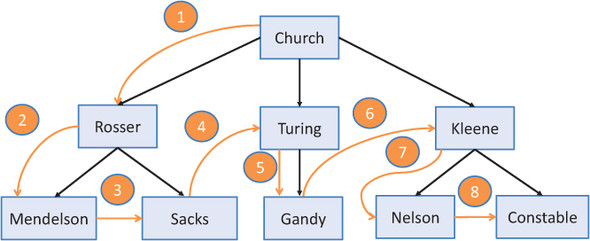 Figure 3.9. Recursive preorder traversal, starting with the root and descending all the way to the left before going to the right
Tail-Recursive Factorial Evaluation
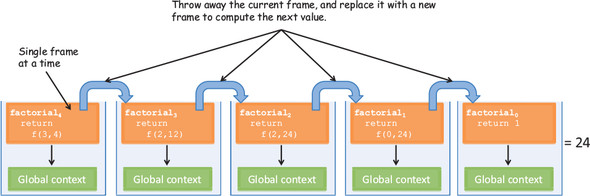 Figure 7.9. A detailed view of tail-recursive factorial(4) evaluation. As you can see, the function uses a single frame. TCO is in charge of throwing the current function frame to give way for a new one, as if factorial was being evaluated in a loop.
The tail-recursive factorial evaluation demonstrates how TCO allows the function to use a single frame, making efficient use of the stack. This approach prevents the need to unwind multiple frames, as seen in traditional recursive calls.
FAQ (Frequently asked questions)
What is recursion in programming?
What are the main parts of a recursive function?
What is the role of the base case in recursion?
How does the recursive case work in a recursive function?
What is a recursive preorder traversal?
How is recursive addition performed in JavaScript?
What is the base case in the recursive addition function?
What is the iterative case in the recursive addition function?
What does thinking recursively involve?
How does one learn to think recursively?
What are recursively defined data structures?
Where are recursively defined data structures commonly used?
What is recursion in functional programming?
What is tail-call optimization in recursion?
How can the factorial function be implemented recursively?
How do you convert non-tail recursive calls to tail calls?
How is the factorial function modified for tail-call optimization?
How can tail-recursive calls be emulated in ES5?