Resistor
A resistor is a fundamental component in electronic circuits, used to control the flow of electric current. Resistors are characterized by their resistance value, which is measured in ohms (Ω). They are essential in various applications, including current limiting, voltage division, and signal conditioning.
Identification and Color Coding
Resistors are typically identified by a series of color bands painted on their bodies. These color bands represent the resistor's resistance value and tolerance. The most common systems for color coding are the four-band and five-band systems.
-
Four-band resistors: These have two digit bands, a multiplier band, and a tolerance band. The first two bands represent the first two significant digits of the resistance value, the third band is the multiplier, and the fourth band indicates the tolerance.
-
Five-band resistors: These include an additional digit band, providing more precision in the resistance value.
Selecting Resistors for LEDs
When using resistors with LEDs, it is crucial to select the appropriate resistance to ensure the LED operates safely and efficiently. This involves calculating the needed resistance using Ohm's law, which considers the supply voltage and the LED's forward voltage drop. The formula used is:
[ R = \frac{V_{\text{source}} - V_{\text{LED}}}{I_{\text{LED}}} ]
Where ( R ) is the resistance, ( V_{\text{source}} ) is the supply voltage, ( V_{\text{LED}} ) is the forward voltage drop of the LED, and ( I_{\text{LED}} ) is the desired current through the LED.
Example Applications
An example of a resistor application is the use of a 10 kΩ pull-down resistor in a button circuit. This resistor is used to prevent floating and ensure a stable LOW state when the button is not pressed. Pull-down resistors are essential in digital circuits to maintain a defined logic level.
Resistors in Series and Parallel Circuits
In series circuits, resistor values add together, affecting the total resistance and voltage distribution across the circuit. This is illustrated in Figure 3.14, which shows how resistor values combine in a series configuration.
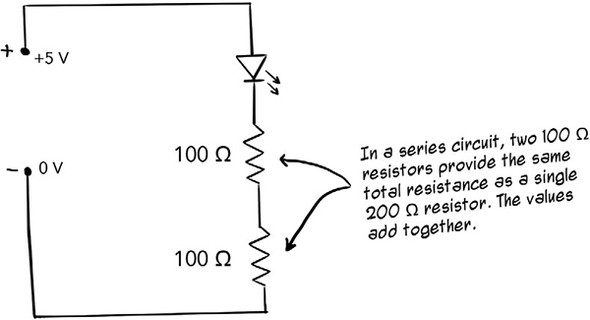 Figure 3.14. Resistor values add together in a series circuit.
In parallel circuits, resistors can be used to distribute current across multiple paths. Figure 3.31 demonstrates a parallel LED circuit powered by a 9 V battery, where resistors are swapped to accommodate the power supply.
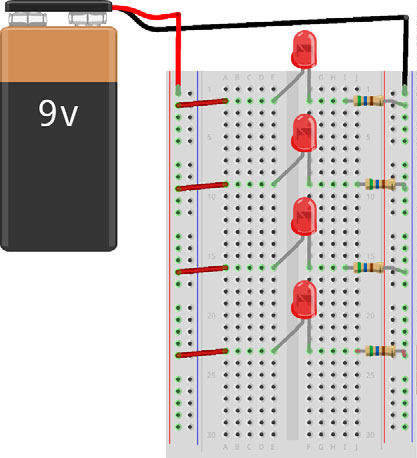 Figure 3.31. Powering the parallel LED circuit with a 9 V battery involves swapping out some resistors and connecting a 9 V battery snap to the power rails.
Resistors play a crucial role in managing current and voltage in both series and parallel circuits, ensuring the proper functioning of electronic components.
FAQ (Frequently asked questions)
How are resistors color-coded?
What do the bands on a four-band resistor represent?
How do you select a resistor for an LED?
How are resistors identified?
What are common systems for resistor color coding?
What is an example of a resistor used in a button circuit?