Scoping in JavaScript
Scoping in JavaScript is a fundamental concept that determines the accessibility of variables and functions in different parts of the code. JavaScript primarily uses lexical scoping, which means that the scope is determined by the position of functions and blocks in the code. This allows variables to be accessible within the function they are declared in and any nested functions. Understanding scoping is crucial for building robust JavaScript applications, as it defines where variables are accessible and helps in properly hiding information.
Overview of Scoping
Scoping in JavaScript is primarily function-level, a concept known as lexical scoping. This means that the scope of a variable is determined by its location within the source code, and nested functions have access to variables declared in their outer scope. This is in contrast to block scoping, which is used in languages like C#, Java, and C++. Lexical scoping allows for more flexible code but also introduces the potential for variable conflicts.
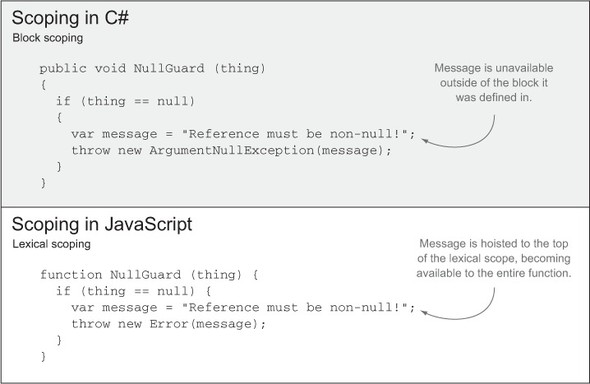 Figure 5.2. Discrepancies in scoping across languages
In Figure 5.2, a message variable is used in both examples. In the first example, message is only available inside the if statement block, while in the second example, message is available to the entire function, thanks to lexical scoping.
The this Keyword
The this keyword in JavaScript is a crucial part of understanding scoping, as it refers to the object it belongs to. However, its value can change depending on how a function is called. By default, outside of strict mode, this will refer to the global object, which is the Window object in a browser environment. This behavior is demonstrated in the following example:
Listing 5.3. Understanding the this keyword
function scoping () {
    console.log(this);

    return function () {
        console.log(this);
    };
}
scoping()();
// <- Window
// <- Window
In this example, both console.log(this) statements output the global Window object, illustrating the default behavior of this.
Manipulating this
There are different ways to manipulate the this keyword. The most common way is to invoke methods on an object, which assigns the object as the this context. For example, when calling 'Hello'.toLowerCase(), 'Hello' is used as the this context for the function call.
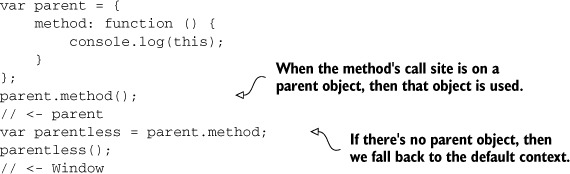
When functions are invoked directly as properties on an object, the object becomes the this reference. However, if a method is detached from its object and invoked, this defaults back to the global object. This behavior is shown in the following example:
Listing 5.4. Scoping the this keyword
var parent = {
    method: function () {
        console.log(this);
    }
};
parent.method();    // <- parent
var parentless = parent.method;
parentless();
// <- Window
In this example, when method is called on parent, this refers to parent. However, when method is assigned to parentless and called, this defaults to the global Window object.
Strict Mode
Under strict mode, the behavior of this changes. Instead of defaulting to the global object, this will be undefined if not explicitly set. This can help prevent accidental modifications to the global object and is a recommended practice for writing more secure JavaScript code.
Understanding scoping and the this keyword is essential for managing variable lifetimes and ensuring that variables are only accessible where they are intended to be. This knowledge is crucial for developing scalable and maintainable JavaScript applications.
| Book Title | Usage of Scoping | Technical Depth | Connections to Other Concepts | Examples Used | Practical Application |
|------------|------------------|-----------------|-------------------------------|---------------|-----------------------|
| [JavaScript Application Design: A Build First Approach](https://www.manning.com/books/javascript-application-design) | Discusses lexical scoping and contrasts it with block scoping used in other languages. | Explains the `this` keyword and its behavior in different contexts, including strict mode. | Connects scoping to the `this` keyword and its manipulation. | Provides examples with code listings and figures to illustrate scoping and `this` behavior. | Highlights the importance of understanding scoping for writing flexible and secure code. [more](https://livebook.manning.com/book/javascript-application-design/chapter-5/50) |
| [Designing Scalable JavaScript Applications](https://www.manning.com/books/designing-scalable-javascript-applications) | Focuses on function-level scoping and its importance in building robust applications. | Details the dynamic nature of the `this` keyword and its implications. | Links scoping to variable accessibility and information hiding. | Includes code examples to demonstrate the default behavior of `this` and its manipulation. | Emphasizes scoping as crucial for managing variable lifetimes and preventing unexpected behavior. [more](https://livebook.manning.com/book/designing-scalable-javascript-applications/part-2/1) |
FAQ (Frequently asked questions)
What is scoping in JavaScript?
Why is scoping important in JavaScript?
What does scoping in JavaScript refer to?
What is scoping in JavaScript?
What type of scoping does JavaScript use?
What does the 'this' keyword refer to in JavaScript?
How does the 'this' keyword change in JavaScript?
Why is understanding the 'this' keyword important in JavaScript?
How is variable scoping determined in JavaScript?
Where are variables accessible in JavaScript?
What does scoping refer to in programming?