Serial Communication
Serial communication is a fundamental method of data transmission in electronics, where digital data is sent one bit at a time over a communication channel. This approach contrasts with parallel communication, which transmits multiple bits simultaneously. Serial communication is favored for its simplicity and reduced wiring requirements, making it widely used in various electronic components.
Overview
Serial communication involves the exchange of data between devices using specific protocols. It can be categorized into asynchronous and synchronous types. Asynchronous serial communication, a common form, does not use a shared clock signal. Instead, devices must agree on a baud rate and use data frames to structure the transmission. Synchronous serial communication, on the other hand, uses a shared clock line to synchronize data exchange, allowing multiple devices to communicate over a single bus without pre-configured data rates.
Asynchronous Serial Communication
Asynchronous serial communication is characterized by the absence of a shared clock signal. Each device acts as its own timekeeper, necessitating a common agreement on the baud rate, which is the speed of bits expressed in bits per second (bps). Data is transmitted in frames, each consisting of a start bit, 5-9 data bits, a stop bit (or two), and optionally a parity bit for error detection.
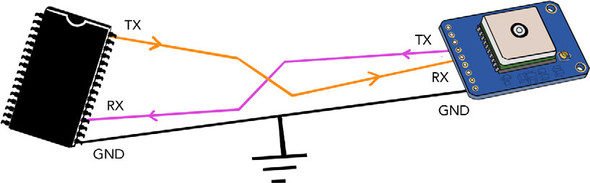 Figure 7.5. The exchange of asynchronous serial data: each of two connected devices can transmit (TX) data to and receive (RX) data from the other component. Note that one device’s TX connects to the other’s RX and vice versa. A GPS breakout board like Adafruit’s is an example of a component that communicates its data using asynchronous serial.
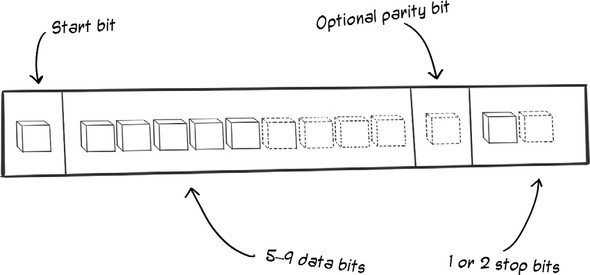 Figure 7.6. A frame of asynchronous serial data. A single start bit is followed by 5–9 bits of data. A parity bit may be used for error detection. Then one or two stop bits indicate the end of the frame.
A practical example of asynchronous serial communication is the Firmata protocol, which transmits data in 8-bit chunks (8N1) between a host computer and an Arduino board via a USB cable. The Arduino's Universal Asynchronous Receiver/Transmitter (UART) handles the serial data exchange.
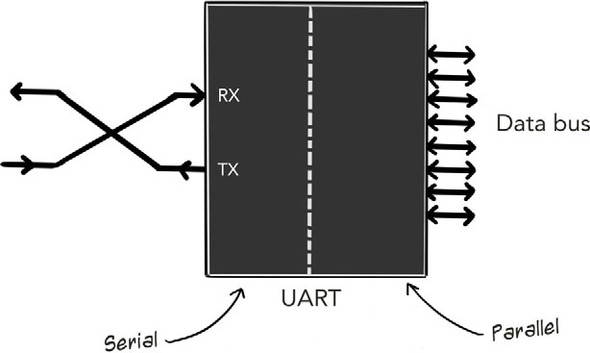 Figure 7.8. A UART is specialized hardware for asynchronous serial communication and parallel-to-serial conversion.
Synchronous Serial Communication
Synchronous serial communication uses a shared clock line to synchronize data exchange between devices. This method allows for efficient communication with multiple devices on a single bus, as seen in protocols like SPI and I2C. These protocols enable multiple devices to communicate over shared lines, optimizing the use of development board I/O pins.
Protocols and Applications
Serial communication protocols such as UART, SPI, and I2C are integral to data exchange between devices. UARTs are hardware components that manage asynchronous serial communication, converting parallel data to serial and vice versa. SPI and I2C, as synchronous protocols, facilitate communication with multiple devices using a shared clock line.
An example of serial communication in action is the use of the I2C protocol to connect a HMC5883L magnetometer to an Arduino Uno. This setup allows for data exchange with minimal wiring, demonstrating the efficiency and versatility of serial communication in electronic projects.
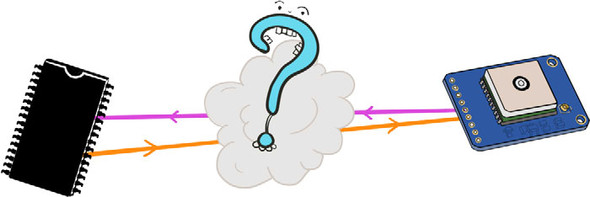 Figure 7.4. For devices to exchange data using serial communication, they need to know how to talk to each other.
The Johnny-Five library further enhances the flexibility of serial communication by enabling the integration of various I2C sensors, such as temperature, pressure, and accelerometers, into projects. This capability allows developers to mix and match sensors to suit their specific needs.
FAQ (Frequently asked questions)
What is serial communication?
What do devices need to know to exchange data using serial communication?
What are the basics of serial communication?
How does serial communication differ from parallel communication?
What is asynchronous serial communication?
How does asynchronous serial communication work?
What protocols are used in serial communication?
How is the I2C protocol used in serial communication?
What is synchronous serial communication?
What are the types of serial communication?
How can different I2C sensors be integrated in projects?