Time-out in JavaScript
A time-out in JavaScript is a mechanism that allows you to execute a callback function once after a specified delay. This is achieved using the setTimeout function, and if needed, the time-out can be canceled using clearTimeout. Time-outs are an essential part of asynchronous programming in JavaScript, allowing developers to delay the execution of code without blocking the main thread.
How Time-outs Work
When a time-out is set using setTimeout, the specified callback function is placed into the task queue once the delay has expired. The JavaScript runtime will then execute this function when the call stack is empty and the event loop picks it up from the task queue. This behavior is illustrated in Figure 13.11.
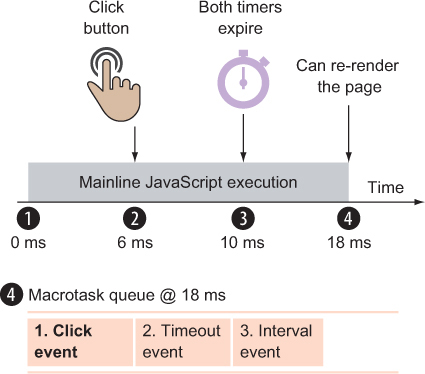 Figure 13.11. Timer events are placed into the task queue as they expire.
Example of a Time-out
The following pseudocode demonstrates how a time-out can be set in JavaScript. In this example, a time-out is registered to execute a function after 10 milliseconds.
Listing 13.3. Pseudocode for our time-out and interval demo
setTimeout(function timeoutHandler(){
  /*Some timeout handler code that runs for 6ms*/
}, 10);
Time-outs and the Event Loop
The event loop in JavaScript processes tasks one at a time, which means that the execution of timer handlers may not occur exactly when expected. This is particularly true when multiple tasks are queued, as the event loop can only handle one task at a time.
For instance, in a scenario where both a time-out and an interval are registered, the execution of these handlers can be delayed due to other tasks in the queue. Figure 13.13 illustrates how the execution of interval handlers can be affected by other tasks, such as mouse clicks or time-out handlers.
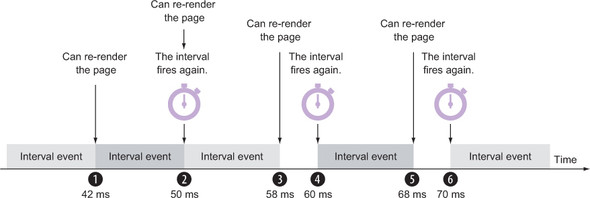 Figure 13.13. Because of the setbacks caused by the mouse click and time-out handler, it takes some time for the interval handlers to start executing every 10 ms.
In this example, even though an interval was expected to fire at regular 10 ms intervals, the actual execution times varied due to the event loop's processing of other tasks. This demonstrates the importance of understanding that timer handlers may not execute precisely at the scheduled time, especially in complex applications with multiple asynchronous operations.